
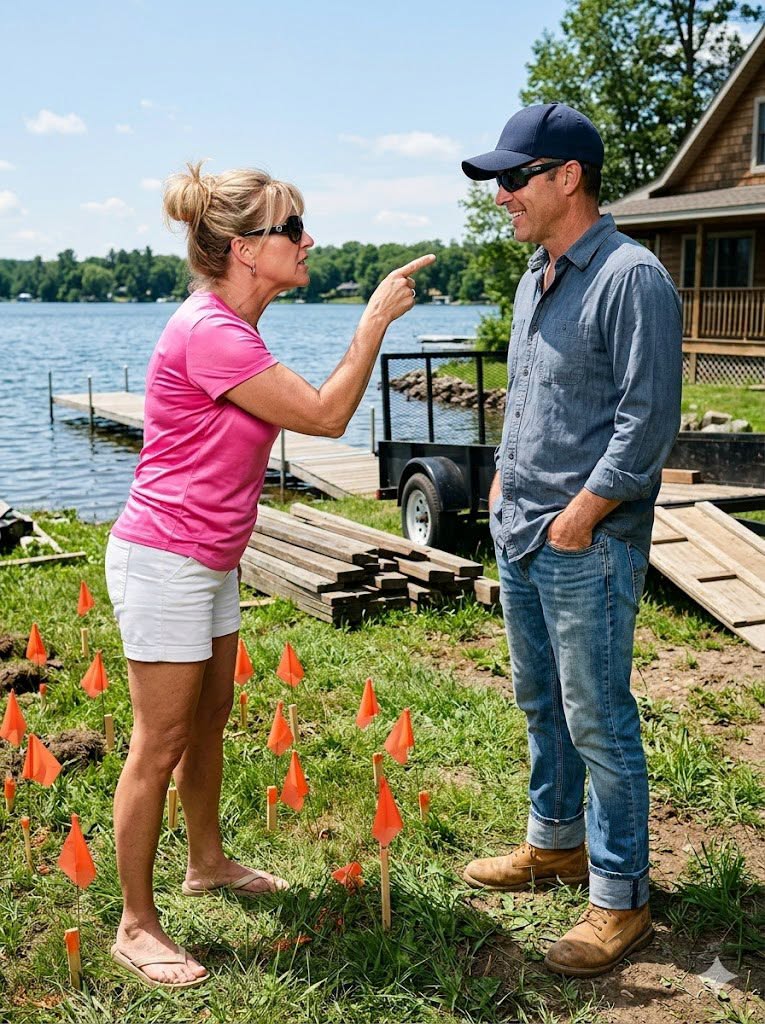
I contacted county zoning enforcement officer Jasmine Riley and state environmental agent Callaway, asking them to determine whether the construction had been approved through the proper channels.
Their review found no record of the permits that would normally be required for work affecting a protected watershed.
As the investigation continued, additional agencies became involved, including Detective Reigns and state auditor Dalton Pierce.
What had begun as a property dispute gradually developed into a broader examination of the homeowners association’s financial practices.
Questions Beyond the Dock
Financial records revealed irregularities that extended well beyond the construction itself.
Investigators identified documentation suggesting that property classifications had been altered and that reserve funds intended for legitimate community projects had been redirected through a company connected to Lorraine’s sister.
Those findings led investigators to examine other expenditures made over previous months.
With the assistance of my attorney, Sarah Mercer, I provided the documents, photographs, and records I had gathered, allowing investigators to compare them with the association’s official files.
The evidence belonged to the authorities.
My responsibility was simply to preserve it accurately.
Accountability Through the Community
Following the investigation, law enforcement officers charged Lorraine and former treasurer Clyde Fenshaw with offenses related to the misuse of association funds.
The remaining board members either resigned or were replaced through the association’s established procedures.
During a special community meeting, homeowners voted to appoint an interim trustee panel led by retired judge Howard Bell to oversee the association while an independent financial review was completed.
The audit later identified additional irregularities involving landscaping and repair invoices spanning approximately eighteen months.
Many residents were disappointed to discover how much trust had been misplaced.
Yet the community also recognized that transparency, once restored, could become the foundation for rebuilding confidence.
Rebuilding Instead of Simply Recovering
In the months that followed, the neighborhood adopted stronger financial safeguards.
Major expenditures now required greater transparency, independent reporting, and homeowner approval before moving forward.
The changes were not simply new rules.
They reflected a renewed commitment to shared responsibility.
Some of the reclaimed lumber from the unauthorized dock was later donated to a local program that builds accessible fishing areas for disabled veterans.
It seemed fitting that material connected to conflict could eventually serve a purpose that benefited others.
A Quiet Shoreline
A year later, I often found myself sitting beside the lake with my dog, Rusty, watching the water return to the calm that had first drawn me there.
Looking back, I realized the dispute had never been only about a dock.
It was about stewardship.
Property deserves to be respected.
Community resources deserve to be managed honestly.
And leadership deserves to be exercised with transparency rather than entitlement.
Standing firm did protect my own property.
More importantly, it helped a neighborhood rediscover the trust that every healthy community depends upon.
That, in the end, proved to be the most worthwhile outcome of all.