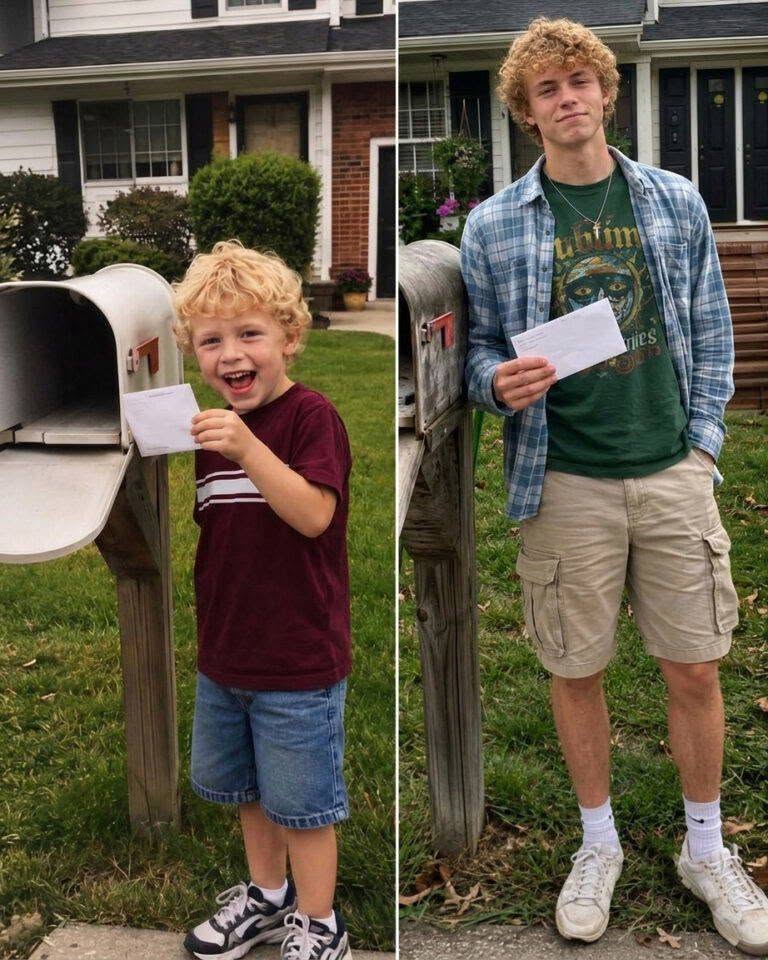
And by the time my son finished reading it, both of us were crying over a man Adrian barely remembered.
The first envelope came when he was six.
I found it tucked between an electricity bill and a supermarket flyer.
There was nothing special about it.
No colorful stickers.
No glitter.
No birthday decorations.
Just our address written carefully across the front.
“Adrian,” I called. “You got mail.”
At six years old, receiving anything with your own name on it is apparently more exciting than winning the lottery.
He came running into the kitchen.
“For me?”
“For you.”
He tore it open at the table.
Inside was a cheap birthday postcard with a cartoon balloon on the front.
Five dollars had been folded neatly inside.
Adrian stared at the money.
“Who sent it?”
I turned the card over.
Nobody had signed it.
There was no message beyond the printed birthday greeting.
“No idea.”
He looked delighted.
“A mystery birthday person!”
I laughed.
At the time, I thought nothing of it.
I was a single mother working hard enough to keep groceries in the refrigerator and the lights on. I didn’t have the emotional energy to investigate an unsigned postcard containing five dollars.
Maybe some distant relative had remembered him.
Maybe an old family friend had forgotten to sign the card.
People did strange things.
Life moved on.
Then Adrian turned seven.
Another white envelope arrived.
Different card.
Same neat handwriting.
Another small bill inside.
Still no name.
When he turned eight, it happened again.
By then, Adrian had transformed the mystery into a birthday tradition.
On the morning of his ninth birthday, he appeared beside my bed before sunrise.
“Mom.”
I opened one eye.
“What?”
“Did you check the mailbox?”
“It’s six forty-five in the morning.”
“What if it came early?”
“Adrian, mail is not magic.”
He grinned.
“What if mystery mail is?”
I threw a pillow at him.
By breakfast, he was standing at the front window watching for the postal truck.
He didn’t care that I had decorated the kitchen.
He barely looked at the wrapped presents on the table.
All he wanted was that envelope.
And somehow, every single year, it came.
Sometimes five dollars.
Sometimes ten.
When he turned eleven, the mysterious sender included a twenty.
Adrian held it in the air like a winning lottery ticket.
“Oh, this is getting serious.”
“What is?”
“My secret person is moving up in the world.”
I laughed.
But by then, I had started wondering too.
I inspected the postmarks.
Compared the handwriting from year to year.
Held the envelopes toward the kitchen light.
I even kept several of them in a drawer.
My sister thought I was becoming ridiculous.
“It’s probably Dad,” she said.
“My father is dead.”
“I meant Adrian’s dad.”
That possibility made my stomach tighten.
Adrian’s father had disappeared before Adrian was born.
There had been no complicated custody battle.
No tragic misunderstanding.
No great love story interrupted by circumstances.
He simply decided fatherhood was inconvenient and vanished.
He had never met his son.
Never mailed a Christmas present.
Never asked for a school photograph.
Never sent child support unless legally forced.
As far as I knew, he didn’t even know our current address.
So I dismissed the idea.
Still, I wondered.
Who remembered my son every year?
Who knew his birthday but never wanted recognition?
Who cared enough to repeat the same strange little ritual while deliberately staying outside our lives?
It wasn’t frightening.
That was almost what bothered me.
It felt thoughtful.
Careful.
Intentional.
Like someone had placed one hand at the edge of Adrian’s childhood and refused to move it.
When Adrian turned thirteen, he opened that year’s envelope while I made pancakes.
He studied the card longer than usual.
Then he looked at me.
“Mom?”
“Yes?”
“Are you doing this?”
I laughed.
“Doing what?”
He held up the card.
“These.”
“Absolutely not.”
“Seriously?”
“I am deeply offended that you believe I am organized enough to maintain a secret birthday operation for seven years.”
He smiled, but only briefly.
Then he looked down again.
“Could it be my dad?”
The question landed harder than I expected.
I kept flipping the pancake because it gave me something to do with my hands.
“Sweetheart, your father doesn’t know where we live.”
Adrian’s expression fell.
I hated that.
So I tried to make it lighter.
“And honestly, if he suddenly developed fatherly instincts, anonymous birthday stationery would be a pretty strange place to start.”
Adrian gave a weak laugh.
Then I made a joke I regretted almost immediately.
“Besides, these envelopes actually contain money. Your father would never.”
That one made him laugh properly.
But when the laughter faded, he stared at the card again.
I realized then that part of him had wanted it to be his father.
Children can grow up without someone and still wonder whether that person thinks about them.
After that day, we stopped trying to solve the mystery.
The envelope simply became part of Adrian’s birthdays.
Candles.
Cake.
Photographs.
And the white envelope.
Year after year, my little boy became a teenager.
His voice deepened.
He grew taller than me.
He stopped asking whether worms had mothers and started talking about college, jobs, and the kind of life he wanted.
Then last week, he turned eighteen.
The night before, I stood in the kitchen frosting his cake.
He had specifically requested that it “not look emotionally significant.”
Apparently, eighteen-year-old boys can sense when their mothers are preparing to decorate baked goods with nostalgia.
Still, I couldn’t shake the strange feeling in my chest.
Eighteen felt different.
Official.
Final somehow.
Like childhood was closing its door whether I was ready or not.
The next morning, the envelope arrived.
Same plain white paper.
Same careful handwriting.
Same size.
I placed it beside his breakfast plate.
When Adrian walked into the kitchen and saw it, his face changed immediately.
For one second, I didn’t see an eighteen-year-old.
I saw the six-year-old who had stood on his toes watching for the mail truck.
“There it is,” he said softly.
He picked it up.
Turned it over.
Then looked at me.
“You’re staring.”
“I am not.”
“You look nervous.”
“I raised you. Nervous is my permanent condition.”
He laughed.
Then he opened the envelope.
At first, everything seemed normal.
A birthday card.
Then something else slid onto the table.
A folded sheet of paper.
I stopped pretending to clean the counter.
That had never happened before.
Adrian unfolded the letter.
His eyes moved across the page.
Then the color slowly disappeared from his face.
“Adrian?”
He didn’t answer.
He read it again.
Slower this time.
I moved closer.
“What does it say?”
He finally looked at me.
His expression frightened me.
Not because he seemed afraid.
Because he looked as though something he had wondered about his entire childhood had suddenly become real.
“It’s different this year.”
“How?”
“There’s a name.”
My stomach tightened.
“What name?”
He looked down at the signature.
“Thomas.”
I knew no Thomas connected to Adrian.
“Let me see.”
He handed me the letter.
I read.
Adrian,
If you are reading this, then you are eighteen, and I have kept my promise as long as I was meant to.
First, happy birthday.
Second, I owe you the truth, or at least enough of it for you to decide whether you want the rest.
Please go to Merrick and Rowe on Fulton Street and ask for the envelope being held in your name. They have instructions to release it once you become an adult.
You do not know me the way you might think.
But I knew someone who loved you very much.
I hope these birthdays helped you feel remembered.
Take care, son.
Thomas.
I read the last line twice.
Take care, son.
Adrian had noticed it too.
“Do you see why I thought maybe…”
He didn’t finish.
He didn’t need to.
His father.
Of course.
A mysterious man.
Eighteen years.
A law office.
A secret letter.
It sounded exactly like the dramatic return of an absent parent who wanted forgiveness without having done any of the hard work.
Anger rose inside me immediately.
“If this is your father…”
Adrian looked up.
“You think it could be?”
“No.”
I answered too quickly.
Then corrected myself.
“I don’t know.”
He sank into a chair.
“What if it is?”
For a moment, he looked much younger than eighteen.
I sat across from him.
“Then we find out.”
“You’d go with me?”
“Of course.”
“What if he wants to meet me?”
That question hurt, but I made myself answer carefully.
“That would be your decision.”
“What would you do?”
The truth?
I would have slammed the door shut.
But Adrian deserved a choice that wasn’t shaped entirely by my anger.
So I said, “I would get the truth first.”
We drove downtown that afternoon.
Adrian talked constantly for ten minutes.
Then didn’t speak for the next fifteen.
“What if Thomas is dead?” he finally asked.
“He signed the letter.”
“That doesn’t mean recently.”
“Please stop creating additional mysteries. We already have enough.”
He stared through the passenger window.
“What if he really is my father?”
I kept my eyes on the road.
“Then whatever he says doesn’t erase who raised you.”
Adrian nodded.
But I knew that wasn’t what he was asking.
He wanted to know whether an absent father had remembered him.
Whether someone who walked away had secretly cared.
That question belonged to him.
The law office was on the second floor of an old brick building.
A receptionist greeted us.
“Name?”
“Adrian Walker.”
She typed for several seconds.
Then she looked up at him differently.
Not suspiciously.
More gently.
“One moment.”
She disappeared into the back.
When she returned, she carried a large sealed envelope with ADRIAN WALKER written across the front.
My heart started pounding.
She handed it to him.
“Would you like to use a private room?”
I frowned.
“A private room?”
She gave me a sympathetic smile.
“Mr. Merrick thought you might prefer one.”
That made everything suddenly feel much more serious.
She led us into a small conference room.
Wooden table.
Two chairs.
A box of tissues sitting in the corner.
Adrian noticed them too.
“That’s encouraging,” he muttered.
I almost laughed.
Almost.
He sat down.
I stayed standing.
Then he broke the seal.
Inside was a smaller envelope.
Older.
Yellowed slightly around the edges.
There were several letters.
And on top was a typed note.
Adrian read it silently.
Then froze.
“What?” I asked.
He turned the page toward me.
Mr. Adrian Walker,
Enclosed, according to instructions provided years ago by my late client Harold Walker, are personal letters to be delivered upon your eighteenth birthday.
Mr. Thomas Bell facilitated the annual birthday correspondence and gifts at your grandfather’s request.
If you have questions after reading these materials, I remain available.
Sincerely,
James Merrick
For several seconds, neither of us moved.
Then Adrian whispered, “My grandfather?”
Harold.
My father.
My knees suddenly stopped feeling reliable.
I sat.
Dad had died when Adrian was still a baby.
Cancer.
Fast.
Merciless.
By the end, he barely had enough strength to sit upright.
But every day he asked the same question.
“How’s my boy?”
Adrian had grown up with photographs of him.
Stories.
A wooden toy truck Dad had made before his hands became too weak to finish the train he had planned to build next.
But Adrian had no real memories of him.
He had been too young.
My hands began shaking before Adrian even touched the first letter.
Then he opened it.
I recognized the handwriting immediately.
My father.
No question.
No doubt.
Adrian began reading aloud.
“If you are reading this, kiddo, then I missed more of your life than I ever wanted to.”
His voice faltered.
He swallowed.
Then continued.
“I’m sorry for that first.”
I covered my mouth.
“Your mother has always been stronger than anyone gives her credit for. You may not understand that yet, but someday you will. She carried you before you were born, and she will carry you in a hundred different ways afterward. I hate knowing I’m leaving her to do this without me.”
I shut my eyes.
For eighteen years, I had believed my father’s last concern had been whether I would be all right.
I had never imagined he had done something about it.
Adrian kept reading.
“I asked my friend Thomas to help me after I’m gone. I want you to receive one small sign every birthday that somebody is thinking about you. Not enough money to spoil you. Just enough that no matter what life looks like that year, you’ll know you were remembered.”
Adrian blinked hard.
“I won’t get to see your first day of school. I won’t see the bad haircuts, the scraped knees, the birthdays, the graduations. There may be times when you wonder who is still standing in your corner. I couldn’t bear the thought of you ever believing the answer was nobody.”
Adrian stopped reading.
His face crumpled.
A broken sound escaped him.
Half laugh.
Half sob.
I reached across the table and took his hand.
There were more letters.
One described Adrian as a baby.
“You frown in your sleep like you’re already disappointed by the state of the world.”
Adrian laughed through his tears.
“That does sound like me.”
Another letter told him never to judge me by my worst day.
“Your mother loves hard enough to break herself sometimes. Remember that when she loses patience. Forgive her occasionally. She’ll need it.”
“That sounds unfairly accurate,” I whispered.
Adrian smiled.
Then he opened the final letter.
The handwriting was shakier.
Dad must have written it close to the end.
“I have asked Thomas not to tell your mother about the cards.”
My throat closed.
“Not because I want secrets between you. She simply has enough grief ahead of her. I don’t want her counting down each birthday card as another reminder that I’m gone.”
I started crying before Adrian finished.
“Let this be something light.”
“Let the mystery make you smile.”
“By eighteen, maybe you’ll both be strong enough for the truth.”
“By then, I hope your mother has laughed more than she has cried.”
I shook my head as tears fell onto the table.
“Dad…”
Adrian’s voice broke again.
“By then, I hope you understand that love does not always disappear when a person does.”
Silence filled the room.
All those years.
All those birthdays.
I had wondered whether some stranger lingered at the edge of Adrian’s life.
Whether his father was secretly trying to make himself feel less guilty.
Whether somebody was buying a little piece of my son’s affection one birthday at a time.
I had been wrong.
It had been my father.
And Thomas had simply carried the promise forward.
Adrian wiped his face.
“So Thomas isn’t my dad.”
I gave a tearful laugh.
“No, baby.”
He studied the attorney’s letter.
“He was Grandpa’s friend?”
The name suddenly stirred something inside me.
Thomas Bell.
Tom Bell.
“Oh my God.”
“What?”
“I remember him.”
“You do?”
“Barely.”
I leaned back.
“He used to go fishing with Grandpa. He wore these awful brown suspenders and cheated at cards.”
Adrian smiled.
“You forgot him?”
“I forgot a lot after Grandpa died.”
That was painfully true.
Grief had blurred entire pieces of my life.
I was pregnant.
Terrified.
Then I became a mother.
Then Adrian’s father disappeared.
Some memories simply sank beneath survival.
A soft knock came at the door.
An older man entered.
“Adrian? I’m James Merrick.”
He shook Adrian’s hand.
Then looked at me.
“I’m sorry for your loss, even after all these years. Harold spoke about both of you often.”
I wiped my face.
“Is Thomas still alive?”
Mr. Merrick’s expression changed.
“He passed away six months ago.”
Adrian went still.
“He did?”
“Yes. But he came into this office shortly before that to make certain these instructions were still in place.”
I felt another wave of sadness.
A man I barely remembered had quietly remembered my son for more than a decade.
“Why didn’t he ever tell us?” Adrian asked.
Mr. Merrick smiled faintly.
“Your grandfather asked him not to.”
He looked at me.
“Harold believed the cards would mean something different if they remained simple. If you knew, he worried every birthday would become another anniversary of his death.”
That sounded so exactly like Dad that I started crying again.
Adrian asked, “Did Thomas ever want me to know he was the one mailing them?”
“No.”
Mr. Merrick shook his head.
“When I once told him he deserved some credit for keeping the arrangement going, he said, ‘I’m only holding the ladder for a friend.’”
That sentence destroyed whatever composure I had left.
When we returned to the car, neither of us started the engine.
Adrian placed the letters carefully on his lap.
For several minutes, we just sat there.
Then he spoke.
“Mom?”
“Yes?”
“Did Grandpa really think I might feel forgotten?”
I looked at him.
“I think he was afraid of everything he would miss.”
Adrian stared down at the letters.
“I used to hope the cards were from Dad.”
There it was.
The truth beneath all those birthdays.
“I know.”
“I feel stupid.”
“You are not stupid.”
“I wanted him to remember me.”
I reached over and squeezed his hand.
“You were a child wanting his father to care. There is nothing stupid about that.”
He nodded slowly.
Then looked down at my father’s handwriting.
“This is better.”
I swallowed.
“Better?”
“Yeah.”
He traced one line with his thumb.
“Because Grandpa actually loved me.”
We drove home with the letters between us.
That evening, we spread every old birthday card across the kitchen table.
I had saved them.
I didn’t even know why.
Maybe some part of me had always understood that they mattered.
There was the cartoon balloon.
The one with the terrible birthday cake illustration.
The card Adrian had opened at thirteen when he asked whether the sender might be his father.
Twelve years of small reminders.
And now, beside them, my father’s handwriting.
Near the bottom of the attorney’s envelope, Adrian found one final note.
It was from Thomas.
Adrian,
Harold asked me to stop after your eighteenth birthday. He said by then you would be a man and would no longer need a mystery to know you were loved.
I don’t know whether anyone ever outgrows needing that.
But I do know this.
Your grandfather talked about you before you could even talk back.
You were loved before you were born.
You were remembered every year after.
Happy birthday.
Tom.
Adrian read it twice.
Then handed it to me.
“He sounds like Grandpa’s kind of person.”
“He was.”
“Keeping a promise for twelve years is kind of insane.”
I smiled.
“Your grandfather specialized in stubborn friends.”
Around midnight, after far too much birthday cake and more tears than either of us wanted to admit, Adrian looked at me.
“Do you think Grandpa would be mad that you didn’t know?”
“No.”
I looked around at all the cards.
“I think he would be delighted that his ridiculous plan worked.”
Adrian smiled.
“I used to think the mystery was the best part.”
“And now?”
He looked at me with red eyes and the face of an adult who somehow still contained every little boy I had ever raised.
“Now I think the best part is that he found a way to stay.”
I could not have said it better.
For twelve years, I thought someone anonymous was reaching into my son’s life.
Maybe out of regret.
Maybe guilt.
Maybe obligation.
I had imagined almost every explanation except the right one.
It was love.
Quiet love.
Patient love.
The kind that does not need anyone to clap.
The kind that can survive through handwriting, five-dollar bills, cheap birthday postcards, and one loyal friend who keeps showing up at the mailbox.
Yesterday, Adrian gathered all the old cards and carried them upstairs.
I leaned against his doorway.
“You know, you’re eighteen now. Legally, I’m required to become less sentimental.”
He rolled his eyes.
“Please don’t destroy the ending.”
“Too late.”
He picked up my father’s first letter.
“I think I’m going to frame this.”
“The letter?”
He nodded.
“Yeah.”
Then he looked at me.
“Mom?”
“What?”
“Thanks for going with me.”
I smiled.
“Always.”
And maybe that was what my father had been trying to tell both of us all along.
People leave.
People die.
Children grow up.
Lives change.
But sometimes love is stubborn enough to keep finding the mailbox.
{"post":108708,"page":2,"next":[{"id":108705,"title":"My 5-Year-Old Daughter Whispered One Sentence Just Minutes Before My Wedding \u2013 What I Discovered Made Me Grab Her Hand and Run from My Own Celebration","url":"https:\/\/new24.info\/108705"},{"id":108702,"title":"My Husband Left Me Because I Couldn\u0027t Give Him a Child \u2014 Six Months Later, I Was Pregnant with Twins, and He Went Pale When He Learned Who Helped Me","url":"https:\/\/new24.info\/108702"},{"id":108699,"title":"I Found Someone\u0027s Daughters Hiding Inside My Empty Trash Can \u2013 Then One Whispered, \u0027Please Don\u0027t Send Us Back\u0027","url":"https:\/\/new24.info\/108699"},{"id":108696,"title":"My Stepdad Raised Me Since I Was Four \u2013 What He Suddenly Whispered to Me at the Hospital Left Me in Tears","url":"https:\/\/new24.info\/108696"},{"id":108693,"title":"After My Wife Passed Away, I Fell in Love Again \u2013 But During a Family Dinner, My Little Girl Pointed at My New Wife and Called Her a \u0027Monster\u0027","url":"https:\/\/new24.info\/108693"},{"id":108690,"title":"What To Do In The Event Of Seeing Square Waves In The Ocean","url":"https:\/\/new24.info\/108690"},{"id":108688,"title":"Understanding the Functional Purpose and Structural Limitations of Your Kitchen Island Ledge","url":"https:\/\/new24.info\/108688"},{"id":108685,"title":"Remembering Oliver Power Grant, the Strategic Architect Behind the Wu-Tang Clan\u0027s Enduring Cultural Legacy","url":"https:\/\/new24.info\/108685"},{"id":108681,"title":"The Truth Behind a Daughter\u0027s Prom Night and the Long Road to Family Reconciliation","url":"https:\/\/new24.info\/108681"},{"id":108677,"title":"I Kept My Prom Dress for 55 Years Waiting for My High School Love Who Went to Vietnam \u2013 When We Finally Married, His First Night Confession Changed Everything","url":"https:\/\/new24.info\/108677"},{"id":108674,"title":"A Mother\u2019s Quiet Exit Exposes Her Son\u2019s Hidden Deception","url":"https:\/\/new24.info\/108674"},{"id":108670,"title":"My Son Put Me in a Nursing Home So He Could Sell My House \u2013 I Quietly Let Him Do It, but Just a Few Days After I Moved In, He Called and Shouted, \u2018How Could You Do This to Me?!\u2019","url":"https:\/\/new24.info\/108670"},{"id":108667,"title":"The Kids Next Door Spent Every Sunday Cleaning Our Neighborhood \u2013 Then I Noticed What They Were Actually Doing","url":"https:\/\/new24.info\/108667"},{"id":108664,"title":"If you\u2019re over 60, eating a banana a day causes\u2026","url":"https:\/\/new24.info\/108664"},{"id":108661,"title":"5 colors to avoid after 50: they can dull your glow","url":"https:\/\/new24.info\/108661"},{"id":108656,"title":"My Brother Expected My House But Found Only Empty Walls","url":"https:\/\/new24.info\/108656"},{"id":108651,"title":"How Escaping A Freezing Montana Cabin Exposed An Ultimate Family Betrayal","url":"https:\/\/new24.info\/108651"},{"id":108647,"title":"How I Acquired My Neglectful Father\u2019s Company And Confronted Him On Father\u2019s Day","url":"https:\/\/new24.info\/108647"},{"id":108643,"title":"How My Ruined Wedding Gowns Led To My Proudest Military Moment","url":"https:\/\/new24.info\/108643"},{"id":108639,"title":"How My Parents Tried To Overturn A Sixty Seven Million Dollar Inheritance","url":"https:\/\/new24.info\/108639"}]}