
He gave me an address.
And what I found behind that door changed almost every memory I had of the man I called Dad.
“The pancakes were always shaped like stars,” I told the nurse.
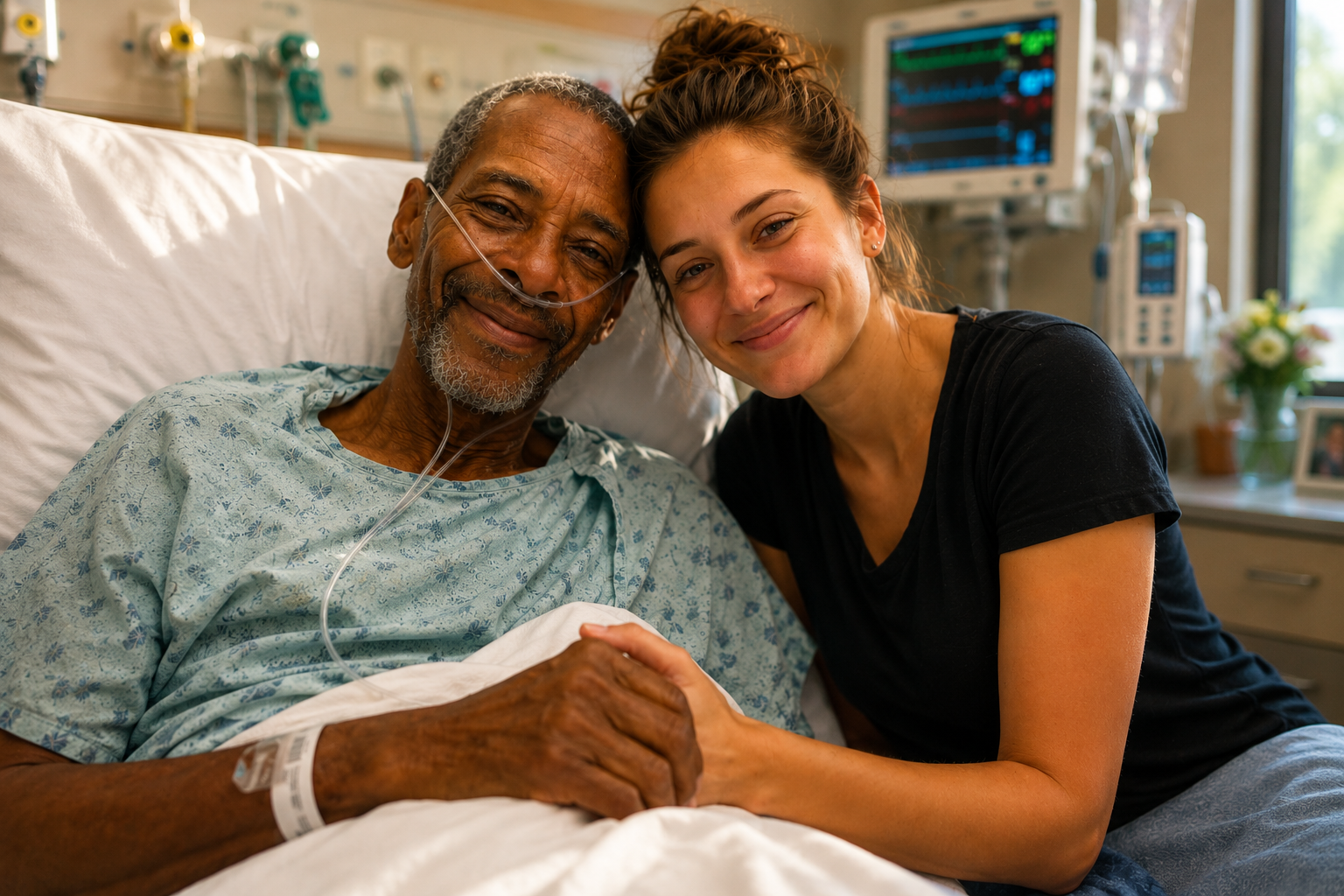
She smiled faintly as she adjusted the blanket over Frank’s frail legs, careful not to disturb the tubes disappearing beneath his hospital gown.
“Every Sunday,” I continued. “Even when I was thirty-five, married, and bringing my own daughter over for breakfast, he still used that ridiculous metal cutter.”
Frank’s eyes opened.
He had barely been awake all afternoon.
His breathing had become shallow, and every few minutes I found myself watching his chest just to make sure it rose again.
For a second, I expected his familiar crooked smile.
Instead, tears appeared in his eyes.
“Dad?”
His lips moved.
I leaned closer.
“You still ate them.”
I laughed softly.
“Of course I did. Complaining might have gotten me oatmeal.”
Something almost like a laugh escaped him.
That was Frank.
Even while dying, he could somehow pull me back toward a Sunday morning kitchen.
Frank married my mother when I was four.
For the first few months, I refused to call him anything.
Not Frank.
Certainly not Dad.
My biological father had disappeared before I was old enough to remember him, but apparently I had learned distrust early.
When Frank asked whether I wanted toast, I pointed toward the bread.
When he offered to read me a bedtime story, I pulled the blanket over my head.
He never forced me.
He simply stayed.
He learned that strawberry jam had to reach every corner of my toast.
He discovered that thunderstorms terrified me, so he sat outside my bedroom door because I refused to let him come inside.
And every Sunday morning, he made apple pancakes shaped like stars.
One morning, about three months after he married Mom, I wandered into the kitchen and said:
“Dad, mine’s burning.”
Frank dropped the spatula.
I remember staring at him.
He stared at me.
Neither of us mentioned what I had called him.
He simply slid the least-burned star onto my plate.
Five months later, my mother died from a brain aneurysm.
One ordinary morning, she reminded me to put away my shoes.
By evening, she was gone.
The house filled with relatives.
Adults whispered in hallways, apparently believing children became deaf whenever conversations were painful.
“He isn’t really her father.”
“Her aunt could take her.”
“He’s still young.”
“He’ll want another life eventually.”
I heard every word.
The night after Mom’s funeral, I crawled beneath the kitchen table.
Frank found me shortly before sunrise.
He didn’t ask why I was hiding.
He simply lowered himself onto the floor and sat beside me.
“Are you leaving?” I whispered.
His face changed.
“No.”
“Everybody leaves.”
“I won’t.”
“Promise?”
Frank held out his little finger.
“I promise.”
And he kept that promise.
He raised me.
He sat through parent-teacher conferences.
He taught me to drive.
He waited awake the first time I stayed out past midnight.
He walked me down the aisle.
When my daughter was born, he hovered beside me as if I were still twelve years old and likely to drop her.
To me, Frank wasn’t my stepfather.
He was Dad.
Whenever I asked about his life before my mother, however, he always gave me the same answer.
“The important part started when you came along.”
I thought it was sweet.
I never realized it was an evasion.
Frank’s health began failing shortly after his seventy-eighth birthday.
First came exhaustion.
Then weight loss.
Then specialists.
Then the careful voices doctors use when medicine has stopped being about recovery and started becoming about comfort.
During his final week, I barely left his bedside.
I slept in a vinyl chair.
I knew which machine made which sound.
I woke whenever his breathing changed.
On his final evening, the doctor quietly pulled me into the hallway.
“It may only be a few hours, Rosalie.”
I nodded.
I couldn’t speak.
When I returned, Frank seemed asleep.
I sat beside him and slipped my hand beneath his.
Suddenly, his fingers closed around my wrist.
Hard.
My eyes flew to his face.
“Promise me something,” he whispered.
“Anything.”
“Promise you’ll hear everything before you hate me.”
My heart stumbled.
“I could never hate you.”
“Promise.”
“I promise.”
His eyes remained fixed on mine.
Then he said the words I still hear sometimes when the house is quiet.
“I’ve lied to you your entire life.”
I tried to smile.
“Dad, you’re exhausted.”
“My mind is clear.”
“Then tell me what you mean.”
“Everything you think you know about why I stayed… why I became your father… it isn’t the whole truth.”
My stomach tightened.
“Was my biological father alive?”
Frank shook his head.
“Did Mom hide something?”
Another shake.
“Then what?”
His trembling hand disappeared beneath the blanket.
When it emerged, he was holding a folded piece of paper.
He pressed it into my palm.
“Go there.”
I unfolded it enough to see an address.
“Now?”
“Yes.”
“I’m not leaving you.”
“You have to.”
Tears slid toward his ears.
“Please, Rosalie.”
He almost never called me Rosalie.
To him, I had been sweetheart, kiddo, honey, troublemaker.
Hearing my full name frightened me more than anything else.
“Tell me yourself.”
His eyelids fluttered.
“Some truths need another voice.”
The monitor began chirping.
A nurse hurried inside.
She adjusted his oxygen and checked his pulse.
“He’s still here,” she told me. “But he may not wake again.”
I stood in the hallway with the address in my hand.
The house was less than twenty minutes away.
I almost tore the paper in half.
Whatever Frank had hidden could wait.
The man who had raised me was dying.
Then I remembered his face.
He hadn’t been afraid of death.
He had been afraid of dying before I understood something.
So I went.
During that drive, I imagined every betrayal possible.
A second family.
Another wife.
A child he had abandoned.
Maybe he had stayed with me out of guilt.
Maybe my entire childhood had been built around some promise he regretted.
By the time I reached the address, my hands hurt from gripping the steering wheel.
I knocked.
An elderly woman opened the door.
She had silver hair and pale blue eyes.
The moment she saw me, one hand flew to her mouth.
“Rosalie.”
I stepped backward.
“How do you know my name?”
“My name is Caroline.”
“I don’t know you.”
“No,” she whispered. “But I knew Frank.”
My heart began hammering.
“Frank called me last month. He said you might come.”
“Might?”
“He hoped he’d find the courage to send you.”
She opened the door.
“I think you should come inside.”
I nearly refused.
Then I remembered Frank lying in that hospital bed.
I walked in.
“Tell me what he lied about.”
Caroline did not answer immediately.
She went to a kitchen drawer and pulled it open.
Inside were old metal cookie cutters.
Hearts.
Flowers.
Animals.
And one small star.
I stopped breathing.
It was identical to the cutter Frank had used every Sunday of my childhood.
“Where did you get that?”
“It belonged to Frank.”
“No. His is at my house.”
“He had two.”
Caroline reached deeper into the drawer.
She removed a photograph.
A little girl stood beside a kitchen table.
She looked about five.
In front of her was a plate of apple pancakes shaped like stars.
Behind her stood Frank.
Young.
Thin.
Smiling.
Not the careful smile I knew from family pictures.
A different kind.
The relaxed smile of someone who hadn’t yet learned to be afraid of happiness.
“Who is she?”
Caroline’s eyes filled.
“Her name was Miley.”
Something about the way she said it made me sit down before she continued.
“Frank was married before he ever met your mother.”
I stared at her.
“Miley was his daughter.”
The photograph trembled in my hand.
“Where is she?”
Caroline looked down.
“She died when she was five.”
I could not speak.
“There was an accident at a lake,” she continued. “It happened quickly. Frank blamed himself, even though everyone told him there was nothing he could have done.”
I looked at the little girl again.
She had a gap between her front teeth.
Her hand rested beside one badly burned pancake point.
My chest hurt.
“What happened afterward?”
“His marriage collapsed. Grief destroyed whatever was left between them. Frank stopped answering calls. He packed away photographs. He stopped speaking Miley’s name.”
Caroline touched the star cutter.
“He stopped being a father because he believed being one had destroyed him.”
I stared at her.
“Then why did he never tell me?”
“Because you changed something.”
She smiled sadly.
“After he married your mother, you climbed into his lap one afternoon and fell asleep. When you woke up, you asked if he knew how to make pancakes shaped like stars.”
I shook my head.
“I don’t remember that.”
“You were four.”
She took a breath.
“He called me later that day.”
Her voice cracked.
“He cried so hard I could barely understand him.”
My eyes burned.
“He said he had made the pancakes again. And while he was making them, he said Miley’s name aloud for the first time in years.”
I looked down.
All those Sunday mornings.
All those stars.
They had started with another little girl.
“The pancakes were hers.”
“Yes.”
I expected jealousy.
Instead, I felt grief for a child I had never known.
Then I asked:
“So what was the lie?”
Caroline went very still.
And suddenly I knew the real secret had not been told yet.
“The night after your mother’s funeral,” she said, “Frank packed his truck.”
My stomach dropped.
“No.”
“He came here.”
“He promised me he wouldn’t leave.”
“He did.”
“After.”
The room tilted.
I gripped the table.
“What do you mean, after?”
Caroline sat opposite me.
“He arrived here terrified. He said your aunt was willing to raise you. He said staying with you would be selfish.”
“Why?”
“Because he loved you.”
“That doesn’t make sense.”
“It made sense to a man who had buried one daughter.”
Caroline’s tears spilled over.
“He told me, ‘Every time Rosalie runs toward the street, I stop breathing. Every time she gets sick, I think I’m going to lose her. Every time she laughs, sometimes I hear Miley.’”
I covered my mouth.
“He said he couldn’t survive burying another daughter.”
My breathing became shallow.
“So he was going to leave me.”
“Yes.”
Caroline didn’t soften it.
And somehow, that made me trust her more.
“He almost did.”
I cried harder.
The promise beneath the kitchen table had been one of the strongest memories of my childhood.
I had believed Frank found me, saw a frightened little girl, and knew instantly that he would stay.
Instead, he had almost driven away.
“He lied.”
“Yes.”
I wiped my face angrily.
“What did you say to him?”
“I told him he was confusing fear with absence of love.”
Caroline reached across the table.
“I told him that if losing Miley had taught him how terrible love could hurt, then maybe loving you was the only thing that could teach him why it was still worth having.”
My tears fell onto the photograph.
“He sat in this kitchen until sunrise.”
I looked at her.
“What happened then?”
“He drove home.”
Caroline smiled.
“He unpacked everything before you woke up. Your aunt was still there.”
I remembered pieces of that morning.
Gray light.
My aunt sleeping on the couch.
Frank finding me under the kitchen table.
“He came home…”
“Yes.”
“And then he found me.”
“Yes.”
“Are you leaving?” I had asked.
Everybody leaves.
I could suddenly see the moment differently.
Frank’s expression when I asked.
The pain that crossed his face.
His pinky reaching toward mine.
“I promise.”
The promise hadn’t come from certainty.
It had come after a whole night of terror.
He had been afraid.
And he stayed anyway.
I lowered my face into my hands.
“All my life, I thought I needed him.”
“You did.”
Caroline’s voice softened.
“But he needed you too.”
“Why didn’t he ever tell me?”
“Because he never wanted you to think you had been responsible for saving him.”
I looked up.
“He knew what it meant to make a child carry an adult’s grief.”
Her gaze dropped to Miley’s photograph.
“He would not do that to you.”
Suddenly, one of Frank’s favorite phrases returned to me.
You gave me a reason to keep going, sweetheart.
I had always assumed he meant it figuratively.
He hadn’t.
“He let me believe he rescued me.”
Caroline squeezed my hand.
“He did rescue you.”
Then she looked at Miley’s photograph.
“And you rescued him.”
I drove back to the hospital with the photograph on the passenger seat.
Every traffic light felt personal.
Every slow driver felt cruel.
I rehearsed what I would tell Frank.
I understand.
I don’t hate you.
You were allowed to be afraid.
You still came back.
You stayed.
I love you.
I reached the hospital and ran.
The nurse was waiting outside his room.
One look at her face told me I was too late.
“I’m sorry.”
I pushed past her.
Frank lay exactly where I had left him.
Except the machines were quiet.
No strained breathing.
No oxygen hiss.
No familiar movement beneath the blanket.
I sat beside him.
I took his hand.
“You should have told me.”
My voice shattered.
“You should have let me tell you I understand.”
I pressed his fingers against my cheek.
“You stayed, Dad.”
I cried harder.
“That’s what mattered.”
The nurse eventually placed a small plastic bag beside me.
“His belongings.”
Inside were Frank’s watch.
His keys.
And the old brown wallet he had carried forever.
I opened it.
Behind his driver’s license was a photograph.
Miley.
Standing beside star-shaped pancakes.
The corners were worn almost smooth.
Behind it was another photograph.
Me.
Five years old.
Holding up a crooked pancake with one burned point.
Frank had carried both photographs every day.
One daughter lost.
One daughter found.
Neither replaced the other.
That was the part I finally understood.
He had never loved me because he forgot Miley.
He loved me while remembering exactly what losing a child could do to a person.
And somehow, he chose to risk loving again anyway.
That evening, I went home.
My daughter was sitting at the kitchen table.
The moment she saw my face, she knew.
“Is Grandpa coming home?”
I sat beside her.
“No, sweetheart.”
She began crying.
I held her until the worst of it passed.
Then I walked to the kitchen drawer.
The star cutter was still there.
Scratched.
Darkened.
Older than almost every object in my house.
I set it on the counter.
My daughter wiped her nose.
“Can we make Grandpa pancakes?”
“Yes.”
We mixed flour, milk, eggs, cinnamon, and apples.
I poured the first pancake into the star.
One point burned.
Of course it did.
My daughter smiled weakly.
“Why did Grandpa always make stars?”
I looked toward the two photographs beside the stove.
Miley.
Me.
Two little girls separated by years but connected by the same man.
“Because somebody taught Grandpa that remembering one person doesn’t mean you can’t love another.”
My daughter thought about that.
Then she took a bite.
“It’s burned.”
“Grandpa always burned the points.”
She laughed.
For half a second, the sound filled the kitchen exactly the way childhood laughter must have once filled Frank’s life.
And I understood why it had frightened him.
I also understood why he kept coming back to hear it.
When breakfast was finished, I washed the star cutter and placed it beside the stove instead of returning it to the drawer.
It would stay there.
Next Sunday, we would use it again.
And the Sunday after that.
Not because grief eventually disappears.
Frank had taught me better than that.
Grief stays.
Memory stays.
Love stays too.
And sometimes the bravest promise a person ever keeps is not one made without fear.
It is the one they keep despite being terrified.