Ethan never had time to avoid it.
Neither did seven-year-old Lily or four-year-old Noah.
All three of them died before I reached the hospital.
I survived because I had not been in the car.
That fact cut through me like broken glass.
It still does.
I suspect it always will.
I sat alone in the chapel beneath a wooden cross, staring at the gray dust trapped beneath my fingernails. A nurse had placed a blanket around my shoulders, though I could not feel the cold.
My phone trembled in my hand as I called my father.
He answered after several rings.
Behind him, I heard music, conversation, plates clinking, and my sister Melissa laughing about candles.
“Dad,” I whispered. “There’s been an accident.”
“What happened?”
His voice sounded calm.
Almost distracted.
“Ethan is gone.”
The words caught in my throat.
“Lily and Noah too.”
The noise behind him continued for several seconds.
Then everything became quiet.
My mother took the phone.
“What do you mean, gone?”
“They died this morning.”
Saying it aloud made the room tilt.
“The funeral is Friday. Please, Mom. I need you.”
My father came back onto the line.
“Friday?”
“Yes.”
He released a slow breath.
“Claire, Friday is your sister’s birthday dinner. The reservation has been booked for weeks.”
For one terrible second, I thought grief had damaged my hearing.
“Dad,” I said. “My husband and my children are dead.”
“I understand.”
His tone remained unchanged.
“But today is Melissa’s birthday. We can’t come.”
The call ended before I could beg.
I remained in the chapel holding my phone, listening to the final silence of the disconnected line.
Ash covered my fingers.
Three people I loved more than my own life were gone.
And my parents had decided a dinner reservation mattered more than standing beside me while I buried them.
That was the moment I understood something I would spend the next six months accepting.
I had never been the daughter who truly mattered.
I had always been the dependable one.
The child who could be disappointed without causing trouble.
The daughter whose needs could be reduced, postponed, or ignored because I had been trained to survive without asking for much.
Until that morning, I had never needed them badly enough to discover exactly where their concern ended.
At the funeral, I stood between three coffins.
Ethan’s was dark walnut.
Lily’s was pale pink.
Noah’s was blue.
Ethan’s mother, Margaret, held me upright through most of the service. Her whole body shook as she cried. His father kept one hand pressed firmly against my shoulder, as if he feared I might collapse into the floor if he let go.
My side of the church was almost empty.
My parents were not there.
Melissa was not there.
Neither were my cousins, uncles, or family friends.
Only Aunt Ruth came.
She drove six hours after hearing about the crash from one of my old neighbors because my parents had apparently not thought to tell her.
She appeared in the chapel doorway with her coat still damp from the storm, her hands clasped tightly in front of her.
She looked at the three coffins.
Then she looked at me.
“Oh, Claire.”
That was all she managed before crossing the room and wrapping me in her arms.
Three days after the funeral, my mother sent me a message.
Hope you’re managing. Melissa felt hurt you didn’t call her on her birthday.
I stared at the words until they blurred.
Then I turned off my phone.
Something inside me became quiet that day.
Not empty.
Not defeated.
Quiet in the way a decision becomes permanent before anyone hears it being made.
For six months, I ignored their calls.
They sent holiday photographs, cheerful family group messages, and an invitation to Melissa’s engagement party.
I held the invitation for a long time.
Then I placed it in a drawer with Ethan’s watch, Lily’s final school drawing, and one of Noah’s red socks.
Things I could not throw away.
Things I could no longer bear to look at.
During those months, I performed the enormous and ordinary work grief demanded.
I signed papers.
Identified belongings.
Answered questions about funeral expenses.
Wrote thank-you notes to people whose names I could barely remember.
Every Tuesday, I sat with Margaret because we were the only two people who missed Ethan and the children in exactly the same way.
Sometimes we spoke.
Sometimes we sat in silence.
One Wednesday in October, I slipped my foot into a shoe and felt something hard beneath my heel.
It was one of Noah’s plastic dinosaurs.
A green triceratops.
He used to hide them inside my shoes and laugh when I found them.
I sat on the kitchen floor holding it against my chest until the afternoon light disappeared.
I also began making decisions.
Six weeks after the funeral, I revised my will.
I removed my parents as emergency contacts.
I canceled every medical authorization containing their names.
I transferred the house into a trust bearing Ethan’s, Lily’s, and Noah’s names.
Then I used part of the expected settlement to establish the Miller Memorial Road Safety Foundation.
Ethan’s parents and Aunt Ruth agreed to serve on the board.
The foundation would support families affected by commercial driving accidents, advocate for stronger fatigue regulations, and fund safety education for young drivers.
My attorney, Daniel Price, asked whether I wanted to include a formal statement explaining why no member of my family would ever control or financially benefit from the trust.
“Yes,” I said.
“What should it say?”
I looked at him.
“The truth.”
So the document included one sentence.
My parents refused to attend the funeral of my husband and two minor children because it conflicted with my sister’s birthday dinner.
Written plainly, it looked almost unbelievable.
But it was true.
Journalists found the statement after the legal settlement was finalized.
On a freezing Tuesday morning in January, my name appeared in a headline.
WIDOW OF I-95 CRASH VICTIMS AWARDED $18.7 MILLION; ANNOUNCES CHILD SAFETY FOUNDATION.
The article explained that the truck driver had ignored mandatory rest requirements and that his employer had falsified maintenance and driving records.
It also mentioned the funeral.
By noon, every member of my family was calling.
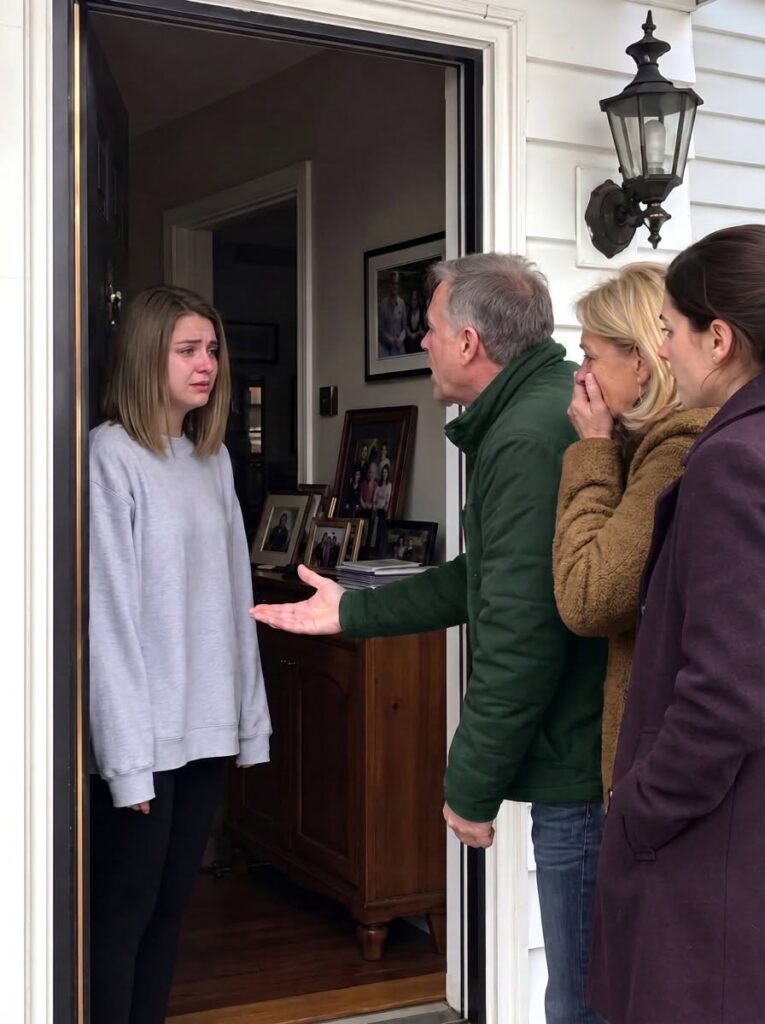
By evening, my father stood outside my front door, pounding hard enough to shake the stained-glass window Ethan had installed three summers earlier.
“Claire!” he shouted. “Open this door right now!”
I stood barefoot in the hallway wearing Ethan’s old college sweatshirt.
The house smelled of cedar, cold coffee, and the silence of rooms where children had once made noise.
Lily’s drawings still covered the refrigerator.
A row of Noah’s toy cars remained beneath the living-room window.
Three urns rested on the mantel.
I did not open the door.
Through the security camera, I saw my mother standing beside my father in an expensive cream coat. Her lips were pressed into a thin line.
Melissa waited behind them wearing sunglasses despite the gray winter sky.
“Claire,” my mother called. “We saw the news. We need to talk as a family.”
Family.
The word sounded almost insulting.
My phone vibrated.
Aunt Ruth had sent a message.
Don’t open the door. I’m ten minutes away. I called Daniel.
My attorney had warned me this might happen after the settlement became public.
The trucking company had fought the case aggressively, but the evidence was overwhelming.
Ethan had done nothing wrong.
The driver had been exhausted.
The company had known it.
The settlement amount became public through the court filings.
I did not celebrate.
No number could return Ethan’s laugh.
No amount of money could bring back Lily’s missing front tooth or Noah whispering secrets to the family dog.
But the money gave me one thing my relatives had never allowed me to possess.
Protection.
My father lowered his voice, slipping into the careful tone he used when he wanted to appear reasonable.
“Claire, we are not here to fight. We’re worried about you.”
I activated the doorbell speaker.
“You were not worried when I stood beside three coffins.”
My mother’s face tightened.
“That is unfair. We were in shock.”
“You told me Melissa’s dinner reservation mattered more than my children’s funeral.”
Melissa removed her sunglasses.
Her eyes were completely dry.
“I didn’t know you were going to turn it into a public scandal,” she said. “My friends are sending me articles. Brandon’s parents saw it. Do you have any idea how humiliating this is before my wedding?”
I looked toward the three urns.
Then back at her face on the screen.
“I’m not punishing you,” I said. “I’m simply done pretending you didn’t make a choice.”
My father raised his fist to pound again.
Before he could, Aunt Ruth’s blue Subaru pulled into the driveway and stopped behind their car, blocking them in.
She climbed out wearing jeans, boots, and a heavy navy coat.
At sixty-two, Ruth had spent her whole life being underestimated.
That afternoon, she looked finished with it.
“Step away from the door, Richard.”
My father turned.
“This is family business, Ruth.”
“No,” she replied. “This is trespassing.”
My mother straightened.
“How dare you speak to your brother that way?”
Ruth looked at her with quiet disgust.
“I drove alone through a storm to bury Claire’s husband and babies while you sat around eating birthday cake. Don’t lecture me about manners.”
For once, my father had no immediate answer.
He was not embarrassed because he regretted what he had done.
He was embarrassed because Ruth had spoken loudly enough for the neighbor across the street to hear.
Appearances had always been my family’s true religion.
Not love.
Not loyalty.
When Melissa screamed at me, I was told not to upset her further.
When she ruined my graduation dress because she wanted attention, I was expected to be gracious.
When she took money from my room and denied it, my parents said I should stop creating tension.
They rarely asked whether something had hurt me.
They only cared about who had witnessed it.
Funerals reveal people.
So does money.
My father faced the camera again.
“Claire, we’re not here because of the settlement.”
“Then why did it take you six months to come?”
He opened his mouth.
Nothing came out.
My mother stepped closer.
“Nobody has mentioned the money.”
Aunt Ruth folded her arms.
“You drove here the day you saw the amount.”
“We came because she’s isolating herself,” my mother snapped.
“No,” I said through the speaker. “I am protecting myself.”
A black sedan stopped at the curb.
Daniel Price climbed out wearing a charcoal overcoat, a folder tucked beneath one arm.
His face showed the same calm emptiness he wore during depositions.
“Mr. and Mrs. Harper,” he said. “You have already been notified in writing not to come to this property without permission.”
My father pointed toward the house.
“She is my daughter.”
“She is a thirty-four-year-old adult who has made her wishes clear.”
“She is grieving and being manipulated,” my mother said, glancing at Ruth.
Daniel opened his folder.
“Your daughter executed her estate documents with full legal capacity in my office, in the presence of two witnesses and a notary. She also provided a written record of the estrangement, including messages sent after the funeral.”
Melissa stared toward the camera.
“You kept screenshots?”
“Yes,” I said. “Especially the message where Mom said you were hurt because I missed your birthday call.”
My mother’s face turned pale.
Across the street, Mrs. Alvarez stood on her porch with her arms crossed.
She had brought casseroles after the funeral.
She had planted lilies near my mailbox because Lily loved the flower that shared her name.
My mother noticed her watching and lowered her voice.
“Claire, please. Let’s not do this outside.”
I opened the door.
Everyone froze.
I stepped onto the porch wearing Ethan’s sweatshirt, my hair tied back, my face bare.
For months, I had imagined that confrontation.
In every version, I cried.
In every version, I screamed.
Sometimes I imagined collapsing before I managed to say anything at all.
But standing in front of them, I noticed how small they looked.
Not physically.
Morally.
“You want privacy now?” I asked. “You should have offered me dignity then.”
My mother’s eyes immediately filled with tears.
They were the quick, practiced tears of someone who knew exactly which emotions usually produced results.
“I lost them too, Claire.”
“No.”
The word came easily.
“You lost the right to call yourself a grieving grandmother when you chose not to attend their funeral.”
Her tears stopped.
Melissa folded her arms.
“That is cruel.”
I turned toward her.
“Cruel was asking why I didn’t call you on your birthday while my children were being buried.”
She flinched.
Not because the words hurt.
Because Ruth and Daniel had heard them.
My father pointed at me.
“You’re tearing this family apart.”
I looked past him toward the bare maple tree in the yard.
Lily’s swing had once hung from one of its branches.
After the crash, I could not bear watching the rope move in the wind, so I removed it.
Only the iron hook remained.
“This family was already broken,” I said. “I just stopped standing in the middle holding the pieces together.”
My mother lowered her voice.
“What do you want from us?”
For one second, the question almost sounded sincere.
Almost.
But it had come six months too late, on the day the settlement became public.
“I wanted you at the funeral,” I said.
My voice began to shake, but I continued.
“I wanted you to hold my hand while I buried my husband. I wanted you to cry over Lily’s pink casket and Noah’s blue one. I wanted my mother and father.”
The porch became completely silent.
Dead leaves scraped across the steps.
“Now,” I said, “I want you to leave.”
My father’s jaw tightened.
“You’ll regret this.”
Daniel immediately raised his phone.
“Please repeat that clearly.”
My father glared at him.
Then he turned away.
My mother remained in place.
For one fragile second, I believed she might finally say something real.
Not a rehearsed apology.
Not an excuse.
The actual words of someone who understood what she had done.
Instead, she said, “Melissa’s wedding is in April. I hope you don’t make this worse.”
The final connection between us broke so quietly that I barely felt it.
“I will not be there.”
Melissa gave a bitter laugh.
“Good. Nobody wants that kind of energy at my wedding.”
Aunt Ruth stepped forward.
“Then everyone has what they wanted.”
Daniel pointed toward their car.
“Leave now.”
They climbed inside and reversed out of the driveway.
There was no dramatic apology.
No last embrace.
No moment where one of them ran back and begged me to forgive them.
Only a car moving down the street and disappearing around the corner.
Then silence returned.
I realized I was breathing normally.
Ruth placed one hand on my shoulder.
“Are you all right?”
I looked at the doorway, the lilies near the mailbox, and the iron hook embedded in the maple tree.
“No,” I said. “But I’m free.”
The headline changed everything, though not because of the money.
The settlement simply exposed what had always been there.
My family had not panicked because they suddenly understood how deeply they had hurt me.
They panicked because strangers could finally see it too.
Over the following months, I moved forward one piece at a time.
The foundation held its first fundraiser in May.
Ethan’s parents spoke about commercial driver fatigue and the legal loopholes that allowed companies to falsify rest records.
I spoke for four minutes.
My voice shook when I said Ethan’s name.
It broke when I said Lily’s and Noah’s.
But I said them.
Whenever reporters asked about my parents, I gave the same answer.
“My focus is honoring my husband and children.”
It was true.
It was also the cleanest way to keep the door closed.
Melissa married in April without me.
Aunt Ruth heard that my mother had placed an empty chair near the front of the venue.
Someone sent her a photograph.
I never asked to see it.
I did not need to.
An empty chair does not prove love.
Sometimes it only proves that someone still cares more about appearances than the person who was supposed to sit there.
On the first anniversary of the crash, I drove to the cemetery before sunrise.
I brought yellow tulips for Ethan.
Daisies for Lily.
A small red toy truck for Noah because he would have wanted something to play with, even there.
I sat in the grass between their graves and told them about the foundation.
I told Ethan that his parents were helping other families.
I told Lily that Mrs. Alvarez’s flowers had bloomed.
I told Noah that I still found dinosaurs in impossible places.
Then I whispered the truth.
“I miss you every minute. But I’m still here.”
Wind moved softly through the cemetery trees.
There was no answer.
Of course there was no answer.
Only cold air, pale morning light, and my hand resting against their names carved into stone.
For the first time since the funeral, I did not feel abandoned.
I felt surrounded by the people who had truly loved me.
People whose love came without conditions, calculations, or a system that measured my grief against the inconvenience of changing a dinner reservation.
Ethan used to say my family had taught me to apologize for bleeding on the floor after they cut me.
He always said it gently.
That was how he delivered truths I needed to hear without turning them into accusations.
He had been right.
It took losing him for me to understand exactly how right.
I rose from the grass and walked toward my car beneath the pale January light.
The living continue.
That is the entire instruction.
It is also the hardest thing anyone can ask of you.
You keep moving.
You carry the people you lost.
You say their names.
You protect what remains.
And you stop allowing anyone to demand that your grief become smaller so their comfort can remain untouched.
I drove home.
I made coffee.
And I kept living.