
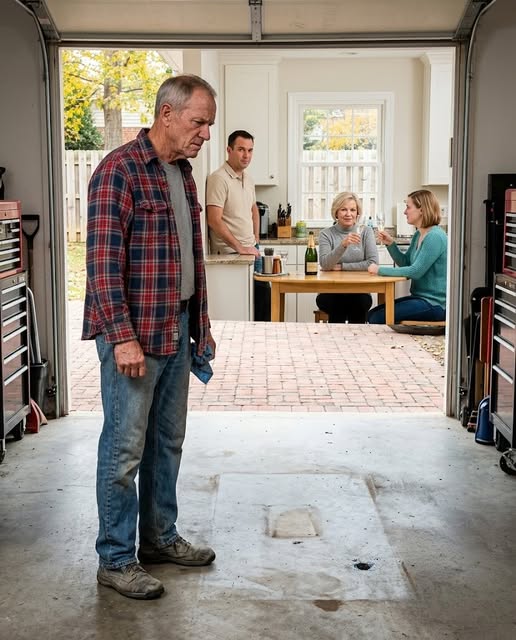
Margaret stood behind me, her posture radiating a triumphant, self-satisfied energy that felt entirely alien to the man I thought I had known for thirty-six years. She spoke with a bright, sharp clarity, announcing that she had sold the bike for fifty-five thousand dollars while I was at my doctor’s appointment in Asheville. To her, it was simply a rusty pile of junk finally cleared away to fund an Alaskan cruise and a kitchen renovation, a long-overdue disposal of my supposed clutter.
I followed her into the kitchen, my movements mechanical and detached. The air inside the house felt thick, heavy with the scent of celebratory champagne being poured by her sister, Beverly, and her brother-in-law, Trevor. They were laughing, their voices clinking against the crystal glasses my mother had gifted us on our wedding day. To them, the sale was a masterstroke of domestic efficiency, a way to turn a piece of my history into a luxury vacation and home improvements. They did not see the man who had spent every Sunday morning for over three decades meticulously polishing chrome and checking the engine, treating the bike not as a machine, but as a living bridge to the father who had handed me the keys on my twenty-first birthday.
My father’s words echoed in my mind, as clear as the day he spoke them: “Take care of her, son. She’ll outlive both of us if you do.” I had honored that promise. I had kept the bike running, kept it clean, and kept it safe. Margaret had watched this ritual for years, often teasing me with a dismissive roll of her eyes, claiming I loved the motorcycle more than I loved her. Standing there, listening to her recount the sale to her family, I realized with a sickening clarity that she had never been joking. She had viewed my devotion to my father’s memory as a personal affront, a competitor for my attention that she had finally, ruthlessly eliminated.
Trevor slapped my shoulder, his laughter booming as he suggested the workshop could now be converted into a profitable guest suite. I accepted a glass of champagne, though I had no intention of drinking it. I watched them, these people who had never bothered to understand the weight of the things I held dear. They saw only the cash, the potential for rentals, and the clearing of space. They could not comprehend that the motorcycle was the last tangible piece of my father’s legacy, a vessel for memories that were now being auctioned off to strangers to pay for a cruise I had no desire to take. I felt the cold realization settle deep in my bones: our marriage had been a long, quiet war of attrition, and I had been losing it without even knowing the battle had begun.
The phone rang at 4:23 p.m., cutting through the celebratory chatter. Margaret reached for it, her smile still firmly in place, expecting perhaps a congratulatory call or a final confirmation of the transaction. She answered, but her expression shifted almost immediately from triumph to confusion, and then to a pale, trembling alarm. I watched as she listened, her grip tightening on the receiver until her knuckles turned white. The voice on the other end was frantic, shouting so loudly that the sound bled into the room: “Why are the police in my office?”
The room went silent. Beverly and Trevor froze, their glasses halfway to their lips. I set my untouched champagne on the kitchen table and walked toward the workshop, my heart beating with a cold, steady rhythm. The buyer, a man who thought he had purchased a simple piece of junk, had discovered too late that the motorcycle was not just a machine, but a registered piece of evidence in a long-standing legal inquiry regarding the provenance of vintage assets. I had known the bike was more than just a memory; it was a protected heirloom, and the title had never legally left the trust my father had established. The sale was void, and the legal repercussions for unauthorized liquidation were immediate and severe.
As I reached the door, I looked back at Margaret one last time. She was staring at the phone, then at me, the realization dawning that she had sold something that was never hers to sell, and in doing so, had invited a scrutiny she was entirely unprepared to handle. The kitchen, once a place of shared history, now felt like a stage for a final, irreversible act. I walked out into the October sunlight, leaving them to their panic, finally understanding that the life we had built was as fragile as the silence I had maintained for all those years. The bike would be returned to its rightful place, but the illusion of our partnership had been shattered beyond repair. In that resolution, I found a strange, quiet peace, knowing that the truth had finally reclaimed its territory from the greed that had sought to bury it. The cycle of my father’s protection had held, ensuring that the legacy he left behind remained firmly in my hands, while the false foundation of my marriage crumbled under the weight of its own deceitful ambition.