Mia’s story began 14 years after mine.
By then, Vivian was 31 and living independently.
She had a brief relationship with a married architect named Stephen Lawson. When she became pregnant, he promised to leave his wife.
He never did.
Vivian refused to repeat the arrangement forced on her as a teenager. She gave birth to Mia and raised her alone for four years.
Then Vivian was diagnosed with a serious heart condition.
“She thought she was dying,” Mia explained. “She placed me temporarily with my father and his wife.”
Vivian recovered.
But Stephen and his wife refused to return Mia.
A legal battle followed.
Because Stephen was listed as the father, had more money, and claimed Vivian’s health made her unstable, he received primary custody.
Mia spent summers at the seaside house until she turned 18.
“Why did you stop coming eleven years ago?” I asked.
Mia looked at Eric.
“Because he told me Vivian had sold the house and moved abroad.”
“That’s a lie,” Eric said.
Mia pulled a bundle of returned letters from her bag.
The address was correct, but each had been redirected to a private mailbox registered to Eric’s accounting company.
“My mother found these after the investigation began,” Mia said. “Vivian wrote to me. I replied. Neither of us received anything.”
“What investigation?”
“The one Vivian started six months before she died.”
The blood drained from Eric’s face.
Mia explained that Vivian had become suspicious after learning Eric repeatedly contacted county offices about the house.
He asked about zoning, shoreline development permits, and subdivision rights.
The property was worth far more than I realized.
A luxury developer had offered nearly $2.4 million for the house and surrounding land.
Eric planned to obtain control before Vivian revealed that Mia had an ownership claim.
“You separated them for money,” I said.
“I didn’t separate anyone.”
“You intercepted their letters.”
“I redirected business correspondence.”
“Birthday cards are not business correspondence.”
Eric rose.
“This is ridiculous. Whatever I did, I did to prevent a stranger from taking what belonged to you.”
Mia stood too.
“I am not a stranger. I am Vivian’s daughter.”
“So is Rachel.”
“Exactly. Vivian wanted us to share it.”
Eric looked at me.
“You would have lost half the property.”
“I would have gained a sister.”
His expression told me he couldn’t understand why that mattered more.
Why Chloe’s Name Appeared
One question remained.
Why was Chloe named in an adoption file?
Mia removed the final collection of documents.
The first was a hospital record from 25 years earlier—the year Chloe was born.
I remembered that pregnancy clearly.
The nursery with pale yellow walls.
Eric assembling the crib incorrectly three times.
My water breaking in the produce aisle.
Seventeen hours of labor followed by an emergency cesarean section.
When I woke, Eric placed Chloe in my arms.
She had a tiny pink cap and a serious expression.
I had never doubted she was mine.
“She is my daughter,” I said.
“No one is disputing that,” Mia replied.
“Then why is there an adoption file?”
“It isn’t Chloe’s adoption.”
She slid the document toward me.
The name at the top was Sophie Elaine Carter.
My maiden name was Carter.
The birth mother was listed as Rachel Carter.
But I had never given birth to a child named Sophie.
The date was two years before Chloe’s birth.
My stomach tightened.
“What is this?”
Eric closed his eyes.
“Rachel—”
“What is this?”
He sat down slowly.
Before Chloe, I had suffered what Eric and the doctors described as a late miscarriage.
I was nearly six months pregnant.
There was bleeding, an ambulance ride, surgery, and medication that blurred the next two days.
Eric told me the baby had not survived.
There was no funeral.
He said the hospital handled everything because the baby was too premature.
I had spent years grieving a daughter I never held.
“You told me she died,” I whispered.
Eric began crying.
“I believed she would.”
The room tilted.
“What does that mean?”
Our baby had been born alive.
She was extremely premature and transferred to a specialist hospital while I remained unconscious.
Eric was told she might suffer severe complications.
Terrified and financially overwhelmed, he contacted Vivian.
“She offered to help,” he said.
Vivian paid the medical costs and arranged accommodation near the specialist hospital.
Then Eric’s mother, Carol, intervened.
Carol had always considered me emotionally fragile. She persuaded Eric that raising a child with possible disabilities would destroy our marriage.
Without telling me, they discussed adoption.
“You gave away my baby while I was unconscious?”
“I was told she might never walk or speak.”
“So you gave her away?”
“I panicked!”
Chloe pushed away from the table.
“You let Mom believe her baby was dead?”
Eric covered his face.
“The adoption wasn’t finalized immediately. I planned to tell Rachel.”
“When?” I demanded.
“After you recovered.”
“But you didn’t.”
“No.”
Vivian learned what happened several weeks later.
She tried to stop the adoption, but Eric threatened to prevent her from seeing me if she interfered.
Eventually, Sophie was adopted by a couple in another state.
Vivian never stopped searching for her.
“That was the third child,” Mia said. “Not Vivian’s biological daughter—her granddaughter.”
Chloe’s name appeared in the file because Vivian amended her will six months earlier.
She divided the seaside property equally among her two daughters and the granddaughter taken from one of them.
Me.
Mia.
And Sophie.
“Where is she?” I asked.
Mia looked toward the porch.
“She’s outside.”
A young woman stood beyond the screen door.
She appeared to be around 27, with short dark hair and a loose blue summer dress. She was beside Jamie, helping him untangle a kite string from the porch railing.
She looked through the screen at me.
Even before anyone spoke, I knew.
The shape of her eyes matched Chloe’s.
The nervous movement of her fingers matched mine.
Eric whispered her name.
“Sophie.”
She entered slowly.
Nobody moved toward her.
Not because we didn’t want to, but because all of us understood that she had entered a room filled with strangers whose decisions had shaped her entire life.
“My name is Sophie Evans now,” she said.
Her voice was steady.
“I knew I was adopted. My parents told me when I was six.”
I could barely speak.
“Did you have a good childhood?”
It was not the first question I expected to ask, but it was the only one that mattered.
“Yes,” she replied. “My parents were wonderful.”
Relief and grief struck me together.
“Are they alive?”
“My mother is. My father died three years ago.”
“I’m sorry.”
“Thank you.”
She looked at Eric.
“You signed the consent form.”
He nodded.
“You claimed my birth mother was medically incapable of participating.”
“I was wrong.”
“You lied.”
“Yes.”
Chloe stepped beside Sophie.
For several seconds, the sisters studied each other.
Then Chloe gave a small, tearful laugh.
“You have my eyebrows.”
Sophie touched one eyebrow.
“My mother always said they looked permanently suspicious.”
“They do.”
Sophie smiled.
It was the first warm moment in the room.
I wanted to embrace her.
Instead, I asked:
“May I come closer?”
She nodded.
I stopped several feet away.
“I don’t expect you to call me Mom.”
“That’s good,” she said gently. “I already have a mom.”
“I understand.”
“But I would like to know you.”
My legs weakened.
Sophie closed the distance and held me.
I had imagined holding my lost baby thousands of times.
The reality was nothing like those dreams.
She was an adult woman with her own history, preferences, grief, and family. She was not returning to complete the life I had imagined.
She was offering me a place in the life she already possessed.
That was more than I deserved to ask for.
Eric’s Plan
Vivian’s investigation uncovered more than hidden letters.
Eric had forged my signature on a preliminary property transfer and accepted $150,000 from the developer as an “advisory fee.”
He planned to use the money to cover losses from several bad investments.
Our retirement savings were nearly gone.
He had also borrowed against our home without telling me.
The seaside property was supposed to rescue him.
“Was our entire marriage a lie?” I asked that evening.
Eric sat alone on the porch while the others walked along the beach.
“No.”
“You lied about my mother, my sister, my daughter, our savings, and this house.”
“I loved you.”
“Love is not an answer to fraud.”
He cried.
Part of me wanted to comfort him out of habit.
I didn’t.
The following morning, Eric left with an attorney.
I filed for divorce two weeks later.
The forged transfer was canceled. The developer recovered most of its advance, and Eric faced charges for fraud and document falsification.
He eventually accepted a plea agreement requiring restitution and community service. He lost his accounting license.
Some relatives believed I should forgive him because he had been frightened when Sophie was born.
Fear explained the first terrible decision.
It did not explain 25 years of lies or his attempt to steal the inheritance.
Understanding a person’s weakness does not require remaining available for their betrayal.
Our First Real Summer
The house was not sold.
Mia, Sophie, and I became its joint owners, just as Vivian intended.
That arrangement was not always easy.
Mia wanted to repair the roof immediately. I wanted to replace the plumbing. Sophie wanted time to understand whether she even felt comfortable owning part of a stranger’s house.
We argued.
Then we learned how to listen.
Chloe and Sophie became close faster than either expected. They did not pretend to recover a shared childhood. Instead, they created new traditions.
Morning swims.
Late-night card games.
Barefoot walks to the ice cream stand.
Jamie appointed himself official judge whenever they disagreed.
Sophie’s adoptive mother, Diane, visited in August.
I was nervous to meet her.
She was the woman who had held my daughter through fevers, school disappointments, birthdays, and grief. Every selfish part of me feared feeling replaced.
Instead, Diane embraced me.
“I wish you had known she was alive,” she said.
“Did you know I was told she died?”
“Never. We were told you voluntarily chose adoption.”
We sat together on the screened porch for hours.
There was no competition between us.
She was Sophie’s mother.
I was also part of Sophie’s beginning.
Both truths could exist without diminishing the other.
We placed a bench near the dune path in Vivian’s memory.
The inscription did not call her my aunt or my mother.
It simply read:
For Vivian, who kept searching for the truth even when she was afraid to speak it.
I remained angry that she waited so long.
But I also understood the family that shaped her.
My grandparents taught their daughters that appearances mattered more than honesty. Linda repeated that lesson. Vivian struggled against it but never escaped completely.
The secrecy passed from one generation to the next until Eric learned how easily silence could be used.
We decided it would stop with us.
On the final evening of summer, we carried dinner onto the beach.
Jamie chased gulls until Mia made him sit down.
Chloe opened lemonade.
Diane brought Vivian’s old recipe for peach pie.
Sophie sat beside me as the sky turned pink over the water.
“Do you regret coming here?” I asked.
“No.”
“Even after everything?”
She considered the question.
“I regret what happened. But I don’t regret knowing.”
Then she looked toward Chloe and smiled.
“I always wanted a sister.”
“So did I,” Mia called from across the blanket.
We laughed.
The seaside house had nearly been stolen because Eric believed its value could be measured in money.
He was wrong.
Its greatest value was not the land, the ocean view, or the developer’s offer.
It was the place where three branches of a broken family finally met.
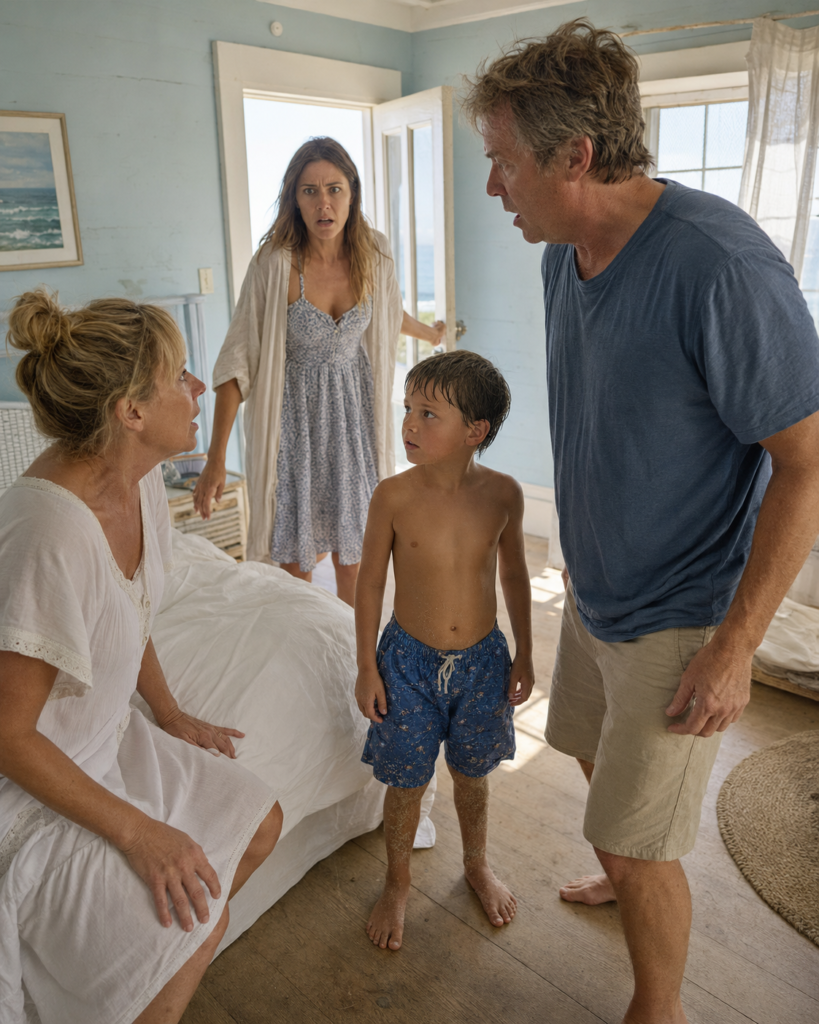
That summer began with a barefoot child asking why I was sleeping in his mother’s bed.
It ended with my two daughters asleep in hammocks on the porch, my sister reading beside them, and a little boy building a sandcastle beneath the moonlight.
The secrets had cost us decades.
But the truth gave us something no inheritance document could guarantee:
A chance to choose one another freely.