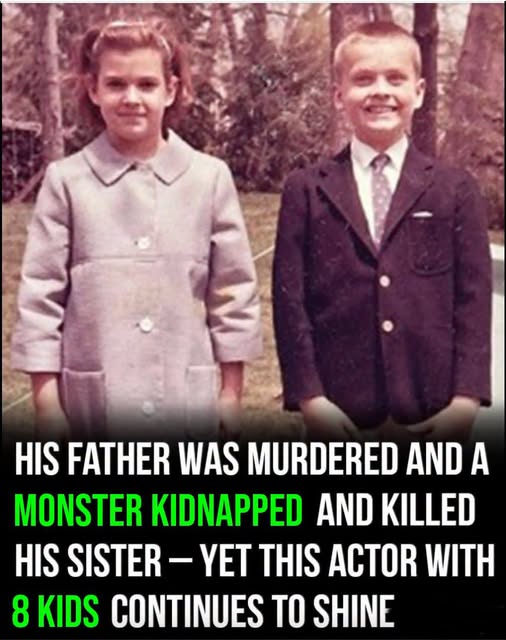
cruel and indifferent to the happiness of a young boy. His grandfather, a pillar of stability and warmth, was the first to be taken, leaving a void that would never quite be filled. Yet, this was merely the prelude to a series of calamities that seemed to follow him like a dark shadow. His father, a man he barely knew, was murdered, a violent act that tore through the fabric of his family and left him grappling with the senselessness of existence.
As he grew into adulthood, the tragedies did not subside; they deepened. The brutal murder of his sister, Karen, remains a scar that defines his internal landscape. It was a trauma so visceral and profound that it threatened to consume his very identity. The grief was compounded when his two half-brothers were lost in a tragic diving accident, a cruel reminder of how quickly the ocean can claim those we hold dear. For years, he sought refuge in the numbing embrace of alcohol, a desperate attempt to silence the cacophony of his own sorrow.
During those long, dark years, he found himself locked in a fierce, silent battle with the divine. He was, by his own admission, furious with God, questioning why he had been singled out for such relentless misfortune. He felt the crushing weight of a survivor’s guilt, convinced that he had somehow failed to protect those who had been taken from him. The bottle became his primary companion, a way to blur the edges of a reality that felt far too sharp to endure without some form of chemical anesthesia.
Yet, even amidst the haze of addiction and the wreckage of his personal life, a flicker of something enduring remained. His professional life, marked by his iconic portrayal of Dr. Frasier Crane, provided a strange, ironic contrast to his private torment. While millions of viewers tuned in to watch him navigate the complexities of life with wit and intellectual grace, the man behind the character was struggling to find his own footing. He learned to compartmentalize, delivering lines with perfect timing while his heart was heavy with the weight of his history.
The turning point did not arrive with a thunderclap, but rather through the slow, arduous process of reclaiming his life from the grip of substance abuse. Sobriety was not merely a choice; it was an act of defiance against the despair that had claimed so many of his loved ones. It required him to look directly at the wreckage of his past, to acknowledge the anger he had harbored for so long, and to begin the difficult work of dismantling the walls he had built around his soul.
As he moved further into his recovery, he began to turn back toward the faith he had once discarded. This was not a return to a simple, unexamined belief, but a complex, hard-won reconciliation with the possibility of grace. He discovered that faith did not offer an exemption from suffering, but rather a framework within which to endure it. It provided a sense of perspective, allowing him to see that his life, while marked by tragedy, was also capable of being defined by something far more resilient.
His commitment to his family became the bedrock of his new existence. Having lost so much, he became fiercely protective of the bonds he had forged, viewing his role as a father and husband as the most significant performance of his life. He understood, perhaps better than most, that the time we have with those we love is finite and precious. He poured his energy into being present, into showing up, and into ensuring that his children would know the depth of his devotion.
The irony of his career is that by playing a character who was often defined by his neuroses and his search for connection, he was able to find a form of catharsis. He brought a humanity to his work that resonated with audiences because it was rooted in real, lived experience. He was not just acting; he was channeling the complexity of a man who had seen the worst of the world and had decided, against all odds, to keep moving forward.
Today, when he looks back at the path he has traveled, he does not see a story of triumph over tragedy in the sense that the past has been erased. Instead, he sees a testament to the endurance of the human spirit. He has learned that we are not defined by the things that happen to us, but by the way we choose to respond to them. He has chosen to respond with love, with forgiveness, and with an unwavering commitment to the living.
The scars remain, as they always will, but they are no longer the focal point of his life. They are part of a larger narrative, one that includes the laughter of his children, the quiet satisfaction of a day well-lived, and the peace that comes from knowing he has done his best to honor those he lost. He has found that even in the aftermath of the most devastating storms, it is possible to plant seeds that will eventually bloom into a life of profound meaning and purpose.
In the end, his story serves as a reminder that we are all capable of surviving the unthinkable. We are all capable of finding our way back from the brink, even when the darkness feels absolute. Kelsey Grammer’s journey is a testament to the idea that love, while it cannot prevent loss, is the only thing strong enough to sustain us through it. He stands now not as a victim of his history, but as a man who has finally found his way home to himself, grounded in the love he gives and the grace he has learned to accept.