Instead, I saw complete chaos.
Cars lined the street and blocked the front of my property. Strangers in formal clothes moved across my lawn carrying ice buckets, drink trays, and decorations. A catering van sat outside my house. A bartender had set up near the garden.
Then my sister Madison appeared on camera.
She was wearing a silver cocktail dress, smiling as though she owned the place, welcoming guests into the home I had built with my late husband, Daniel.
My private sanctuary had become the venue for her promotion party.
I called her immediately.
When she answered, music and laughter filled the background.
“What are you doing in my house?” I asked.
Madison did not sound ashamed.
She sounded annoyed that I had interrupted her.
She said she had used the spare key because my home was “perfect” for celebrating her promotion to regional director. She said it was only one night. She said I was out of town anyway. She said I should be happy for her.
I told her to end the party immediately.
Her voice sharpened.
She said her special night was not going to stop just because I was being dramatic.
That sentence settled something in me.
For most of my life, Madison had taken what she wanted and trusted that someone else would absorb the damage. My money. My time. My patience. My privacy. And whenever I objected, our mother called it jealousy, sensitivity, or selfishness.
But this was not a borrowed dress or an unpaid favor.
This was my home.
The place where Daniel and I had planned our life.
The place I had carefully preserved after losing him.
Madison had not only crossed a boundary. She had turned my grief, my trust, and my absence into an opportunity.
I stopped arguing.
Then I called my neighbor, Graham Patel.
Graham was an off-duty police sergeant, and more importantly, he understood what that house meant to me. He had seen Daniel and me plant the front hedges. He had checked on the property after the funeral. He knew it was not just a large house with good lighting and a wide lawn.
It was the last place that still held our ordinary life.
I told him there were trespassers on my property.
He walked outside and confirmed what I was seeing on camera: the catering van, the bartender, the guests, the blocked street, the entire unauthorized event.
Then he asked me one clear question.
“Do you want them removed?”
“Yes,” I said.
Within minutes, flashing police lights reflected across my windows.
From the live feed, I watched Graham walk up my front path with two uniformed officers. The music lowered. Guests turned. Madison stepped forward, still trying to look composed.
Graham asked whether she had permission to hold the event there.
Madison smiled tightly and began to lie.
She said I knew about it.
She said it was a family arrangement.
She said I had agreed.
But Graham still had me on an open call.
My voice came through clearly.
“I did not give permission. She is trespassing.”
The room went silent.
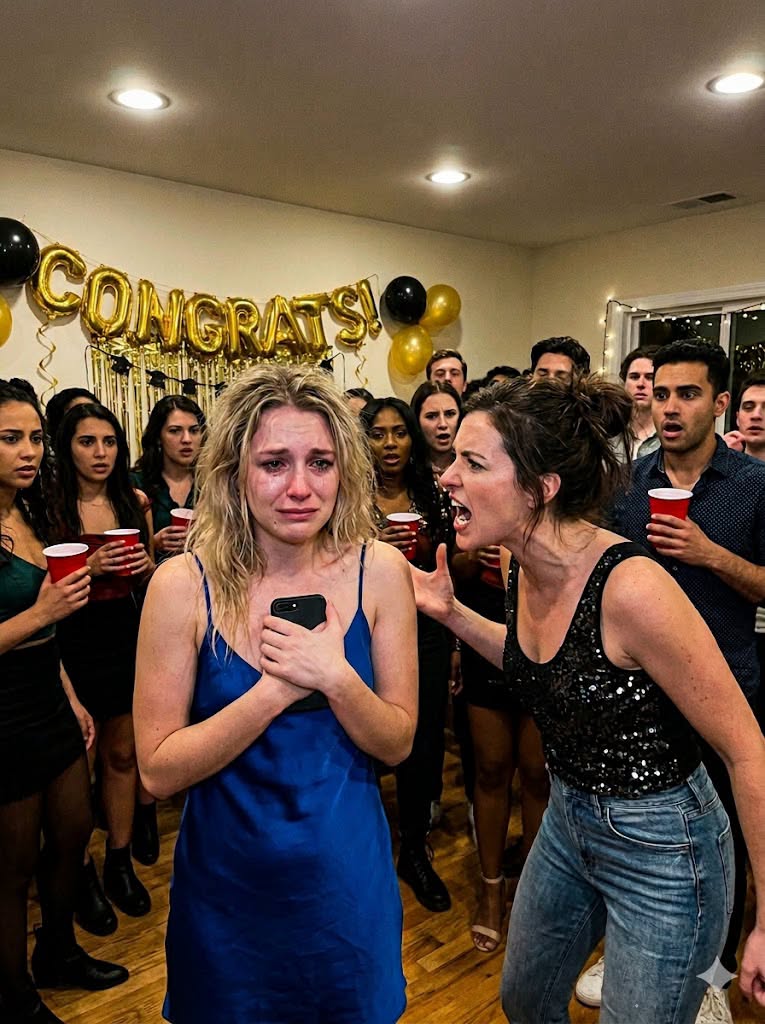
Guests who had been laughing moments earlier began looking for their coats. Caterers exchanged confused glances. The bartender started packing up. Madison’s important boss stood near the doorway, watching her confidence collapse in real time.
I did not enjoy her humiliation.
But I also did not soften the truth to protect the image she had built on my property without consent.
Then one of the responding officers asked a question that changed the whole situation.
“Who removed the hallway camera?”
I went still.
The interior camera near the front hall had been disconnected before the party began.
That was not impulse.
That was planning.
Madison had not simply used a spare key and hoped I would not notice. She had tried to hide what she was doing. She had prepared the violation in advance, trusting that by the time I found out, the night would already be over and I would be pressured to let it pass.
For years, I had been told to keep peace by absorbing disrespect quietly.
But peace built on one person’s silence is not peace.
It is permission given under pressure.
That night, from a hotel room hundreds of miles away, I finally stopped giving it.
My sister wanted my home for her celebration.
Instead, she gave everyone in that room a clear view of who she was when she thought no one could stop her.
And for the first time, I did not rush to cover the damage.
I let the truth stand in the doorway with the police lights behind it.