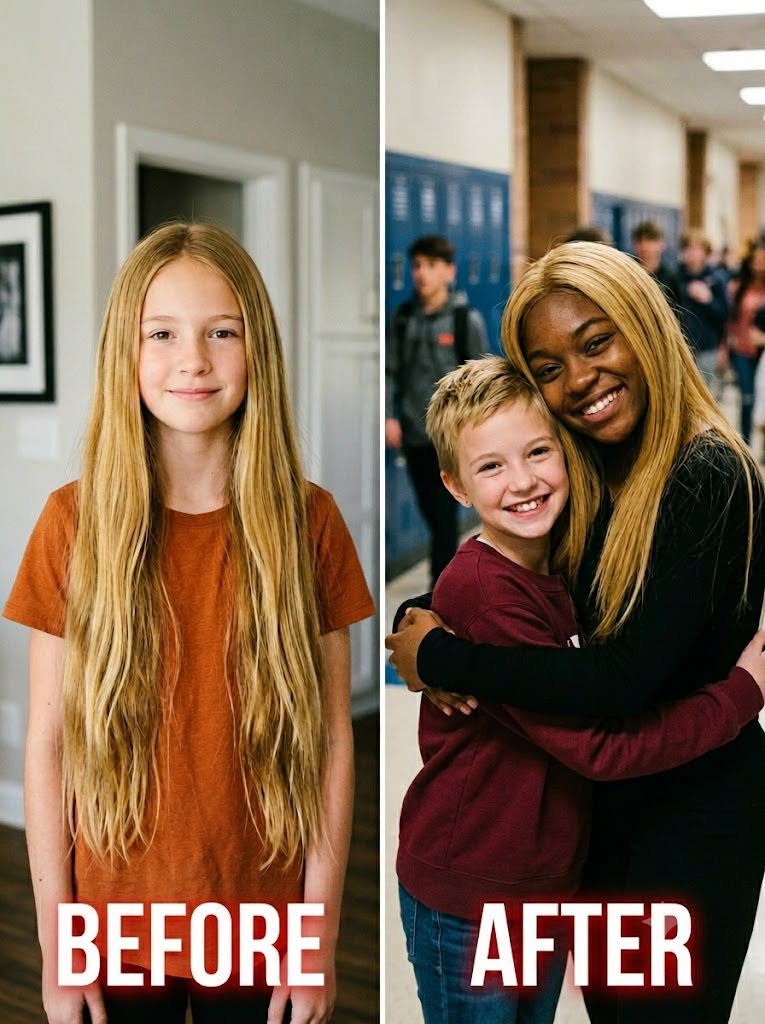
Then she explained.
Her classmate Millie was in remission and had been mocked at school because of her hair loss. Letty had heard the laughter. She had seen Millie trying to hide. She had gone home, looked in the mirror, and decided she had something she could give.
“I wanted to make her a wig,” she said.
My shock softened into something deeper.
Pride.
Grief.
Love.
All of it at once.
Jonathan would have understood immediately. He hated seeing anyone suffer alone. He had always taught Letty that kindness was not something to admire from a distance. It was something you did with your own hands when someone needed it.
We went to a local salon owned by Teresa and Luis.
They did not scold her. They did not laugh at the jagged cut. They listened, then gently fixed what they could. Luis had worked beside Jonathan for eight years, and as he shaped Letty’s hair, he smiled sadly.
“Your dad would have been proud,” he told her.
By the next morning, they had turned the donated hair into a proper wig for Millie.
When we dropped it off at school, I thought that would be the emotional center of the day.
I was wrong.
Shortly afterward, Principal Brennan called me in a panic. Six unfamiliar men had arrived at the school asking to see Letty.
I rushed there with fear tightening in my chest.
But when I stepped into the office, I found something I will never forget.
Letty was standing beside Millie, who was wearing the new wig. Millie’s mother, Jenna, sat nearby with tears running down her face.
Around the principal’s desk stood six men in work jackets — Jonathan’s former coworkers.
Marcus, his supervisor, was there. So was Hank, one of his closest friends.
On the desk sat an old yellow work helmet that had belonged to Jonathan. A purple sticker still clung to the side, one Letty had placed there years earlier when she was small and proud that her father wore “important gear.”
The men had come because they had heard what Letty had done.
They told us Jonathan had always treated them like family, and because of that, they considered us family too.
Then Marcus turned to Jenna and handed her a check.
It came from a charity fund Jonathan had quietly started at work to help families overwhelmed by medical bills. He had never told me how much he was doing. That was like him — not secretive for praise, but humble about goodness.
Jenna hesitated.
She looked embarrassed, as though accepting help meant admitting defeat.
I took her hand and told her the truth.
“This is exactly who Jonathan wanted to help.”
No family should have to carry fear, illness, and bills alone while pretending everything is fine.
Then I turned to Principal Brennan.
Kindness had brought Millie comfort, but kindness alone was not enough if cruelty was allowed to continue. I told him the boys who mocked her needed real consequences, and the school needed stronger protection so no child would feel forced to hide in a bathroom because of other people’s laughter.
He nodded.
Suspensions were already underway, he said, and new measures would be put in place.
Before we left, Marcus handed me a sealed envelope.
He said Jonathan had left it in his locker, meant for me “when the time was right.”
That night, after Letty had fallen asleep, I opened it.
Jonathan’s handwriting met me like a voice I had been aching to hear.
He told me not to carry everything alone.
He told me to let people love us.
He reminded me that grief was not proof I had to close every door. Sometimes love continues through the hands of those who remember.
I cried for a long time.
But for the first time since the funeral, the grief did not feel like a locked room.
It felt like a door had opened.
That evening, we invited Jenna and Millie over for dinner. Teresa and Luis came too, along with Marcus and Hank. Our table was crowded, imperfect, and full of the kind of warmth I thought had disappeared with Jonathan.
Letty sat beside Millie, laughing softly as they passed bread across the table.
I watched my daughter and understood something.
Jonathan was not gone from the world as completely as I had feared.
He was in the fund he had started.
In the helmet with the purple sticker.
In the men who showed up because he had once shown up for them.
And most of all, he was in Letty — in her courage, her tenderness, and her willingness to give part of herself so another child could feel less alone.
That morning began with scissors on a bathroom floor.
It ended with a house full of people who reminded us we were still loved.
Jonathan was no longer physically with us.
But his love had not ended.
It had simply found new ways to arrive.