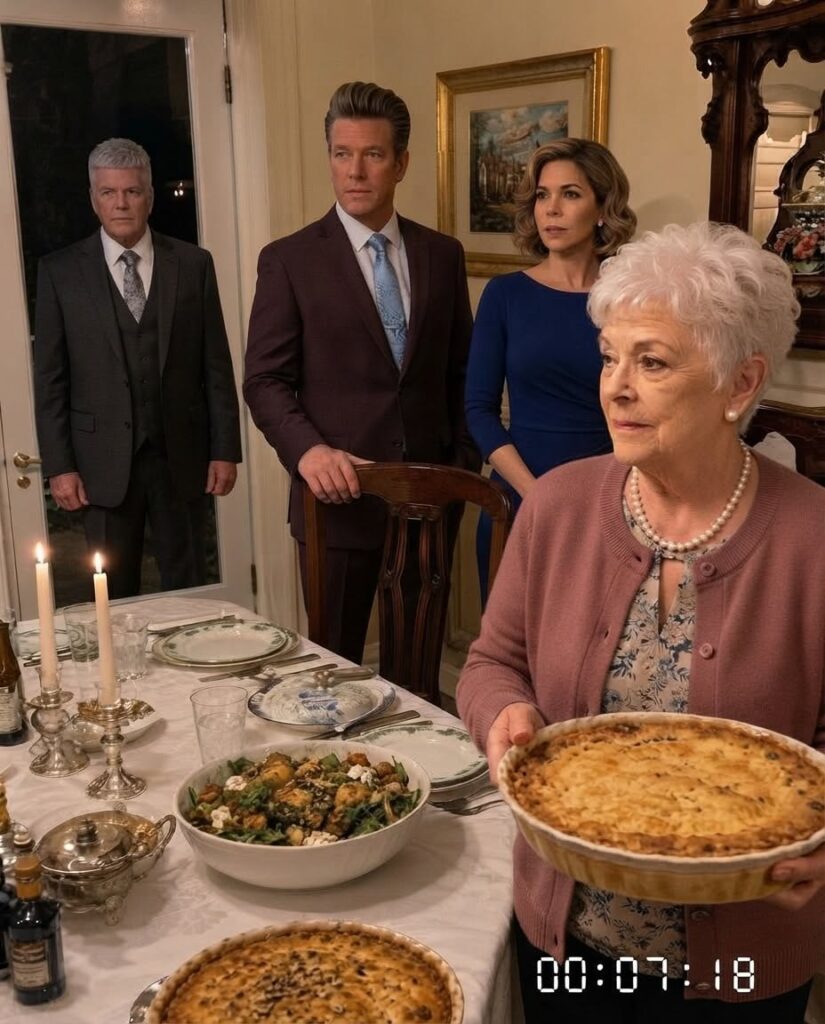
Four glasses stood beside them.
Four chairs had been pulled out.
The empty chair was positioned at the head of the table, exactly where Robert had always sat during family dinners at our farmhouse.
I stopped in the doorway.
“Michael,” I said carefully, “why are there four places?”
My son’s face lost its color.
His wife, Vanessa, covered her mouth with one hand.
Neither of them answered.
The house smelled of roast chicken and rosemary, but beneath those warm scents was something else—an aftershave I had not smelled since Robert died.
My fingers tightened around the pie dish.
Robert and I had shared forty-one years together on a small farm outside Millbrook, Pennsylvania.
He had died while checking the fence in the north pasture.
One moment, he had been walking beneath the morning sun with a coil of wire over his shoulder.
The next, he was gone.
The doctor told me the heart attack had been immediate and painless.
I repeated those words whenever the loneliness became unbearable.
Immediate and painless.
As though the way he died could soften the fact that he had left.
Our granddaughter Emma was away at a sleepover that evening, so I had expected a quiet dinner with Michael and Vanessa.
Instead, I stood staring at Robert’s empty chair while my son looked as though he had been preparing for this moment for two years and still did not know how to begin.
Finally, Michael spoke.
“Mom, there’s something we never told you about Dad.”
Vanessa hurried from the room.
I placed the pie on the sideboard because my hands had started trembling.
“What do you mean?”
Michael pulled out the chair beside him.
“Sit down.”
“I don’t want to sit down. I want you to explain why your dead father has a place at this table.”
He lowered his eyes.
“A few weeks before he died, Dad came here alone.”
I stared at him.
“Why didn’t I know that?”
“He made me promise not to tell you.”
The first sharp edge of anger cut through my shock.
“Your father and I did not keep secrets from each other.”
Michael looked toward the empty chair.
“I thought that too.”
Vanessa returned carrying a small wooden box with brass corners.
The moment I saw it, I recognized it.
Or at least, I thought I did.
Robert’s father had carved him a tackle box when he was a boy. Robert kept it in our basement for decades, filled with old hooks, tangled fishing line, and rusted lures he refused to throw away.
“That box is in my basement,” I said.
Michael placed it on the table.
“The one in your basement is a copy.”
My chest tightened.
“What?”
“Dad made a duplicate so you wouldn’t notice the original was gone.”
Even in something as ordinary as an old fishing box, Robert had hidden the truth from me.
Michael rested his hand on the lid but did not open it.
“He told me to keep this hidden for exactly two years.”
“Why two years?”
“He said you needed time to grieve the man you knew before learning about the man he used to be.”
The room seemed to tilt.
I gripped the back of a chair.
“What man did I know?”
Michael’s voice trembled.
“Dad was never only a farmer.”
He opened the box.
Inside lay several faded photographs, old newspaper clippings, official-looking documents, a worn leather journal, and an envelope bearing my name.
I recognized Robert’s handwriting immediately.
I had seen it on grocery lists, anniversary cards, farm receipts, and little notes beside the coffee maker.
The sight of it nearly broke me.
I touched the envelope but did not open it.
“What did he tell you?”
“Not everything.”
Michael pulled out the chair again.
This time, I sat.
“He said there were parts of his life he had buried before he met you. He was afraid those parts might come back.”
I looked at the empty chair across from me.
Then I opened the letter.
My dearest Brittney,
There is no painless way to tell you this, so I will begin with the truth.
Before I met you, I worked for the Central Intelligence Agency.
I stopped reading.
A strange laugh escaped me.
It sounded sharp and frightened.
“That’s ridiculous.”
Michael said nothing.
“Your father grew corn. He repaired tractors. He fell asleep during the evening news.”
“I know.”
“He complained when coffee went up by twenty cents.”
“I know, Mom.”
“He was not a spy.”
Michael pushed one of the photographs toward me.
It showed a much younger Robert standing outside a stone building beside three men I had never seen.
His hair was dark.
His posture was straighter.
The easy smile I knew was missing.
Several faces in the photograph had been deliberately scratched out.
On the back, someone had written a date and a city.
Prague, 1976.
My hands turned cold.
I looked back at the letter.
Robert wrote that he had been recruited after college and spent eight years working as a field operative in Eastern Europe during the final decades of the Cold War.
He used false names.
He gathered intelligence.
He carried messages, watched people, and entered rooms where one wrong word could have ended his life.
He had lived in Prague, Vienna, Budapest, and cities he did not name.
Then, in 1981, he met me at a farmers market.
I remembered that day clearly.
I had been selling jars of peach preserves with my sister.
Robert stopped at the table and asked whether the peaches were grown locally.
I told him I had picked every one myself.
He bought six jars.
The following week, he returned and claimed he had finished all of them.
I later discovered he had given four away because he needed an excuse to see me again.
According to his letter, meeting me changed the direction of his life.
He no longer wanted false identities or dangerous assignments.
He wanted a name he could keep.
A house where he could sleep without checking the hallway.
A woman he could love openly.
He wanted children who knew exactly who their father was.
The Robert I had known was not a disguise.
He had chosen to become that man.
I pressed the letter against the table.
“Why didn’t he tell me?”
Michael’s eyes filled with pain.
“He was afraid the truth would put you in danger.”
“That sounds like an excuse.”
“Maybe it was.”
The honesty in his answer stopped me.
I continued reading.
Three months before Robert’s death, someone from his former life had contacted him.
They wanted him to assist with one final operation.
Robert refused.
But the person knew where we lived.
They knew my name.
They knew about Michael, Vanessa, and Emma.
Robert wrote that he had spent his final months terrified that the life he abandoned had found its way back to us.
His heart attack had been real.
But the stress had become unbearable.
Beneath the letter were government documents bearing official seals, foreign newspaper clippings, lists of dates, coded notes, and copies of identification papers carrying names I had never heard.
One passport showed Robert’s photograph beside the name Thomas Hale.
Another identified him as Daniel Mercer.
I held both documents in my hands and felt as though I were looking at evidence of two strangers wearing my husband’s face.
Michael opened the leather journal.
“Dad told me that if anything happened to him, it might not be natural.”
I looked up sharply.
“What are you saying?”
“He worried someone could make his death look like a heart attack.”
“The doctor said it was natural.”
“I know.”
“He had a family history of heart trouble.”
“I know that too.”
“Then why would you say something like this?”
“Because Dad asked me to.”
Michael’s voice cracked.
“He made me promise that if anyone ever contacted you or started asking questions, I would tell you everything.”
A chill passed through me.
“Has anyone contacted you?”
“No.”
“Has anyone come to the farm?”
“Not that I know of.”
“Then perhaps your father was frightened and imagining danger that was no longer there.”
“Maybe.”
Michael looked toward the box.
“But he wanted you prepared.”
Suddenly, small details from Robert’s final months returned to me.
He had insisted on updating our wills.
He installed additional security lights around the farmhouse.
He replaced locks that had never given us trouble.
He taught me how to use the rifle in our bedroom closet, even though I had never shown any interest in guns.
He began checking the windows before bed.
Sometimes I woke and found him standing in the kitchen, staring into the darkness beyond the glass.
Whenever I asked what was wrong, he blamed the coyotes.
I had believed him.
I noticed several small bottles at the bottom of the box.
I opened one.
The familiar scent rose immediately.
The aftershave I had smelled when I entered Michael’s house.
“These belonged to him?”
Michael nodded.
“He collected one from each country where he worked.”
The scent carried me back through four decades.
Robert shaving beside me in the bathroom.
Robert fastening his shirt before church.
Robert kissing my cheek while I complained that he had used too much.
I closed the bottle.
At the bottom of the box lay one final envelope sealed with red wax.
Across the front, Robert had written:
FOR BRITTNEY—ONLY IF SHE CHOOSES TO KNOW MORE.
I picked it up.
The paper felt heavier than it should have.
“What is inside?”
Michael glanced at Vanessa.
“Dad said it contains the details he left out. Names, missions, and people who may still be alive.”
“Have you read it?”
“No.”
“Why not?”
“It wasn’t written for me.”
I turned the envelope over.
Opening it might tell me everything.
It might explain the sleepless nights, the locked doors, and the fear in Robert’s final months.
It might also fill my memories with images I could never remove.
The quiet man who canned peaches with me every August had once lived under false names.
The husband who rescued baby birds from the barn had once been trained to deceive people.
The father who cried at Michael’s graduation had once carried secrets across hostile borders.
I looked at Robert’s empty chair.
For two years, I had wished for one more conversation.
Now he had left me one, and I was afraid to hear the rest.
“I don’t need to open it,” I said.
Michael stared at me.
“Are you certain?”
“No.”
I held the envelope against my chest.
“But I still don’t need to.”
I looked at the photographs of the young operative and then at the letter written by the husband I had loved for forty-one years.
“Your father chose our life instead of that one.”
Michael remained silent.
“He chose to become a farmer,” I continued. “He chose to become your father and my husband. Whatever he did before he met me belongs to the man he decided not to be anymore.”
Relief moved across Michael’s face.
Perhaps he had feared I would allow the secret to destroy every good memory I had.
I asked to keep the box.
Someday, when Emma was older, I wanted her to know that her grandfather had lived an extraordinary life before choosing what others might call an ordinary one.
We finally ate dinner.
Robert’s place remained untouched.
The candles burned lower while we remembered the man we knew.
The man who fell into the pond while teaching Michael to fish.
The man who once drove twenty miles because I casually mentioned wanting a particular apple pie.
The man who talked to the cows as though they were difficult employees.
The man who cried every time he watched the same Christmas film and always blamed dust.
Before I left, Michael walked me to the door.
“Are you angry with me?”
“For keeping the box?”
He nodded.
“You promised your father.”
“And with him?”
I looked through the dining room toward the empty chair.
“I haven’t decided.”
That was the truth.
I drove home through the Pennsylvania countryside beneath a sky filled with stars.
I passed the fields Robert had plowed, the pond where he taught our children to skip stones, and the small church where we married.
The farmhouse stood dark at the end of the gravel lane.
For the first time, it looked like a place I did not completely know.
I carried the box upstairs and placed it on our bed.
Then I walked through the rooms, noticing ordinary details that suddenly seemed different.
Robert always locked the truck, even when it sat ten feet from the house.
He checked every window before bed.
He never sat with his back to a restaurant entrance.
Whenever we traveled, he memorized the nearest exits.
He kept cash hidden in three different rooms.
I had considered those things harmless quirks.
Now I wondered how much of his training had survived.
Yet the discovery did not make our marriage feel false.
If anything, it made his commitment feel deeper.
Every morning for forty-one years, Robert woke and chose the farm.
He chose breakfast at our kitchen table instead of meetings under false names.
He chose repairing fences instead of crossing borders.
He chose parent-teacher conferences, church picnics, muddy boots, and ordinary evenings beside me.
He had known danger.
He had known secrecy.
And after experiencing both, he chose peace.
Several weeks later, I found the duplicate tackle box in the basement.
It sat exactly where it always had, covered in dust.
Inside were old hooks, tangled fishing line, and rusted lures.
Robert had copied the original so carefully that I had walked past the replacement for years without noticing.
I sat on the basement steps and laughed until the laughter turned into tears.
Then I called Michael.
“Do you think your father was happy?” I asked.
“With you?”
“With this life.”
Michael did not hesitate.
“Do you remember what he always said when people asked whether he wished he had traveled more?”
I did.
Robert would smile and reply, “I’ve had enough excitement for three lifetimes. This is my reward.”
For the first time, I understood what he meant.
A year later, Emma came to the farmhouse carrying a poster board and a folder of colored markers.
She needed help with a school project about family history.
We spread old photographs across the kitchen table.
She found one of Robert standing beside his first tractor.
“Grandpa looks serious.”
“He was trying to look impressive.”
“Did it work?”
“Not particularly.”
She laughed.
Then she asked, “Do you think Grandpa ever did anything exciting before he became a farmer?”
My eyes moved toward the hallway.
The wooden box remained in my closet.
The red-sealed envelope was still unopened.
“I think your grandfather lived exactly the life he wanted,” I said.
“That’s not very exciting.”
“Sometimes choosing your own life and remaining loyal to it is the greatest adventure of all.”
Emma considered that answer, then wrote it across the bottom of her poster.
Robert had left me two gifts inside the wooden box.
The first was the truth about his past.
The second was the freedom to decide how much of that truth I wanted to carry.
I chose his love instead of his secrets.
Perhaps one day I will open the final envelope.
Perhaps I never will.
But I no longer need every hidden name or dangerous detail to understand him.
The most extraordinary part of Robert’s life was not that he once lived under false identities in distant countries.
It was that after years of danger, he found something worth leaving that world behind for.
A farmhouse.
A family.
A woman selling peach preserves at a farmers market.
And a quiet life he chose, every single day, until his final breath.