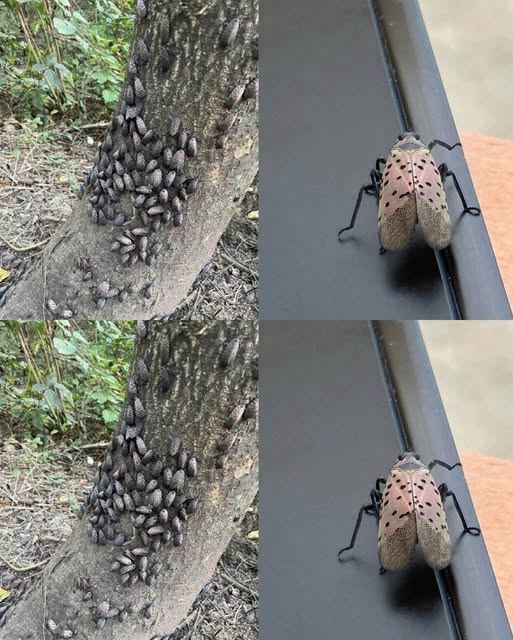
These symptoms are often the first indicators that you are dealing with this destructive pest. The insect feeds by piercing the stems and trunks of plants to extract sap, a process that robs the vegetation of essential nutrients. As they feed, they excrete a sugary, liquid waste known as honeydew. This substance accumulates on surfaces below the infested tree, creating a sticky environment that eventually promotes the growth of sooty mold. This black, powdery fungus coats the foliage, effectively blocking the sunlight required for photosynthesis and further stressing the plant’s ability to survive and thrive throughout the growing season.
Understanding the life cycle of the spotted lanternfly is essential for effective management. The insect undergoes several distinct stages, each requiring different levels of vigilance. Early in the season, you may encounter young nymphs. These juvenile insects are characterized by a black body covered in white spots. As they mature, they begin to develop vibrant red markings on their bodies. By the time they reach adulthood, they are approximately one inch in length and possess gray wings adorned with black spots. When they take flight, they reveal striking, bright red hindwings that make them quite distinctive, even to the casual observer.
The threat extends beyond the immediate damage caused by feeding. During the late summer and autumn months, adult female lanternflies lay their eggs on a wide variety of surfaces. These egg masses are often difficult to spot because they resemble smears of gray, hardened mud. They can be found on tree trunks, fence posts, stone walls, outdoor furniture, and even the undersides of vehicles. Because these insects are prolific breeders, failing to identify and remove these egg masses can lead to a significant increase in the local population the following spring.
Host plants for the spotted lanternfly are numerous and include many species common to residential landscapes. They show a particular preference for maples, walnuts, and various fruit trees, as well as grapevines. The cumulative stress caused by thousands of these insects feeding on a single tree can lead to branch dieback, reduced vigor, and, in severe cases, the death of the plant. Protecting your property requires a proactive approach that begins with regular inspection of these vulnerable trees and structures during every season of the year.
Prevention is one of the most effective tools in your management arsenal. Because these insects are notorious hitchhikers, they often spread to new areas by clinging to outdoor equipment, camping gear, or firewood transported from infested zones. Before moving any items from one location to another, perform a thorough inspection to ensure no nymphs, adults, or egg masses are being inadvertently relocated. By limiting the movement of these items, you can help slow the spread of the insect into new, unaffected neighborhoods and ecosystems.
If you discover egg masses on your property, immediate action is required. The most recommended method for destruction is to carefully scrape the egg masses off the surface using a flat tool, such as a putty knife or a credit card. Once dislodged, the eggs should be deposited directly into a container filled with rubbing alcohol or hand sanitizer to ensure they are completely destroyed. Do not simply scrape them onto the ground, as the eggs can still hatch if they remain intact.
Managing an infestation requires consistent effort and a keen eye. While it can be overwhelming to find these pests in your backyard, you are not alone in this effort. Local agricultural extension offices and state departments of agriculture provide valuable, region-specific guidance and updated information on the current status of the lanternfly in your area. They often offer resources for reporting sightings, which helps scientists track the spread and develop broader strategies for control. By staying informed and maintaining a watchful eye on your trees, you play a vital role in protecting your local environment from the long-term impacts of this invasive species. Take the time to educate your neighbors as well, as a community-wide effort is the most effective way to manage the population and preserve the health of your local landscape for the future.
{"post":107076,"page":2,"next":[{"id":107073,"title":"Remembering the Life and Legacy of Rising Deaf Actress Kaylee Hottle","url":"https:\/\/new24.info\/107073"},{"id":107069,"title":"My Husband Left Me With Our Six-Month-Old Triplets and Went on a Beach Vacation Alone Because I \u2018Hadn\u2019t Earned a Break\u2019 \u2013 When He Came Home, His Smug Smile Vanished","url":"https:\/\/new24.info\/107069"},{"id":107066,"title":"I Married the Mechanic My Family Looked Down On\u2014Then, the Night After Our Wedding, He Opened an Old Metal Box and Revealed Who He Really Was.","url":"https:\/\/new24.info\/107066"},{"id":107063,"title":"I Let a Homeless Teen Borrow My Phone at a Gas Station \u2013 What He Whispered Before Handing It Back Made My Bl00d Run C0ld","url":"https:\/\/new24.info\/107063"},{"id":107060,"title":"My Father Showed Up to My Wedding with My Best Friend as His New Girlfriend and Introduced Her as My \u2018Bonus Mother\u2019 \u2013 What My Brother Did Next Made the Entire Room Go Silent","url":"https:\/\/new24.info\/107060"},{"id":107057,"title":"At My Daughter\u2019s Third Birthday Pool Party, She Pointed at My Stepmom\u2019s Belly and Said, \u2018Daddy\u2019s in There\u2019 \u2013 I Laughed Until I Saw What She Was Really Pointing At","url":"https:\/\/new24.info\/107057"},{"id":107051,"title":"Our Family Was Flying on a Make-a-Wish Trip for My Ill Son \u2013 Halfway Through the Flight, the Pilot Said, \u0027Mike, There\u0027s One Thing About This Trip That You and Your Parents Know Nothing About\u0027","url":"https:\/\/new24.info\/107051"},{"id":107049,"title":"What Happened When My Runaway Wife Crashed Our Twin Daughters Graduation","url":"https:\/\/new24.info\/107049"},{"id":107038,"title":"For Years, My Husband Thought My Poor Eyesight Kept His Secret Safe \u2013 Then I Came Home from Laser Eye Surgery, Looked Inside the Garage, and Screamed, \u0027This Can\u0027t Be Real!\u0027","url":"https:\/\/new24.info\/107038"},{"id":107043,"title":"Spotting My Husband On A Coworker\u2019s Desk Revealed His Hidden Life","url":"https:\/\/new24.info\/107043"},{"id":107037,"title":"One Accidental Phone Call Triggered My Perfect High Stakes Financial Revenge","url":"https:\/\/new24.info\/107037"},{"id":107035,"title":"Understanding Why Some Electrical Wall Outlets Are Installed Upside Down","url":"https:\/\/new24.info\/107035"},{"id":107033,"title":"Why Some Wall Outlets Are Installed Upside Down for Practical Home Utility","url":"https:\/\/new24.info\/107033"},{"id":107013,"title":"\u201cGodzilla vs. King Kong\u201d actor and rising star dies aged 18","url":"https:\/\/new24.info\/107013"},{"id":107028,"title":"The Resonant Echo of a Life Defined by Both Extraordinary Artistry and Profound Personal Struggle","url":"https:\/\/new24.info\/107028"},{"id":107025,"title":"Remembering Kaylee Hottle: A Life of Talent, Representation, and Grace","url":"https:\/\/new24.info\/107025"},{"id":107022,"title":"Remembering Kaylee Hottle: A Rising Star and Advocate Lost in Tragic Maryland Accident","url":"https:\/\/new24.info\/107022"},{"id":107017,"title":"The Resonant Echo of a Life Lived Between Public Adoration and Private Shadows","url":"https:\/\/new24.info\/107017"},{"id":107014,"title":"Investigation Continues Following the Tragic Death of Rising MonsterVerse Star Kaylee Hottle in Maryland Crash","url":"https:\/\/new24.info\/107014"},{"id":107011,"title":"My Dying Husband\u2019s Final Act Was a Carefully Orchestrated Trap to Save Me From My Cousin","url":"https:\/\/new24.info\/107011"}]}