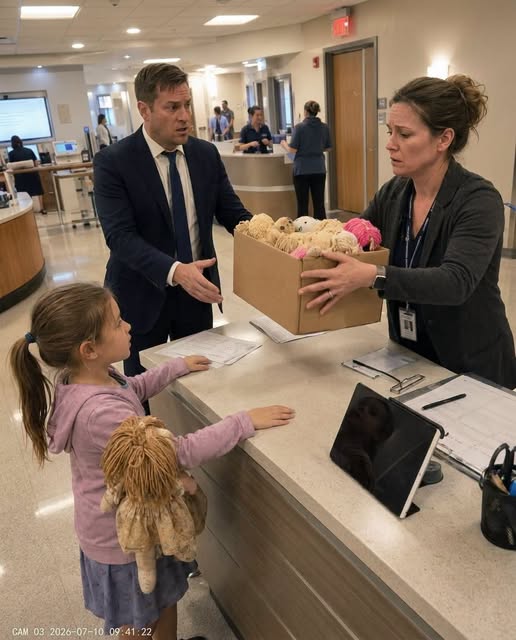
…and the fierce, protective love of a mother who had just been struck by a car to save her. The hospital clerk, eyes glazed with the exhaustion of a thousand administrative heartbreaks, didn’t see a child in crisis; she saw a liability. “Bring insurance by morning, or your mother may never wake again,” the clerk stated, sliding the box of toys back toward the girl. Sarah didn’t cry. She simply stood there, a tiny sentinel guarding a broken life, until a shadow fell across the counter.
Matthew Sullivan, a man whose name was synonymous with glass towers and global influence, had only stopped to check on an injured staff member. He was a man accustomed to the cold calculus of business, but the name on the clerk’s clipboard—Anne Miller—hit him like a physical blow. It wasn’t just a name; it was a memory of a girl in a worn-out coat who had once shared her lunch with him when he had nothing. It was the face of the only person who had ever looked at him not as a future tycoon, but as a friend.
Matthew looked down at the box of dolls. He saw the rag doll, hand-stitched with blue scraps, and he saw the reflection of a life he had once known. Without a word to the clerk, he stepped forward, his presence commanding the oxygen in the room to shift. He didn’t ask for forms. He didn’t ask for payment plans. He simply looked at the doctor who had arrived to deliver the final, devastating news and said, “She is under my care. Do whatever is necessary. Spare nothing.”
The days that followed were a blur of sterile rooms and hushed monitors. While Anne fought for her life in the ICU, Matthew did the unthinkable: he entered the world Sarah had been living in. He visited their apartment, finding the eviction notices, the empty cupboards, and the crushing weight of poverty that Anne had masked with smiles and hand-sewn toys. He didn’t just pay the bills; he restored the dignity that the world had tried to strip away from them. He filled the fridge, settled the debts, and ensured that when Anne finally opened her eyes, she wouldn’t have to worry about the cost of existing.
But the past is a persistent ghost. Seven days later, as Anne began her slow climb back to consciousness, a man named David appeared. He was Sarah’s father, a figure who had been absent for years, suddenly reappearing with flowers and hollow promises the moment he smelled the scent of wealth surrounding the hospital room. His return was a calculated intrusion, a man hoping to leverage a billionaire’s generosity for his own gain.
When David confronted Matthew, questioning his motives with a sneer, the billionaire didn’t flinch. He looked at the man who had abandoned his family and said, “True responsibility doesn’t wait for a bank account to be full. It shows up when there is nothing left to give.” It was a line drawn in the sand. As the hospital records and the truth of David’s intentions surfaced, the charade crumbled. Matthew had saved more than just a life; he had protected a sanctuary. In the end, it wasn’t the money that mattered, but the realization that some debts are paid in kindness, and some treasures are far too valuable to ever be sold.