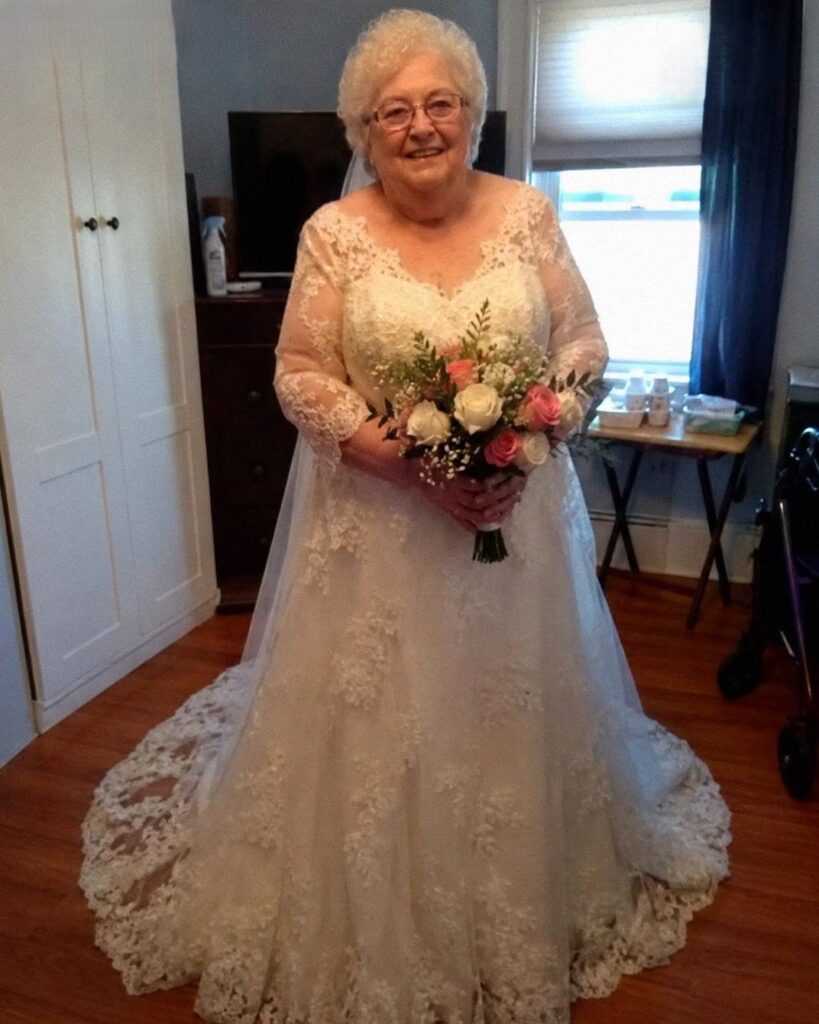
He kept that promise fifty-three years later.
By then, however, we had already lived entire lives without each other.
And just when I believed our story had finally found its happy ending, everything began to unravel.
The mornings in my town moved slowly after my husband, Howard, passed away.
That suited me.
I filled my time with church bake sales, Wednesday shifts at the food pantry, and small household chores that did not really need doing.
I kept my hands busy because stillness invited memories.
Howard and I had shared forty-one good years. We raised no children of our own, but we built a quiet life filled with Sunday drives, garden tomatoes, and coffee on the back porch.
After he died, the house became too large.
Every room seemed to preserve the shape of him.
His slippers remained beside the bed for months.
His favorite mug stayed near the sink.
Sometimes I turned toward the hallway expecting to hear him clear his throat before entering the room.
Eventually, grief stopped feeling sharp.
It became a low, permanent ache I learned to carry.
That Saturday in April, I was arranging lemon bars on a folding table at First Methodist Church when a man behind me said my name as though it still belonged to him.
“Eleanor.”
I froze.
No one had spoken my name that way in more than half a century.
I turned.
Garrett stood beside the brownies with silver hair, deep lines around his eyes, and the same crooked smile he had worn after kissing me behind the bleachers.
For several seconds, neither of us moved.
Then he laughed softly.
“You still wear your hair the same way.”
I touched the loose knot at the back of my head.
“And you still begin conversations too smoothly.”
His smile widened.
We started laughing.
Then, without warning, we both began crying.
There we stood, two people in their seventies, holding each other beside a pitcher of iced tea while Pastor Wells pretended not to notice.
My friend Marlene from the choir noticed everything.
I knew before Sunday service that half the congregation would hear about Garrett’s return.
He stayed until the bake sale ended.
Then he asked whether I would allow him to buy me coffee.
“Coffee?” I said. “After fifty-three years?”
“I can add pie.”
“That sounds more serious.”
We went to the diner near the courthouse.
Garrett paid for coffee, pie, and a second piece when he noticed I liked the first.
Afterward, he walked me to my car as though we were still teenagers and he was afraid my father might see us.
That afternoon, we began learning what life had done to the people we once knew.
Garrett had married a woman named Patricia.
They had shared nearly forty-eight years together before cancer took her.
He spoke of her with tenderness and respect.
I told him about Howard and the gentle life we had built.
Neither of us tried to diminish the marriages that had come between us.
Those loves were real.
So was the one that had survived quietly beneath them.
After that, Garrett and I met every Tuesday at the same diner.
Sometimes we talked for hours.
Other times we simply sat together, sharing pie and watching traffic move through town.
“I always wondered about you,” he admitted one afternoon.
I stirred my coffee.
“You had an unusual way of showing it. Fifty-three years of silence is impressive.”
“Life got in the way.”
“Life always does.”
He looked down.
“My father moved us before graduation. Then there was college, the Army, work, marriage. Every year I told myself it was too late to find you.”
“It probably was.”
“Maybe.”
He reached across the table and touched my hand.
“But not anymore.”
Six months later, Garrett proposed on my front porch.
There was no orchestra.
No photographer hiding behind the hedges.
Only two glasses of lemonade, a late-summer sunset, and Garrett lowering himself carefully onto one knee before immediately complaining about it.
“I don’t have the ring yet,” he said. “But I’m working on it.”
I laughed through my tears.
“You’re fifty-three years late.”
“I know.”
“You expect me to wait longer?”
“Only a little.”
I said yes.
Not because Garrett was wealthy.
I did not yet understand how wealthy he was.
I accepted because somewhere inside the man kneeling before me was the boy who had walked me home through the rain.
The engagement dinner was held at his estate outside Charlottesville.
Calling it a house would have been dishonest.
The property had stone columns, acres of gardens, and a dining room larger than my entire first apartment.
That evening, I met Garrett’s children.
Margaret was fifty-one.
Daniel was forty-eight.
Margaret embraced me with her arms but not with the rest of her body.
Daniel shook my hand the way a businessman greets someone hired to repair the roof.
“So good to finally meet you,” Margaret said.
Her smile was polite and narrow.
“Your father has told me so much about both of you.”
“I’m sure he has.”
Garrett seemed determined not to notice the tension.
He poured wine and told stories about our school days.
Margaret barely touched her food.
Daniel checked his phone repeatedly.
Later, while walking toward the powder room, I heard voices in the hallway.
Garrett’s was low but firm.
“Margaret, I am not changing anything. We have already discussed this.”
“Daddy, please. Think about what Mother would have wanted.”
“Your mother wanted me to be happy.”
“She did not want a stranger taking her place.”
I stepped backward before they saw me.
Until that moment, I had believed their coldness came from grief.
For the first time, I wondered whether something else was involved.
Money.
Property.
Inheritance.
The wedding took place in December at First Methodist.
Marlene cried louder than I did.
Pastor Wells forgot one line of the ceremony because he kept smiling at us.
Garrett held both my hands and whispered, “It took me long enough.”
That first morning in his home as his wife, I woke expecting to feel like a guest who had overstayed her welcome.
Instead, Garrett brought me coffee in a china cup and kissed the top of my head.
“Stop grinning,” I said. “You’ll spill it.”
“Let me grin. I waited fifty-three years for this.”
For a little while, happiness seemed simple.
We read the newspaper together.
Walked through the gardens.
Argued over whether the thermostat was too high.
At night, Garrett told me stories about places he had traveled and regrets he had carried.
I told him about Howard.
He never acted jealous of the man who had loved me well.
“Howard kept you safe until I found you again,” he once said.
I kissed his cheek.
“He did more than keep me safe.”
“I know.”
The trouble began the first Sunday Margaret and Daniel visited after the wedding.
Margaret entered carrying a casserole dish and an expression like cold weather.
Daniel followed two steps behind.
She stopped in the dining room and stared at the linen runner I had placed across the table.
“Mother used to arrange the table that way.”
“I didn’t know that.”
“Patricia,” she said sharply. “In case you have forgotten her name.”
“I have not forgotten your mother’s name.”
I touched the runner.
“I can remove it if seeing it bothers you.”
“Everything about this bothers me.”
Garrett appeared in the doorway.
“Margaret. That is enough.”
She gave him a tight smile.
She did not apologize.
Daniel avoided my eyes.
The remarks continued over the following weeks.
Margaret said one of my dresses was “rather ambitious for a woman my age.”
She asked whether volunteering at church counted as ever having held a real job.
Once, during dinner, she placed her wineglass down and asked what exactly I expected to inherit.
Garrett’s fork stopped halfway to his mouth.
“Margaret.”
“I’m only asking what everyone is thinking.”
“No one is thinking that except you.”
She looked at me.
“Are you telling me she married you for love?”
“Yes.”
Margaret laughed.
“Then she is more foolish than greedy.”
Garrett placed his fork on the table.
“Eleanor is not a subject for interrogation. She is my wife.”
“She is your mistake.”
I had never seen Garrett’s expression become so cold.
“You will not speak to her that way in my home.”
“This was Mother’s home.”
“It is mine.”
Margaret pushed back her chair.
“For now.”
Later that evening, I heard her arguing with Garrett in the hallway.
She mentioned her mother’s memory.
Then she said something about paperwork he had promised not to change.
Garrett’s answer was too quiet for me to hear.
I went upstairs and pretended I had heard nothing.
During the following month, I often found Garrett speaking on the telephone inside his study.
The door would be half closed.
Documents covered the desk.
He frequently spoke to a man named Whitfield.
Whenever I entered, Garrett placed the papers inside a leather folder.
“Just old business,” he told me once.
“What kind of business?”
“Nothing you need to worry about.”
“I’m not worried. I’m nosy.”
He laughed and pulled me onto his lap as though we were twenty again.
“I put certain things in place a long time ago,” he said. “I am making sure every line is airtight.”
“For whom?”
“For everyone.”
“That does not answer my question.”
His smile faded slightly.
“You will always be safe, Eleanor. No matter what those two think of me.”
I should have asked him to explain.
I did not.
The months passed in a warm hush.
Winter softened into early spring.
Garrett and I took drives through the mountains.
We bought tomato plants we never had time to put in the ground.
I allowed myself to believe the storm outside our bedroom door would never enter.
Then, on a Tuesday morning, Garrett poured his coffee and reached for the newspaper.
His hand suddenly moved to his chest.
The cup shattered on the floor.
He looked at me with surprise, as though he had just remembered something important.
“Garrett?”
He tried to speak.
Then he collapsed.
The ambulance came quickly.
Not quickly enough.
A heart attack took him before we reached the hospital.
After waiting fifty-three years to find each other again, we had been married less than five months.
At the cemetery, the wind cut through my black dress.
Margaret stood on the opposite side of the grave.
Her eyes remained dry.
She watched me as though I were a stain someone had failed to remove from the family linen.
Daniel kept his head lowered.
After the burial, we returned to the mansion.
I had been inside for less than ten minutes when Margaret found me in the front sitting room.
She held several stapled pages.
“Get out.”
I thought grief had made me misunderstand her.
“What?”
“The house belongs to the family trust.”
She shook the papers toward me.
“Daddy signed it years before you appeared. Your name is nowhere in these documents.”
I stared at her.
“I buried my husband an hour ago.”
“And now you need to leave his children’s property.”
“Margaret—”
“You have embarrassed our mother’s memory long enough.”
Daniel entered carrying my old brown suitcase.
It was the one I had brought with me when I moved into the house.
He placed it at my feet without speaking.
I looked at him.
“Daniel, please.”
His eyes stayed on the floor.
Margaret pointed toward the door.
“Nothing in this house belongs to you.”
I glanced toward the mantel.
A photograph of Garrett holding a fish rested beside the clock.
“Let me take that picture.”
“No.”
“Just one photograph.”
“The trust is clear.”
I looked again at Daniel.
He said nothing.
So I lifted my suitcase.
Still wearing the black dress in which I had buried my husband, I walked out of the second home where I had known love.
I had nowhere to go except my late sister Ruth’s trailer near the county road.
Ruth had left it to me four years earlier.
I had continued paying the lot rent out of habit, never imagining I might need to live there.
The trailer stood at the end of a gravel lane.
Its steps were warped.
The porch light leaned slightly to one side.
I dragged my suitcase inside and stood in the kitchen listening to the faucet drip.
Ruth’s faded dish towels still hung from the oven handle.
A ceramic rooster sat above the sink.
The place smelled faintly of dust and old wood.
That first night, I slept in a housecoat Garrett had bought me.
It still carried a trace of his aftershave.
I held the fabric against my face and cried in a way I had not cried since Howard died.
Losing Garrett was grief.
Being thrown from his home before his grave had settled felt like erasure.
On the third morning, I called the mansion.
Margaret answered.
“It’s Eleanor.”
A long silence followed.
“What do you want?”
“The photograph from the mantel. The one of your father fishing. I will pay to have it shipped.”
“Do not call here again.”
“Please. It is only a photograph.”
“Nothing there belongs to you.”
The line went dead.
Two days later, a courier delivered a letter printed on Daniel’s business stationery.
It instructed me not to contact the family or challenge the trust.
The letter claimed Garrett had been confused during his final months and warned that any attempt to interfere with the estate would be met aggressively.
I read it twice.
Then I folded it and placed it in a drawer.
I did not have the strength to answer.
Part of me wondered whether Margaret was right.
Perhaps I had entered their lives too quickly.
Perhaps five months of marriage did not entitle me to anything.
Perhaps love did not count once someone was gone.
My neighbor Joyce came over that Sunday carrying a tuna casserole.
“Heard someone moved in,” she said, setting it on the counter. “I don’t ask questions unless they’re invited.”
“I appreciate that.”
“My Walter died in 2009. The first month, I forgot how to eat.”
She opened my refrigerator and placed the casserole inside.
“So I’m not asking whether you’re hungry. I’m leaving food.”
I nearly cried into the foil covering.
Slowly, I began building a life inside that trailer.
I attended the little country church up the road on Wednesdays.
No one there knew Garrett’s name.
They knew only that I sang alto and brought pound cake when it was my turn.
I stopped waiting for the telephone to ring.
I stopped imagining Margaret arriving to apologize.
Eventually, I began believing the silence was the rest of my story.
I told myself I could make peace with it.
Then, exactly two weeks after Garrett’s funeral, I was pinning sheets to the clothesline behind the trailer when tires crunched across the gravel.
I turned with a clothespin between my lips.
A black limousine stopped beside the mailbox.
It looked as misplaced as a grand piano in a cornfield.
The driver stepped out.
Then a tall man in a gray suit emerged carrying a leather folder and a sealed cream envelope.
“Mrs. Cole?” he called.
I removed the clothespin.
“Yes?”
He crossed the patchy grass.
“My name is Arthur Whitfield. I was Garrett’s attorney.”
The clothespin slipped from my fingers.
Mr. Whitfield held out the envelope.
“Your husband instructed me to wait until after his death before contacting you.”
“Why?”
“He wanted certain events to unfold without interference.”
I stared at him.
“What events?”
His expression softened.
“He believed his children would remove you from the house immediately.”
The sheets snapped in the wind behind me.
“He knew?”
“He knew exactly what they would do.”
Mr. Whitfield handed me the envelope.
My name appeared on the front in Garrett’s handwriting.
“He instructed me to deliver this personally,” the lawyer continued. “He wanted to ensure you received exactly what you deserved.”
My hands shook so badly that I needed three attempts to break the seal.
The first line read:
My dearest Eleanor, if you are reading this, then Margaret and Daniel have already shown you why I made these arrangements.
My knees gave way.
Mr. Whitfield caught my arm and helped me into the trailer.
We sat at Ruth’s small kitchen table while I continued reading.
Garrett had written the letter six months before his death.
He explained that Margaret had been pressuring him for years to preserve every visible part of the estate for her and Daniel.
The mansion, the furnishings, and most of Patricia’s belongings were held inside a family trust.
Garrett had chosen not to disturb it.
He allowed his children to believe that trust contained everything.
It did not.
Years earlier, he had established a separate private trust under Mr. Whitfield’s management.
Margaret and Daniel had never controlled it.
They could not challenge it without exposing the harassment and pressure Garrett had carefully documented.
Mr. Whitfield opened the leather folder.
“The mansion remains with the children, exactly as they expected.”
I nodded.
“I do not want the house.”
“Garrett knew that.”
The lawyer turned a page.
“He left you a lake cottage free of debt, a lifetime monthly income, full medical coverage, and ownership of several investment accounts.”
I stared at him.
“There must be a mistake.”
“There is no mistake.”
He slid the documents toward me.
“The trust is irrevocable. His children were informed this morning.”
I thought of Margaret holding those papers after the funeral.
She had believed she had taken everything.
Garrett had already placed the things that mattered beyond her reach.
Mr. Whitfield then lifted a small wooden box from his case.
“He also left you this.”
I opened it.
My hand flew to my mouth.
Inside were photographs.
Every photograph of Garrett I had asked for and been denied.
There was the fishing picture from the mantel.
A photograph of him as a young man beside his first car.
A picture from our wedding.
One of us laughing at the diner.
Beneath them lay his 1972 class ring.
Beside it was a diamond ring.
The inside band carried an engraving.
For Eleanor, whom I promised behind the bleachers.
I began crying.
Not the desperate tears I had shed alone in the trailer.
These were gentler.
They carried grief, love, and the unbearable relief of knowing Garrett had not forgotten me.
“He bought the ring shortly after your wedding,” Mr. Whitfield said. “He planned to give it to you on your first anniversary.”
I slipped it onto my finger.
It fit perfectly.
“Garrett did not want to fight his children publicly,” the lawyer continued. “He did not want Patricia’s memory dragged through court. So he prepared an answer for every cruelty he expected.”
The locked doors.
The refusal to give me a photograph.
The suitcase placed at my feet.
Garrett had anticipated all of it.
His letter ended with these words:
Do not mistake their rejection for your worth.
You were never a visitor in my life.
You were the promise I carried longest.
Go to the lake, Eleanor.
Plant something.
Sing loudly.
Wear the ring.
Live without asking anyone’s permission.
Two months later, I moved into the cottage.
It stood beside a quiet lake surrounded by pine trees.
The porch faced the water.
Garrett had already arranged for the kitchen to be painted yellow because I once told him yellow rooms felt warmer in winter.
On the mantel stood another copy of the fishing photograph.
Margaret wrote first.
Her letter was angry at the beginning and apologetic by the end.
She claimed grief had influenced her behavior.
Daniel wrote next.
He said he had been ashamed but too weak to challenge his sister.
Neither letter mentioned the suitcase.
Neither mentioned refusing me a single photograph.
Both asked whether we might discuss the trust.
I sent one response.
I hold no grudge. I wish you peace. Please do not write again.
Then I returned their letters unopened after that.
Joyce visited most Sundays.
She brought coffee, gossip, and more casseroles than one person could eat.
I planted tomatoes beside the porch.
Lavender near the steps.
A small white rose bush beneath the bedroom window.
And I wore Garrett’s diamond ring every day.
Sometimes, near sunset, I sat on the dock and thought about a seventeen-year-old boy walking a girl home through the rain.
He had made a promise without understanding how long life might require him to carry it.
Garrett kept that promise fifty-three years late.
But love kept late is still love kept.
And dignity—real dignity—is not something another person can remove from your finger, lock inside a mansion, or drop at your feet in an old brown suitcase.
It remains yours.
Even after every door closes.