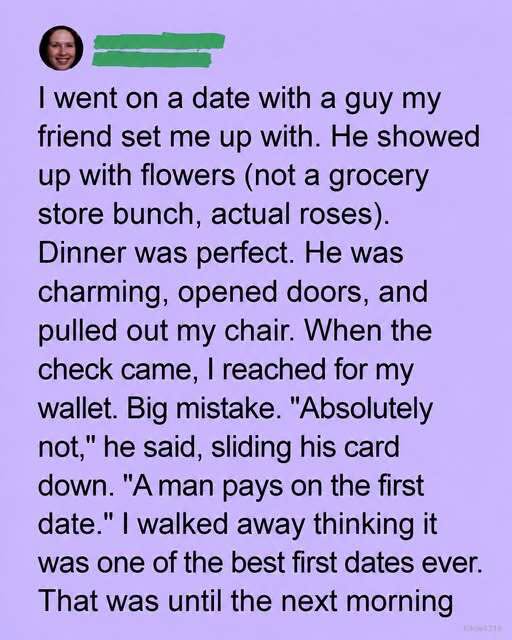
It was an email with the subject line: “Invoice for Last Night.” At first, I let out a sharp, incredulous laugh, assuming it was some bizarre, dry-witted attempt at humor. I opened the message, expecting a punchline. Instead, I found a cold, itemized list of expenses. There were charges for the dinner, the bouquet of roses he had brought, the engraved keychain he had gifted me, and—most chillingly—a line item labeled “Emotional Labor.” The total was calculated down to the cent, and at the bottom, he had included a threat: “Failure to comply” would result in him contacting Chris, Mia’s boyfriend, to “report” my behavior.
The air in my living room suddenly felt thin. This wasn’t a joke; it was a shakedown. The man who had spent the entire evening playing the role of a gentleman—pulling out my chair, complimenting my dress, and acting with old-fashioned charm—had been keeping a ledger. Every kindness he had extended was not a gift, but a loan with interest, and he was now calling in the debt. I felt a wave of nausea. The “romantic” evening had been a performance, and the curtain had just dropped to reveal a man who viewed human interaction as a series of transactional liabilities.
I immediately texted Mia, my hands shaking. Her response was instantaneous: “He’s insane. Do not respond.”
Mia and Chris were as horrified as I was. They took matters into their own hands, sending Eric a mock invoice of their own, charging him for the “emotional trauma” of knowing him and for the “entitlement fee” he displayed. Their attempt to inject humor into the situation backfired, however. It acted as a catalyst, causing Eric to spiral. His messages shifted from defensive posturing to aggressive demands, then finally to pathetic, self-pitying rants about how he was “just trying to be a provider.”
I chose silence. I blocked his number, his email, and his social media profiles, refusing to give him the satisfaction of a reaction. Mia and Chris eventually severed all ties with him, realizing that a man who keeps a spreadsheet of his dates is not just a red flag—he is a danger to one’s peace of mind.
Looking back, the night started like a romantic comedy but ended as a harsh lesson in human nature. It taught me that genuine generosity is never a contract, and kindness is never a debt to be repaid. I didn’t pay his invoice, but I paid a price in the form of a lost evening and a newfound skepticism. In the end, I walked away with my dignity intact, while he was left with nothing but a worthless receipt and a reputation in tatters. I learned that when someone shows you they are a transactional predator, you don’t negotiate—you close the account permanently.