
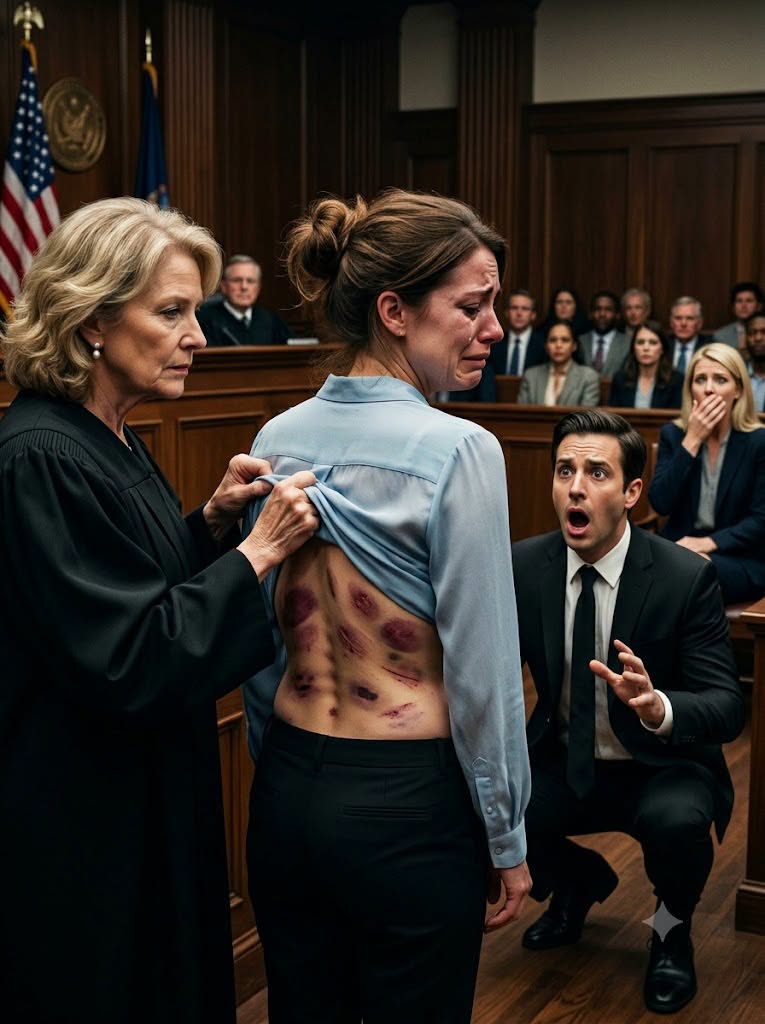
Then Clara went to change her clothes.
That was when I saw the marks on her back.
Some were old. Some were new. All of them told the truth her mouth had not yet been able to speak.
For a moment, I was only her mother.
Then my daughter looked at me with fear in her eyes and said the name of that fear plainly.
Daniel.
Her husband.
A confident attorney at Mercer Vale and Knox.
She told me he had warned her that no one would believe her. That he would use his colleagues, his connections, and the court system itself to take Sophie away if she ever tried to leave.
I listened without interrupting.
Inside, I felt the kind of anger a mother feels when the child she once held has been made to live in terror. But anger, by itself, would not protect Clara.
Evidence would.
Procedure would.
Timing would.
For twenty-two years, I had served as Judge Evelyn Hart of the United States District Court. Daniel did not know that. To him, I was only Evelyn Cross, Clara’s mother — ordinary, quiet, and useful to underestimate.
So I let him underestimate me.
That night, I took Clara to the hospital. We documented every injury. We spoke carefully with medical staff. We secured Sophie. Then we obtained an emergency protective order.
By the next morning, Daniel was at my door.
He arrived with the arrogance of a man who had spent years confusing fear with control.
He spoke over Clara. He dismissed me. He said he would file emergency custody papers claiming she was unstable. He mentioned supporting statements from his law partner, Gregory Vale, and a therapist whose name sounded rehearsed before it sounded real.
I let him speak.
Sometimes people reveal more when they believe no one in the room understands the game they are playing.
Later, we found the proof he never expected us to have.
Hidden security footage stored on a cloud account showed Daniel and Gregory discussing the false narrative they planned to use in court. They spoke of Clara’s supposed instability, the fake therapist, and how quickly they could move if they made her appear dangerous before she could defend herself.
It was not only cruelty.
It was strategy.
When Daniel confronted me outside the courthouse, he was still wearing the same confidence.
Then a court employee passed us and greeted me.
“Good morning, Judge Hart.”
Daniel’s face changed.
In that single moment, he understood what he should have understood much earlier: he had mistaken silence for ignorance, motherhood for weakness, and the law for something he could bend without consequence.
The hearing was packed.
Judge Marisol Vega presided.
Daniel chose to represent himself, which was fitting in a painful way. His confidence had carried him this far, and he still believed it could carry him through evidence, testimony, and truth.
Clara sat beside her attorney, pale but steady.
When the medical testimony was presented, the room quieted. The injuries were not consistent with accidents. The timeline showed a pattern. The recordings confirmed planning, pressure, and deliberate deception.
Daniel tried to question Clara himself.
He brought up old statements she had made, moments when she had denied what was happening or explained away injuries. He wanted the court to see contradiction.
Instead, Clara gave them context.
“I was afraid,” she said.
Her voice shook, but it did not break.
“I said what I thought would keep me and my daughter safe.”
There are truths that do not need to be loud to be powerful.
That was one of them.
Judge Vega granted a two-year protective order. She awarded temporary sole custody to Clara and referred Daniel’s false filings, supporting statements, and related documents to the proper authorities for investigation.
The decision did not erase what Clara had endured.
But it gave her room to breathe.
And sometimes, after years of fear, room to breathe is the beginning of freedom.
The legal consequences came quickly.
Daniel’s professional life unraveled under the weight of his own conduct. Gregory Vale, faced with the evidence of his role, eventually surrendered his license. The false therapist was investigated. What they had built through intimidation, reputation, and careful lies could not withstand the light of records and testimony.
Four days of trial followed.
Daniel was sentenced to six years and permanently lost the career he had used as a weapon. Gregory’s fall was quieter, but no less complete. Men who once believed they could use the law to silence a woman were forced to answer to it.
Eight months later, Clara and Sophie moved into a bright new home.
It was not grand, but it was peaceful.
Sunlight filled the kitchen in the mornings. Sophie painted at the table. Clara slept through the night more often. Slowly, ordinary life returned — not all at once, but in small, trustworthy pieces.
My daughter also returned to graduate school.
She wanted to help women who had lived with fear so long they no longer trusted their own voices. She told me she did not want her pain to remain only pain. She wanted it to become a doorway for someone else.
One spring morning, we stood together on the courthouse steps.
Clara looked at the building quietly.
“I used to think this place would take Sophie from me,” she said. “Now I know it helped give us our life back.”
I took her hand.
The court had protected her. The jury had believed her. The truth had been heard.
But the deepest victory was not only legal.
It was Clara standing there without lowering her eyes.
It was Sophie safe.
It was a daughter who had once been taught to fear her own voice learning to trust it again.
Daniel had believed power meant knowing how to frighten people.
Clara learned something stronger.
Power can also mean telling the truth after years of silence.
It can mean asking for help.
It can mean walking into a courtroom afraid and still refusing to disappear.
And sometimes, justice begins the moment a wounded daughter comes home without luggage, and her mother understands that quiet must now become protection.