
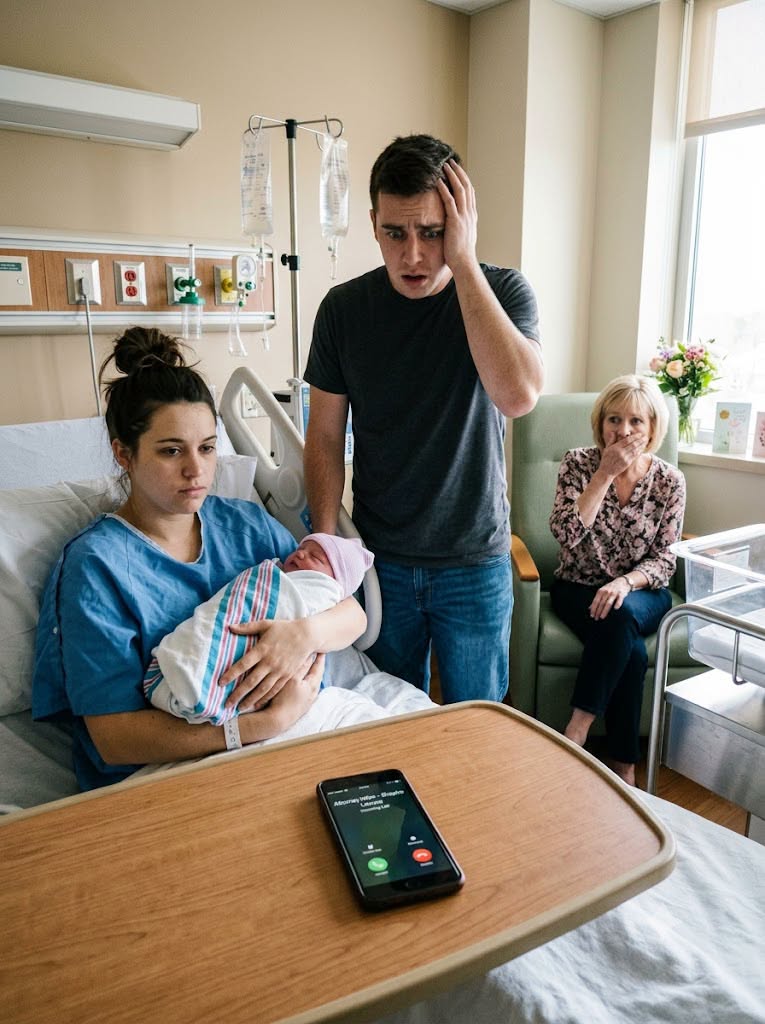
After four years of marriage, I expected my husband, Mark, to stand beside me in wonder. I expected tears, gratitude, maybe fear in the beautiful way new parents are afraid. I expected him to look at our daughter and see a blessing.
Instead, he stood at the foot of my bed with his arms crossed.
His face was cold.
“I want a DNA test,” he said. “I’m not convinced she’s mine.”
The nurse froze.
The room seemed to lose its air.
In the corner, my mother-in-law, Carol, went pale.
For a moment, I could not speak. My body had just brought our child into the world. I was weak, bleeding, aching, and holding the most innocent person either of us had ever known.
And Mark had chosen that moment to turn suspicion into accusation.
My heart broke.
But my mind became frighteningly clear.
I reached for my phone and called my attorney, Rachel Bennett.
“Prepare the divorce papers,” I said.
Mark stared at me, as if he had expected tears, pleading, or proof of devotion. But something inside me had gone still. There are wounds a marriage can survive, and there are wounds that reveal what has already been breaking in secret.
Before the room could settle, Carol spoke.
Her voice trembled.
“Mark,” she said, “there is something you need to know.”
He turned toward her, irritated at first, but her expression stopped him.
Carol explained that when Mark was twenty-two, he had suffered a severe infection after surgery. Doctors had warned his parents that it would be highly unlikely for him to father a child naturally. Mark had fallen into a deep depression at the time, and his parents had chosen to hide the full truth from him, believing they were protecting him.
The room became painfully quiet.
Carol reached into her purse and pulled out an old medical report.
Mark took it from her slowly.
He read it once.
Then again.
The arrogance left his face as the words began to reach him.
His accusation had not come from evidence. It had come from fear, shame, and a wound he had never been allowed to understand. His brother had fed that fear with gossip about Ethan, my sixty-three-year-old married coworker, and Mark had let the rumor grow stronger than everything he knew about me.
Stronger than my loyalty.
Stronger than our marriage.
Stronger than the daughter lying against my chest.
He looked at me then, his anger turning into grief.
“I didn’t know,” he whispered.
But I did.
I knew what he had done.
I knew that after years of standing beside him through family problems, disappointments, and private struggles, he had allowed one rumor to outweigh my character.
He tried to step closer.
I stopped him.
“The test will happen,” I said. “Not because I owe you proof, but because Lily deserves the truth written clearly. But you chose to accuse me in the most vulnerable moment of my life. That choice has consequences.”
Two weeks later, the results came back.
Mark was Lily’s biological father.
Just as I had always known.
When he came to my mother’s house, he brought baby supplies, flowers, and a face full of desperation. He said he was sorry. He said he panicked. He said he wanted counseling. He said we could still save our family.
I listened.
Not because his pain erased mine, but because I wanted to answer from steadiness, not anger.
“Our family was fractured the moment you looked at our newborn daughter and treated her like a problem instead of a gift,” I told him.
His eyes filled with tears.
I did not enjoy his regret.
But regret does not rebuild trust by itself.
I filed for legal separation and arranged supervised visits. Lily deserved to know her father, but she also deserved a mother who would not pretend cruelty was simply a mistake because it arrived wrapped in fear.
If Mark wanted trust again, he would have to earn it slowly.
Through consistency.
Through humility.
Through showing that he could protect his daughter’s dignity, not only claim her when proof made it safe.
In time, I forgave Carol for her silence.
Not because hiding the truth had been harmless. It had not been. Her secrecy had shaped pain in ways none of us could undo. But I came to understand that she had acted from fear, not malice, and that she too had to face the cost of trying to protect someone by hiding what needed light.
Today, when I rock Lily in her nursery, I do not think first of that hospital room.
I think of her small fingers curled around mine.
I think of the quiet rise and fall of her breathing.
I think of the life ahead of her, and the kind of love she deserves to grow inside.
She is safe.
She is wanted.
She is deeply loved.
And if there is one truth I will teach her as she grows, it is this: love is not proven by suspicion, control, or fear.
Love protects what is fragile.
Love honors what is true.
And love never asks a woman to accept humiliation in the name of keeping a family together.