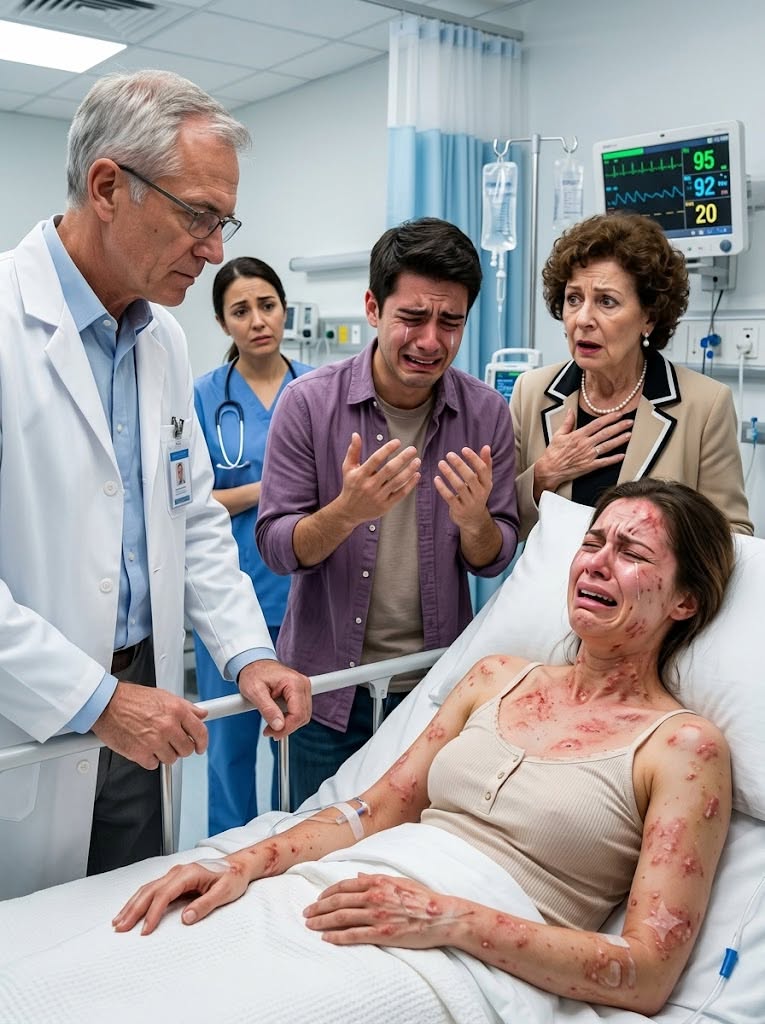
Behind the curtain in the emergency room, I heard my husband, Samuel, speaking to the attending physician.
His voice was calm. Too calm.
He told the doctor I had always been clumsy. He said I had been rushing, that I must have slipped, that his mother had tried to help me. He shaped the story carefully, turning my injuries into my own fault and his mother into a concerned witness.
I lay there listening, unable to believe how easily he could protect the person who had hurt me.
But Samuel had forgotten one important detail.
Dr. Cynthia Stone was on duty that night.
Cynthia had been my college roommate, my closest friend, and one of the few people who had never accepted Samuel’s quiet attempts to make me seem unstable. When she examined me, her expression changed.
The injuries did not match his story.
She did not argue with him in the hallway. She did not warn him.
She simply did what needed to be done.
She contacted Detective David Powell and asked him to come to the hospital.
That was the first thread pulled loose.
For three years, Samuel and Joyce had worked patiently to isolate me.
They monitored my finances. They questioned my memory in front of friends. They corrected my stories, interrupted my decisions, and spoke about me with a kind of soft concern that made others doubt me before they ever asked me what was true.
To outsiders, Samuel looked devoted.
Joyce looked worried.
I looked fragile.
That was the picture they wanted.
But they had underestimated the woman they were trying to erase.
Before my marriage, I had been a high-stakes attorney specializing in complex financial fraud. I knew how deception moved. I knew how people hid money, built false paper trails, and used confusion as a weapon.
Samuel believed that six months earlier, I had signed over control of my family estate to him.
He was wrong.
The documents he held were altered decoys.
The genuine irrevocable trust papers were secured in a Phoenix bank vault, along with digital evidence I had gathered carefully over time: financial records, recordings, messages, altered documents, and proof of the pressure they had placed on me.
I had also prepared for the possibility that they would go further.
A medical directive gave Cynthia access to a sealed blue folder if I was ever incapacitated. Inside were instructions, evidence locations, and the names of authorities to contact.
Some people prepare because they are paranoid.
I prepared because I had learned to believe patterns.
Six months later, the trial began.
Samuel arrived with the same controlled confidence he had worn in the hospital. Joyce sat beside him with her hands folded, dressed like a wounded mother misunderstood by the world.
For a short while, they seemed certain that the same story would save them again.
Then the prosecutor played the kitchen footage.
The courtroom went silent.
The hidden cameras showed what happened clearly. Joyce’s movements. The timing. The deliberate act that caused my injuries. Then Samuel’s words afterward, not frightened, not confused, but calculating how to use my hospitalization to reach the assets he believed were finally within his grasp.
Their confidence collapsed in forty-three minutes.
After that, the rest of the case unfolded with a steadiness they could not interrupt.
An undercover federal investigator testified about Samuel’s laundering of large sums through local charities. Financial records supported it. Bank trails confirmed it. The image he had built as a respectable man was dismantled by the truth he had hidden beneath it.
The jury deliberated for three hours.
Both Samuel and Joyce were convicted on multiple charges, including financial exploitation and conspiracy.
Joyce received fourteen years in state prison.
Samuel received twenty-two.
When the sentences were read, I did not feel the satisfaction people imagine in moments like that.
I felt tired.
I felt grief for the years I had spent defending myself in rooms where no one knew they were watching a slow theft of my life.
But I also felt something steady return.
My name.
My mind.
My future.
One year later, I returned to the same hospital to meet Cynthia.
This time, I walked in without fear.
Together, we discussed the launch of the Ember Project, a support network built with the recovered trust funds. Its purpose was simple: to help people whose injuries had been falsely reported as accidents, especially when abuse and financial control were hidden behind respectable faces.
We offered emergency resources.
Legal representation.
Documentation support.
Safe planning.
The kind of help I had needed before my own life reached the hospital curtain.
My first client was a young woman named Hannah.
Her story was painfully familiar. A controlling partner. Money monitored. Injuries explained away. Friends slowly pushed out of reach. A life being narrowed until escape seemed impossible.
She sat across from me with trembling hands and asked if anyone would believe her.
I told her the truth.
“Some people may not at first. That is why we gather proof. That is why we choose allies carefully. And that is why you do not have to do this alone.”
Her shoulders loosened just a little.
I knew that small movement.
It was the body’s first memory of hope.
I eventually returned to my home, not as a frightened wife trying to keep peace, but as the sole owner of my life again.
The kitchen was rebuilt.
The locks were changed.
The silence in the house no longer felt threatening.
It felt clean.
What happened to me was not made right by punishment alone. Justice mattered, but healing required more than a verdict. It required reclaiming the parts of myself they had tried to make doubtful, helpless, and small.
I found peace by restoring my name.
By protecting my future.
By turning the evidence of my suffering into a doorway for others.
And by understanding, finally, that survival is not only escaping harm.
Sometimes survival is building something strong enough that the next woman does not have to stand alone behind the curtain, waiting for someone to believe her.