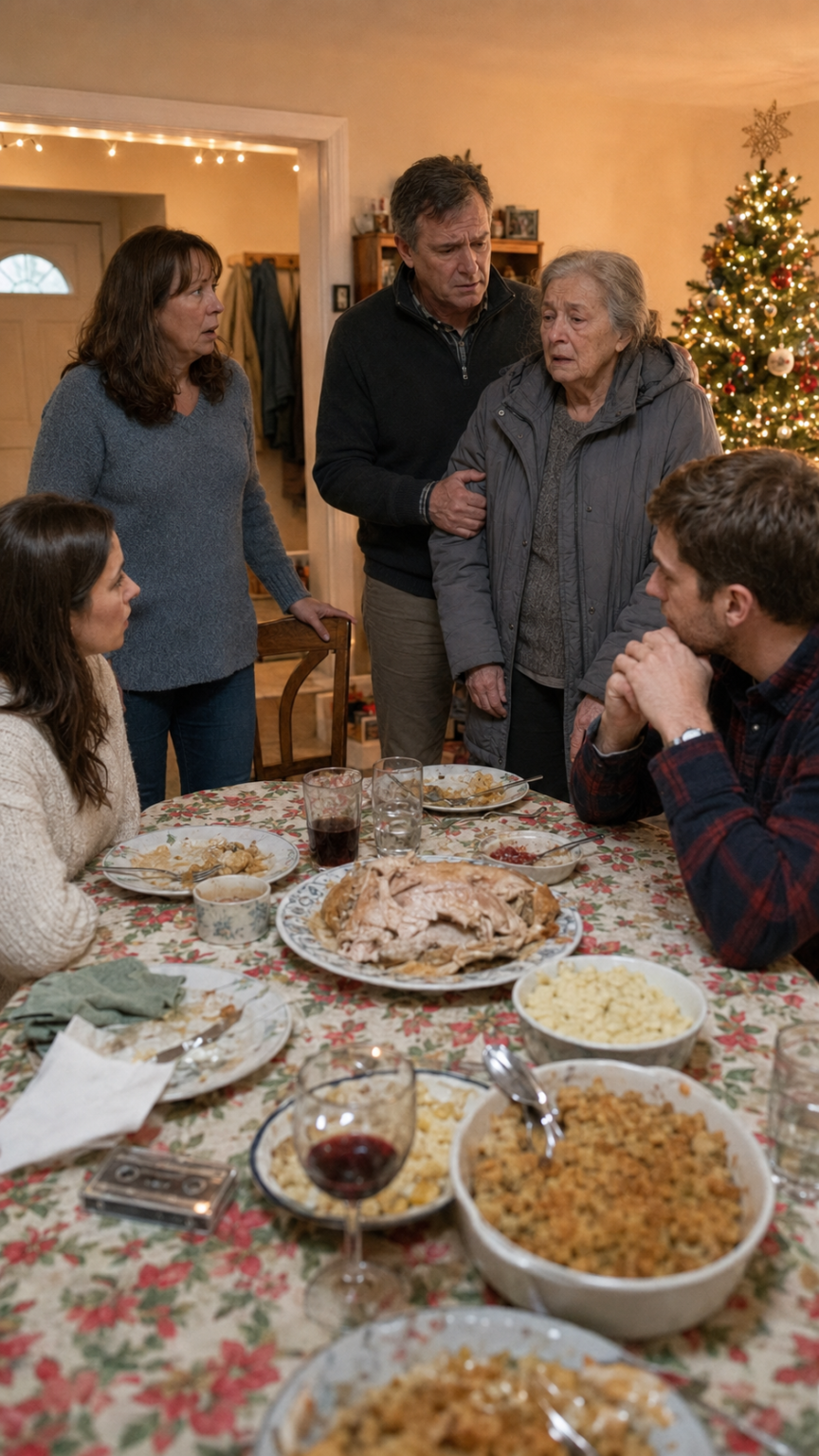
A long pause followed.
I heard my mother breathing shakily.
But Samuel was not Michael’s biological father. I created that lie to protect someone else. I was frightened, selfish, and convinced that silence would save our children. Instead, it destroyed Eleanor’s life.
Michael gripped the back of a chair.
Eleanor closed her eyes.
The tape continued.
Samuel had been hurting me for years. Eleanor knew. She begged me to leave him, but I was terrified he would take Laura away.
My memories of my father were fragments.
His brown coat hanging near the door.
The smell of tobacco.
A loud voice from the kitchen.
My mother locking us inside my bedroom and turning the radio up.
She had told me those memories were dreams.
They weren’t.
On August 14, Samuel followed us to the lake house. Eleanor had brought her infant son because she planned to help me escape that night.
Michael looked at Eleanor.
“You brought me there?”
“You were asleep upstairs,” she whispered.
My mother’s voice trembled through the speaker.
Samuel discovered the train tickets. He attacked me. Eleanor tried to stop him, but he struck her and knocked her unconscious. I reached for the fireplace tool. I only wanted him to stop.
The recording went silent for several seconds.
When Mother spoke again, she was crying.
I hit him once. He fell against the stone hearth. There was so much blood.
I remembered hearing something heavy fall.
For 46 years, I had believed it was thunder.
When Eleanor woke, Samuel was dead. I begged her to take Laura and Michael and run. But before we could leave, my sister arrived.
“Aunt Denise?” I whispered.
Eleanor shook her head.
“Not Denise.”
The recording answered me.
My sister Margaret arrived.
Michael’s face changed.
Margaret was the woman he had always known as his mother.
The woman whose funeral I had attended.
Margaret said she could protect us. She told Eleanor to leave through the back door with the children while she called the police. But Eleanor refused to abandon me.
Eleanor’s hands began shaking.
“She promised we would all tell the truth,” she said.
The recording continued.
Margaret convinced me that if I confessed, Laura would be placed in foster care and I would spend the rest of my life in prison. She told Eleanor that Michael would be taken from her because she had no husband, no money, and no permanent home.
I looked at Michael.
“Margaret was my mother’s sister?”
He nodded faintly.
“I learned that after Eleanor contacted me.”
That meant the woman Michael called his mother had been my aunt.
Michael and I had been raised as strangers even though our families were connected.
But we still did not know who his father was.
The tape crackled again.
Margaret invented the story that Samuel was Michael’s father. She said the police would believe Eleanor killed him after he refused to acknowledge their child. It gave them a motive.
Grace lowered her hands.
“So Grandpa wasn’t Dad’s father.”
“No,” Michael said. “But Margaret made the police believe he was.”
I turned toward Eleanor.
“Why didn’t you tell them the truth?”
“I tried.”
“Then how were you convicted?”
“Because your aunt had evidence.”
The Evidence Margaret Created
Eleanor sat at our Christmas table and told us what happened after my father died.
Margaret called the police before anyone else could.
She claimed she had arrived at the lake house after receiving a frantic phone call from my mother. According to her statement, Eleanor had been threatening Samuel for months because he refused to recognize Michael as his son.
It was a complete invention.
But Margaret supported it with letters supposedly written by Eleanor.
The police found them in Samuel’s car.
“I had never seen those letters,” Eleanor said. “Margaret wrote them.”
“Couldn’t anyone tell the handwriting was different?” Nathan asked.
“This was nearly five decades ago. Handwriting analysis wasn’t performed automatically, and I had written Samuel’s name on an envelope once. Margaret copied it.”
Worse, Eleanor’s fingerprints were found on the fireplace tool.
Of course they were.
She had picked it up after regaining consciousness.
“My mother let you be arrested?” I asked.
Eleanor looked at the floor.
“Patricia was in shock. Margaret kept telling her that if she spoke, you would lose both parents.”
“That doesn’t excuse it.”
“No.”
I looked at Michael.
“And Margaret took you?”
“Not immediately,” he said.
Eleanor was denied bail.
While she waited for trial, Michael was placed temporarily with Margaret because she claimed to be his aunt.
“She wasn’t related to me,” Eleanor explained. “But the authorities believed Samuel was Michael’s father, which made Margaret his aunt through Patricia.”
The lie created the relationship necessary for Margaret to become his guardian.
After Eleanor was convicted, Margaret moved away and raised Michael as her own son.
“What did she tell you?” I asked him.
“That my mother abandoned me. Later, she told me Eleanor had died.”
Eleanor turned toward him.
“I wrote to you every month.”
“I never received anything.”
“I sent birthday cards. Christmas cards. Letters explaining everything.”
Margaret had returned every envelope unopened.
Eventually, prison officials told Eleanor to stop sending them.
I sat down because my legs would no longer support me.
My mother remained silent.
Margaret stole Eleanor’s child.
And Michael grew up believing the thief was his mother.
“Why did Margaret do it?” Grace asked.
No one answered immediately.
Then Eleanor looked at Michael.
“Because she couldn’t have children.”
Michael stared at the Christmas tree.
Every ornament on it carried a memory of his childhood with Margaret. She had taught him to cook, bandaged his knees, attended his graduation, and helped us make the down payment on our first home.
Now we knew that her love had been built on a crime.
“Did she love me at all?” he asked.
Eleanor’s face softened.
“I believe she did.”
“How can you say that?”
“Because terrible people are not always terrible every minute. That is what makes betrayal so difficult to understand.”
Who Was Michael’s Father?
The tape had not ended.
My mother’s voice returned.
Michael’s father was a young teacher named David Lawson. He and Eleanor planned to marry, but David died in a construction accident two months before Michael was born.
Eleanor removed a faded photograph from her handbag.
It showed her as a young woman beside a tall man with Michael’s smile.
She handed it to him.
“His name was David,” she said. “You look exactly like him.”
Michael touched the photograph carefully.
“Why did Margaret choose Samuel?”
“Because Samuel knew David.”
My father had been David Lawson’s employer during the summer when the accident occurred. After David’s death, Samuel helped Eleanor with some of the funeral expenses.
That connection made Margaret’s lie believable.
But my father had never had a relationship with Eleanor.
Michael was not my brother.
Grace and Nathan were not the children of close relatives.
The relief that moved through me was so intense that it hurt.
I held my children while Michael stood across the room staring at the only photograph he had ever seen of his biological father.
Then I remembered the first sentence on the tape.
My mother had killed my father.
Even if she acted to protect herself, she had allowed an innocent woman to take the blame.
“Why didn’t Mother confess later?” I asked.
“She planned to,” Eleanor said.
“When?”
“Several times.”
Eleanor explained that my mother visited her in prison during the first year.
Margaret attended every visit.
She reminded my mother that confessing would send her to prison and leave me without a parent.
Later, when I became older, Mother visited alone.
“She brought the recording,” Eleanor said.
“The one we just heard?”
Eleanor nodded.
“She wanted me to give it to an attorney.”
“Why didn’t you?”
“Because I told her to destroy it.”
I stared at her.
“You could have cleared your name.”
“You were 14. Your mother said you were struggling after changing schools. She said losing her would destroy you.”
“So you sacrificed yourself?”
“I had already lost 12 years. I couldn’t get them back. I didn’t see the purpose in taking your mother away too.”
Anger burned through me.
“That wasn’t your decision to make.”
“No,” Eleanor said. “It wasn’t.”
She reached across the table.
I did not take her hand.
“My entire childhood was based on a lie.”
“So was Michael’s.”
He looked at me.
Neither of us knew which grief deserved attention first.
The Evidence That Reopened the Case
Eight years before that Christmas, my mother died after a short illness.
While cleaning her house, I found no cassette tape, no letters, and no reference to Eleanor.
I now learned that Mother had secretly mailed the recording to Eleanor shortly before her death.
Eleanor submitted it to the prison’s legal office.
Nothing happened.
“The tape was considered an unverified confession from a deceased person,” she explained. “Without physical evidence, prosecutors refused to reopen the case.”
Then, two years earlier, a legal charity began reviewing old convictions involving questionable forensic evidence.
An attorney named Maya Chen took Eleanor’s case.
She located the original letters allegedly written by Eleanor. Modern testing revealed that the paper came from a stationery set produced three years after Eleanor’s arrest.
The letters had been substituted before trial.
Maya also obtained Margaret’s personal diaries from the storage unit Michael inherited after her death.
One entry changed everything.
Patricia will remain silent. Eleanor will be convicted. Michael will be mine, and Laura will never know why her father died.
Michael had never opened the diaries.
Margaret stored them inside a sealed box labeled “church accounts.” He donated most of her belongings after her funeral, but the storage company kept the box because of an unpaid balance.
It remained untouched for nearly 20 years.
The diary, the fraudulent letters, and my mother’s recorded confession persuaded a judge to vacate Eleanor’s conviction.
After 46 years, she walked free.
“Why didn’t you tell me three weeks ago?” I asked Michael.
He looked ashamed.
“When Eleanor contacted me, I thought it was a scam.”
“You met her without telling me?”
“Twice.”
“Where?”
“At her attorney’s office.”
The new betrayal struck differently.
“You knew my mother was connected to this.”
“Not until this afternoon.”
“You still should have told me.”
“I was afraid.”
“Everyone in this story was afraid, Michael. Look what fear did.”
He lowered his eyes.
“You’re right.”
It was the first honest answer anyone had given me that evening.
The Truth About the Christmas Invitation
One question remained.
Why had Michael brought Eleanor to our house without warning me?
He claimed the decision was sudden.
Earlier that day, Eleanor had shown him the photograph of herself with my mother. Michael recognized the lake house from our family albums.
He asked whose cabin it was.
When Eleanor said it belonged to Samuel Reed, Michael finally realized the murdered man was my father.
“I wanted to call you,” he said. “But I couldn’t explain it over the phone.”
“So you brought a convicted murderer into our home?”
“My conviction had been vacated,” Eleanor reminded me gently.
“You were still a stranger to us.”
“Yes.”
Michael looked toward our children.
“I thought we could tell Laura together. I didn’t know Eleanor would bring the tape.”
“I didn’t know Patricia would falsely claim Samuel was Michael’s father on the recording,” Eleanor replied. “She used that lie because she feared someone might hear the first part without listening to the rest.”
Mother had repeated Margaret’s false story before correcting it so the recording would make sense to investigators.
But those few seconds nearly destroyed us.
Christmas dinner remained untouched.
Nobody felt hungry.
Grace eventually heated soup for Eleanor, who admitted she had eaten nothing all day. Nathan found blankets for the guest room.
I watched my children care for a woman they had met only hours earlier.
Despite everything, she was their grandmother.
Michael stood beside the tree, still holding David Lawson’s photograph.
“I don’t expect you to forgive me tonight,” he said.
“I don’t know what I feel.”
“I should have told you immediately.”
“Yes.”
“I thought I was protecting you.”
“That sentence has caused enough damage in this family.”
He nodded.
“No more secrets.”
I wanted to believe him.
But trust is not repaired by a promise made during a crisis. It is rebuilt afterward, through hundreds of ordinary choices.
What Happened After Christmas
Eleanor stayed with us for three weeks.
The first days were uncomfortable.
She woke before everyone else and folded her blankets so neatly that the guest room looked untouched. She asked permission before using the shower. She saved pieces of bread in napkins because prison had taught her never to assume another meal was guaranteed.
Grace began taking her shopping.
Nathan helped her learn to use a smartphone.
Michael kept his distance at first.
He called her Eleanor, never Mom.
She did not correct him.
One afternoon, I found them sitting together at the kitchen table. She was showing him letters she had written during his childhood.
Each envelope had been returned unopened.
Michael read the birthday card she sent when he turned six.
Then he placed his head in his hands and wept.
Eleanor did not touch him until he reached for her.
After that, something slowly changed.
He started asking about David.
Eleanor told him his father loved jazz, hated carrots, and sang badly while repairing things.
Michael laughed.
“I hate carrots.”
“I know,” she said. “You threw them at me when you were a baby.”
It was the first memory they shared.
My relationship with my mother became harder to understand.
She had protected me from an abusive father. She had acted in panic. But she also allowed an innocent woman to lose most of her life.
I could recognize her fear without excusing her silence.
Eleanor eventually received a formal declaration of innocence and compensation from the state.
She used part of the money to purchase a small apartment five minutes from our home.
With the rest, she established a fund providing legal assistance to women convicted after surviving domestic violence.
On the anniversary of her release, we visited my mother’s grave.
I brought the cassette tape.
For years, it represented everything she had hidden.
I considered leaving it at the grave, but Eleanor stopped me.
“Keep it.”
“Why?”
“Because the truth should never be buried again.”
Michael stood beside us holding David’s photograph.
He finally called Eleanor “Mom” that day.
It was not dramatic.
He simply said:
“Mom, are you ready to go?”
Eleanor froze.
Then she smiled.
“Yes, son.”
Our marriage survived, but not because love automatically erased Michael’s secrecy.
We attended counseling. He learned that withholding painful information was not protection. I learned that anger could exist beside compassion without canceling it.
The following Christmas, Eleanor joined us again.
This time, there were no revelations waiting beneath the tree.
Grace gave her a framed photograph from the previous year. Nathan bought her a record player and several jazz albums David had loved.
I gave her a white rose.
It was the same kind Michael had placed on Margaret’s coffin 21 years earlier.
Eleanor held it carefully.
“What is this for?” she asked.
“For everything that was taken from you,” I said. “And for everything you chose not to take from me.”
She understood.
Despite losing her freedom, her son, and nearly half a century, Eleanor had refused to destroy my childhood when she had the chance.
That did not make my mother innocent.
It made Eleanor extraordinary.
We sat around the table and told the truth—even when it was uncomfortable.
Especially then.
Our family had spent decades believing that silence protected children, marriages, and reputations.
In reality, silence protected only the lie.
The truth hurt us when it arrived.
But it also returned a mother to her son, cleared an innocent woman’s name, and taught our family that love built on honesty can survive what love built on secrecy never could.