The morning light filtered through the dusty blinds of Noah’s nursery, stretching pale stripes across a crib that had never held him.
I stood in the doorway, unable to step inside.
Unable to walk away.
Three weeks.
Three weeks since doctors had placed my son in my arms and told me there was nothing more they could do.
Three weeks since I kissed his forehead and memorized every feature of a face I would never watch grow older.
The nursery still looked exactly as it had before I went into labor.
His tiny outfits remained folded on the changing table.
Diapers sat stacked beside unopened wipes.
A stuffed dinosaur waited in the corner.
The stroller remained in its box.
Thomas and I had assembled it once in the hallway.
We laughed while practicing turns around furniture and arguing over which direction the cup holder should face.
Then we packed it away.
Neither of us knew that Noah would never sit in it.
Thomas was gone now, too.
A week earlier, I had walked into our bedroom and found him packing a suitcase.
At first, I thought he was leaving for a few days.
Then I saw the empty hangers.
The dresser drawers.
The travel bag stuffed with clothes.
“You’re really leaving me?”
Thomas froze.
For a second, he looked ashamed.
Then exhaustion settled over his face.
“I can’t stay here anymore.”
The answer hit harder than I expected.
“He was your son.”
“That’s exactly why I can’t do this.”
He zipped the suitcase.
Every sound felt unbearably loud.
“You’re leaving two weeks after we buried him?”
“I’m trying to survive.”
“So am I.”
He rubbed both hands across his face.
“I walk past that nursery and feel like I’m being buried alive.”
I stared at him.
“Do you think I feel any different?”
He didn’t answer.
Because he knew he couldn’t.
I had carried Noah.
I had felt him kick.
I had spent months imagining birthdays, first words, scraped knees, and bedtime stories.
Then all of those futures disappeared in a single day.
“I asked you to pack the nursery,” Thomas said quietly.
“Because I’m not ready.”
“It’s an empty room.”
“It’s his room.”
“No, Kate.”
His voice cracked.
“It’s an empty room, and it’s killing both of us.”
I felt something inside me harden.
“Then leave.”
His eyes widened.
“You mean that?”
“No.”
I swallowed.
“But if seeing his things hurts you so much, then maybe leaving is exactly what you want.”
The silence stretched between us.
Finally, he lifted the suitcase.
At the doorway, he paused.
“I called a realtor.”
The words hit me like a slap.
“What?”
“I think we should sell the house.”
“No.”
“You can’t stay here alone.”
“Watch me.”
He looked at me for a long time.
Then he left.
The front door clicked shut behind him.
And suddenly I was alone.
Not just without Noah.
Without Thomas, too.
That night I sat on the nursery floor.
The mobile above the crib swayed gently from the air vent.
“I’m sorry, baby,” I whispered.
My voice echoed in the room.
“I would have given anything to keep you.”
The next morning I visited Noah’s grave.
Like every visit before it, I sat there far longer than I planned.
When I finally drove away, I took the long route home because the thought of entering that house again made my chest tighten.
That was when I saw her.
A young woman sat on a curb outside a grocery store.
A cardboard sign leaned against her knee.
A baby slept against her chest in a worn carrier.
The straps looked one tug away from breaking.
I parked several rows away.
Then I watched.
Ten minutes passed.
Twenty.
An hour.
She never moved much.
Just adjusted the baby occasionally and stared at traffic.
I should have driven away.
Instead, I went home.
I walked past Noah’s nursery six times.
On the seventh, I opened the door.
The room felt smaller than before.
Quieter.
Like it already knew what I had come to do.
I placed a hand on the back of the nursing chair.
“You’re not coming home.”
The words hurt every bit as much as they had the first time I said them.
“I’ll never get to be your mom the way I wanted.”
My throat tightened.
“But maybe another baby can use your things.”
The mobile shifted slightly.
“I hope you won’t mind.”
Then I started packing.
The diapers.
The blankets.
The bottles.
The tiny outfits.
The unopened stroller.
Every item felt like tearing off another piece of my heart.
By the time I finished, I was shaking.
But I also felt something else.
Relief.
Small.
Fragile.
But real.
When I returned to the grocery store, the woman was still there.
I rolled down the window.
“I brought some things for your baby.”
She immediately shook her head.
“I don’t have money.”
“I’m not selling anything.”
She looked confused.
Then I opened the trunk.
Her expression changed.
First surprise.
Then disbelief.
Then tears.
“I can’t take this.”
“Please do.”
“Ma’am…”
“My name is Kate.”
My voice cracked.
“My son died.”
The words still felt impossible.
“He never got to use any of this.”
The woman covered her mouth.
“I’m so sorry.”
“Please,” I whispered. “Let his things help someone.”
For a moment, neither of us moved.
Then she nodded.
“My name is Elena.”
Together, we unloaded everything.
She touched each item carefully.
Like it was made of glass.
When she saw the stroller, she began crying.
The baby woke and fussed softly.
She lifted him into her arms.
“His name is Mateo.”
I smiled through tears.
“He’s beautiful.”
She looked down at him.
“I keep telling him I’ll do better.”
“You already are.”
Her eyes filled again.
When we finished unloading the car, she grabbed my hand.
“You have no idea what this means.”
Maybe she was right.
Maybe I didn’t.
Because for the first time since Noah died, I felt something besides grief.
Purpose.
That night I ate an actual dinner.
I answered one of my mother’s phone calls.
I watched television.
And for the first time in three weeks, I slept.
Really slept.
I woke before sunrise because someone rang the doorbell.
At first, I thought I was dreaming.
Then it rang again.
Patient.
Almost gentle.
I shuffled to the front door.
Opened it.
And nearly screamed.
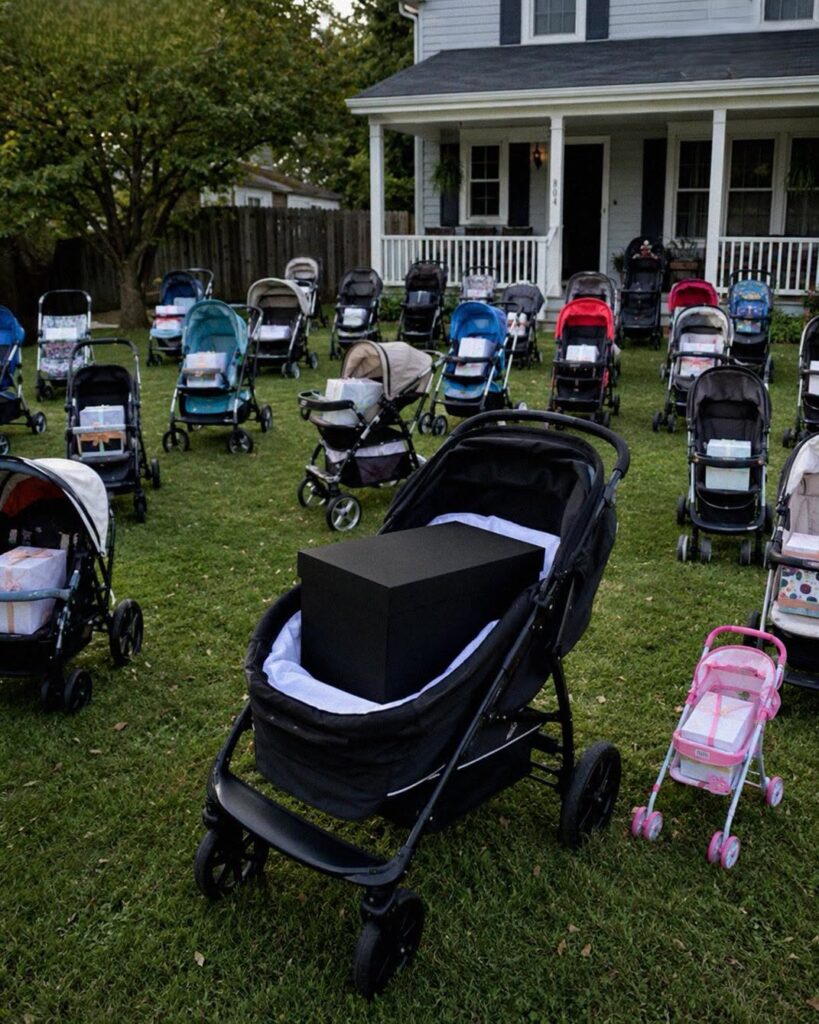
My lawn was covered in strollers.
Dozens of them.
Maybe fifty.
Maybe more.
Rows and rows stretching across the grass.
The early morning dew glittered on their canopies.
No people.
No trucks.
No explanation.
Just strollers.
Silent and waiting.
My pulse hammered.
For one terrible moment, I thought I was losing my mind.
I walked into the yard.
Every stroller contained a box.
Some had envelopes.
Others had folded blankets visible through the openings.
One stroller stood apart from the rest.
It was black.
Larger than all the others.
Inside sat a wooden box with my name written on an envelope resting on top.
My hands trembled.
I opened a different stroller first.
Inside was a baby blanket.
Tiny socks.
A sealed pacifier.
And a letter.
Our daughter Emma lived for nineteen hours. Packing away her things almost destroyed me. Someone once told me that love doesn’t disappear when a child does. It simply needs somewhere else to go.
I opened another.
Our son Owen was stillborn at thirty-eight weeks…
Another.
We lost twins…
Another.
I buried my little girl before she learned to walk…
Each stroller carried a story.
A child.
A loss.
A family.
By the sixth letter, I could barely see through tears.
These weren’t random donations.
They were pieces of broken hearts.
Then I heard car doors.
I turned.
People were arriving.
One by one.
An elderly woman stepped forward.
“Kate?”
I nodded.
“The blue stroller is mine.”
She smiled sadly.
“My grandson never came home from the NICU.”
Another woman pointed toward a pink stroller.
“My daughter lived six weeks.”
A man touched a green stroller.
“My son.”
More people came forward.
Each stroller belonged to someone.
Each box contained things they had never been able to part with.
Until now.
Finally, I asked the question burning inside me.
“Why?”
The elderly woman smiled.
“Yesterday Elena came to our community resource center.”
I immediately recognized the name.
“She told us about a mother who gave away everything she had bought for her son.”
The woman gestured toward the lawn.
“We’re a grief support group.”
My chest tightened.
“Every one of us went home last night and opened a closet we’d been avoiding.”
I looked at the rows of strollers.
The blankets.
The toys.
The tiny clothes.
The letters.
“These aren’t for me?”
“No.”
She shook her head.
“They’re for the next families.”
The next struggling mothers.
The next fathers.
The next babies.
The next people standing where we once stood.
Tears spilled down my cheeks.
Then another car arrived.
Thomas stepped out.
He was carrying a folder.
Probably realtor paperwork.
He froze when he saw the lawn.
“What is this?”
The woman beside me smiled.
“A beginning.”
Thomas looked confused.
Then he looked at me.
Really looked at me.
For the first time since he left.
I saw tears forming in his eyes.
“I came for the papers.”
I nodded.
“I know.”
But neither of us moved.
He stared at the strollers.
The letters.
The people.
The grief that had somehow transformed into generosity.
One stroller at a time.
Finally, I walked to the black stroller.
The crowd fell silent.
I opened the envelope.
Then the wooden box.
Inside was a small plaque.
Nothing else.
Just engraved words.
NOAH’S STROLLERS
When one family is ready to let go, another family should never have to start with nothing.
I burst into tears.
A second letter rested beneath the plaque.
Kate,
This morning your kindness became something bigger than any of us.
Every stroller on this lawn will be donated to a family struggling to care for a child.
Every parent who eventually finds the strength to pass their baby’s things forward will add another stroller.
We hope one day there are hundreds.
We thought the project deserved a name.
Thank you for giving us one.
For several seconds, I couldn’t speak.
I simply stared at the plaque.
Three weeks earlier, I had left the hospital carrying an empty car seat.
Three weeks earlier, I thought Noah’s story had ended before it even began.
Now dozens of families stood in my yard because of him.
Not because he lived long.
Because he was loved.
And love had moved forward.
From me.
To Elena.
From Elena.
To strangers.
From strangers.
To families none of us had met yet.
I placed my hand on the plaque.
“My little boy,” I whispered.
The morning breeze moved gently through the strollers.
For the first time since his death, I didn’t feel like I was standing at the end of something.
I felt like I was standing at the beginning.
Tears ran down my face.
“You finally came home.”
And somehow, surrounded by all those strollers, all those stories, and all those parents carrying the same invisible ache, it felt true.