Mason.
The first Orbeez rolled across the patio when I opened the back door.
It was bright blue, smooth, and no larger than a marble.
It bumped against the toe of my slipper and stopped.
For a second, I stared at it without understanding.
Then I looked up.
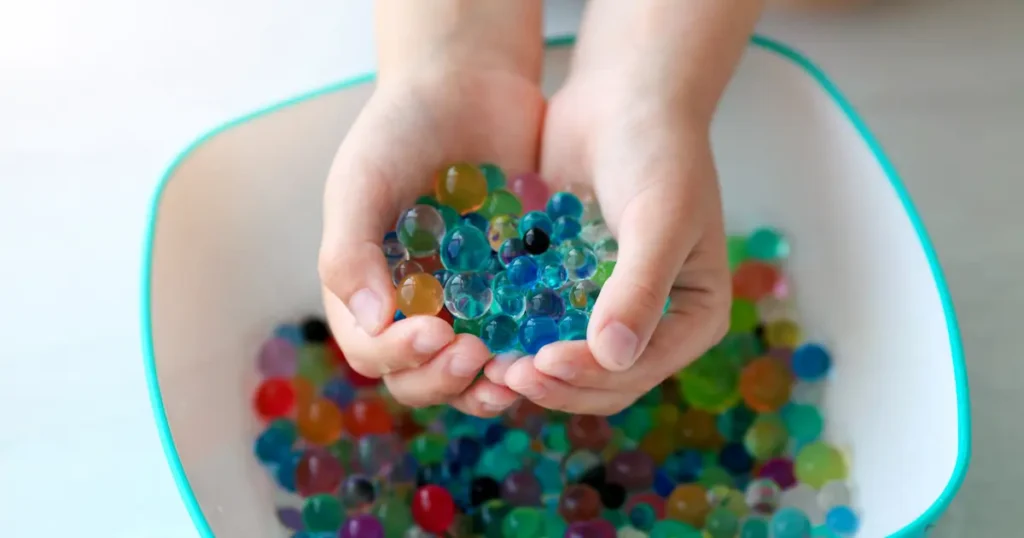
Every inch of our swimming pool had disappeared beneath millions of swollen water beads.
Blue.
Red.
Yellow.
Green.
Purple.
They floated so tightly together that the surface looked solid, like a strange mosaic laid over the water during the night.
I stood frozen in the doorway.
The morning was quiet except for birds in the maple tree and the soft clicking of the beads against the pool tiles.
Then I saw the shape beneath them.
Large.
Rectangular.
Resting at the deepest point of the pool.
Its edges were too straight to be fallen furniture or storm debris.
Someone had put it there.
My fingers tightened around the doorframe.
“Carmelo.”
My voice came out as a whisper.
I tried again.
“Carmelo!”
He entered the kitchen carrying two mugs of coffee.
“What happened?”
I pointed toward the pool.
One mug slipped from his hand and struck the counter.
It did not break, but coffee splashed beneath the toaster and dripped onto the floor.
Neither of us moved to clean it.
Carmelo stepped past me and onto the patio.
The Orbeez shifted gently as the morning breeze crossed the pool, thousands of tiny beads rolling against one another with a faint sound like rain tapping glass.
He stared at the object below them.
“Was that there last night?”
“No.”
“You’re sure?”
“I covered the pool at nine.”
His eyes moved toward the fence.
The cover was folded neatly beside it.
Someone had removed it.
That frightened me more than the beads.
Children climbing into the yard might have damaged the cover or left it floating in the water.
This had been done carefully.
Someone had entered our property, removed the cover, filled the pool with millions of Orbeez, lowered a large object into the deepest section, and then left without waking us.
They had come prepared.
Carmelo walked toward the pool net.
“Don’t touch anything,” I said.
His hand stopped halfway to the handle.
He turned toward me.
I could hear my own breathing, shallow and uneven.
There was only one person who had ever begged us to fill the pool with Orbeez.
Our son.
Mason used to ask every summer.
He loved dropping the tiny dry beads into bowls of water and returning hours later to find them swollen and shining.
When he was six, he decided that each color had a purpose.
Blue ones were for people who felt lonely.
Yellow ones were for birthdays.
Red ones were for emergencies.
Purple ones were for wishes that were too embarrassing to say aloud.
He never explained green.
Whenever I asked, he would cup the beads in his hands and whisper, “Those are private.”
Three unopened boxes of Orbeez still sat on a shelf in our garage.
I had never been able to throw them away.
Carmelo looked at me.
He knew where my thoughts had gone.
“Abby, this doesn’t mean—”
“I know.”
The answer came too quickly.
I did not know anything.
Three years earlier, Mason had vanished during the town’s summer festival.
Vanished.
That was the word people used.
As though a child could simply turn into air.
The park had been crowded that afternoon.
Food trucks lined the grass.
A local band played near the fountain.
Children ran between booths with painted faces, balloon animals, and paper crowns.
Mason had held my hand until we reached the ring-toss game.
He wanted the yellow plastic shovel hanging among the prizes.
He already owned three shovels at home, but this one had a red handle, and according to him, that made it completely different.
He missed the first two throws.
Then someone bumped hard into my shoulder.
I turned for less than a second.
When I looked down, Mason’s hand was gone.
At first, I thought he had stepped behind me.
Then I checked under the game table.
I called his name.
I walked toward the nearest booth.
One minute passed.
Then five.
Then ten.
By sunset, the entire town was searching.
Police officers blocked the roads.
Volunteers walked through the park calling his name.
By midnight, helicopters circled overhead while search teams moved through fields, ditches, creek beds, abandoned buildings, and wooded trails.
For three weeks, they searched.
They found a child’s sneaker that did not belong to him.
A red jacket that belonged to another family.
A broken toy near the creek.
Nothing connected to Mason.
No clothing.
No footprints.
No witness who had seen exactly where he went.
No answer.
The pool became the hardest place in our home after he disappeared.
It was where Mason learned to swim.
He had shouted, “Watch me!” before every jump, even when I was already watching.
He would climb from the water, run three steps despite being told not to, and leap back in before Carmelo could stop him.
After Mason disappeared, Carmelo drained the pool.
For almost a month, it sat empty.
The exposed concrete looked like a grave.
I finally begged him to fill it again.
The water was painful.
But the emptiness was worse.
Now the pool was filled with color.
And something waited beneath it.
Carmelo picked up the net.
“We need to see what it is.”
“We should call the police.”
“What are we going to tell them? That someone put beads in the pool?”
“There is a box under them.”
“We don’t know that.”
“You saw it.”
He looked again at the shape.
Then he nodded.
“You’re right.”
But before reaching for his phone, he lowered the net once.
The Orbeez slid away in thick clusters.
For a moment, a dark corner appeared beneath the water.
Then the beads rolled back into place.
Carmelo tried again.
Each scoop came up heavy and glistening.
We began emptying the beads into anything we could find.
Plastic storage tubs.
Buckets.
Flowerpots.
A wheelbarrow.
Even the large recycling bin.
It took nearly twenty minutes to clear a patch no wider than a serving tray.
The object remained distorted beneath the water.
Box-shaped.
Transparent in places.
Carmelo worked faster.
I carried the full containers away from the pool edge.
A blue bead clung to my wrist.
For one unbearable second, I remembered Mason pressing one into my palm.
“This one’s for you, Mommy, in case you get lonely.”
I brushed the bead away.
It rolled across the patio and disappeared beneath a chair.
“Stop,” Carmelo said.
I turned.
He had cleared enough beads to expose one corner of the object.
Acrylic.
Thick.
Sealed.
The case was larger than a coffee table and appeared to be weighted at its base.
Something had been arranged inside it, but the layers of water and moving beads distorted the contents.
Carmelo leaned over the edge.
Then he went completely still.
“What do you see?”
He did not answer.
“Carmelo?”
His hand moved slowly toward his pocket.
He took out his phone.
“Call the police,” he said.
“What is it?”
He pointed through the water.
At first, I saw only pale, shifting shapes.
Then the Orbeez separated.
Something yellow flashed beneath them.
Small.
Plastic.
A handle.
My fingers closed around the pool rail.
Mason had owned a yellow shovel.
He carried it everywhere that final summer.
To the beach.
Into the backyard.
To the park.
And to the festival.
The police had listed it among the items missing with him.
A small yellow plastic shovel with a crack near the grip.
Carmelo called 911.
His voice remained controlled until the dispatcher asked what was inside the submerged case.
Then he looked at me.
“I don’t know,” he said. “But I think it contains something belonging to our missing son.”
The first police car entered our street seven minutes later.
The officer asked us to step away from the pool.
Another photographed the removed cover, the scattered Orbeez, the containers we had filled, and the footprints around the patio.
A third officer checked the gate.
There was no broken lock.
No damaged fence.
Whoever had entered knew how to reach over and lift the latch from outside.
Neighbors gathered behind curtains and hedges.
Someone across the street began recording until an officer ordered them to stop.
Detective Rios arrived last.
He had led the original investigation into Mason’s disappearance.
I had not seen him in almost a year, but he still looked at me the same way.
Carefully.
As though every sentence might break something.
“Abby.”
I pointed toward the deep end.
“The shovel.”
He crouched beside the pool.
For a long moment, he studied the object.
“Can you confirm that it’s Mason’s from here?”
Carmelo shook his head.
“Not completely. But the crack looks right.”
Rios called for the fire department’s water rescue team.
While we waited, officers searched the yard.
One found wheel marks in the soft ground near the side gate.
Another found torn plastic packaging behind the hedge.
The bags were large, industrial-sized containers of water beads.
There were no names or receipts.
Nothing explained who had brought them.
Nothing explained why.
The rescue team entered the pool at 10:17 that morning.
Two divers cleared the remaining beads from the acrylic case while another secured straps around the weighted base.
The object rose slowly.
Water poured from its sides.
The Orbeez rolled away in bright waves.
The case was transparent and perfectly sealed.
Inside were drawings.
Dozens at first.
Then hundreds.
There were folded letters, friendship bracelets, origami birds, small toys, and handmade cards.
A stuffed dinosaur with one missing eye.
A baseball card.
A paper crown from the summer festival.
And resting across the top of everything was a small yellow shovel.
The crack near the handle faced me.
My knees gave way.
Carmelo caught my arm and lowered me onto the patio step.
No one spoke.
Not the police.
Not the firefighters.
Not even the neighbors watching from behind the fence.
The case was lowered onto a blue evidence tarp.
Detective Rios knelt beside it.
A bundle of letters near the top had been tied with string.
A paper label hung from it.
Rios read the words.
“What does it say?” I asked.
He looked toward another officer.
“Call the community center. Ask for the festival director.”
“What does it say?”
He hesitated.
Then he read it aloud.
“For Mason. From the children who remember.”
The case remained sealed while the officers photographed it from every angle.
Everything had to be documented.
Every surface examined.
Every object logged.
Procedure.
That was the word they used.
I sat beside the pool while Orbeez drifted into the corners like pieces of a celebration no one had explained.
At 11:12, a silver car stopped beside our curb.
A woman stepped out wearing mismatched shoes and a cardigan buttoned incorrectly.
I recognized her immediately.
Mrs. Lewis.
She had directed the town community center for nearly fifteen years and had organized the summer festival the year Mason disappeared.
She entered the yard, saw the acrylic case, and covered her mouth with both hands.
“Oh no.”
Detective Rios met her near the gate.
“Do you recognize this?”
She nodded.
Her eyes moved toward me.
“I know what was inside it.”
That was not the same as saying she knew who had placed it in our pool.
Rios noticed the difference.
“What do you mean, inside?”
Mrs. Lewis looked toward the scattered Orbeez.
“I didn’t know anyone was bringing it here.”
Carmelo stepped closer.
“Bringing what?”
She pressed her fingers against her lips.
For a few seconds, she seemed to be trying to decide which truth to tell first.
Then she looked directly at me.
“The town has been keeping something from you for three years.”
The mystery became larger than the pool.
Mrs. Lewis sat beside me on the patio step.
The sealed case remained in front of us while officers moved through the yard.
“For the first few weeks after Mason disappeared, children left things at the festival memorial,” she said.
I looked through the acrylic wall.
Crayon drawings.
Bracelets made from yarn.
Folded paper animals.
“There was a table near the fountain,” she continued. “We thought we would keep everything there until the search ended.”
Her hands tightened together.
“But the search never ended the way anyone hoped.”
When the temporary memorial was removed, the community center stored everything.
No one could bear to throw the items away.
“Why didn’t you tell us?”
She lowered her eyes.
“At first, everyone thought seeing it would hurt you.”
I looked toward the case.
“It does.”
“I know.”
“Then why put it in our pool?”
“I didn’t.”
She glanced toward Detective Rios.
“Every summer, children kept bringing more.”
The festival returned each year.
It was never the same.
Music played again.
Booths reopened.
Families came back.
Children who remembered Mason grew older.
Children who had only heard his story began leaving objects too.
One letter.
One drawing.
One bead.
One toy at a time.
“We never organized it,” Mrs. Lewis said. “The children simply started doing it.”
Beside the memorial box at the community center, volunteers placed a glass bowl.
Children began dropping Orbeez into it because someone remembered how much Mason had loved them.
A blue bead for loneliness.
A yellow one for remembrance.
A red one for hope that the police would find something.
And green ones for wishes they wanted to keep private.
For three years, the bowl filled.
Then it overflowed.
More containers were added.
Eventually, there were millions of beads stored in sealed bags at the center.
“Who moved everything?” Detective Rios asked.
Mrs. Lewis looked toward the ground.
“A group of volunteers wanted to return the memorial before this year’s festival.”
“Return it where?”
“To Abby and Carmelo.”
Carmelo looked around the ruined patio.
“So they filled our pool?”
“They thought the water beads would make it meaningful.”
“Meaningful?”
His voice rose.
“They entered our yard in the middle of the night and made us think our son was lying at the bottom of the pool.”
Mrs. Lewis flinched.
“They did not understand how it would look.”
“How could they not?”
“I told them we needed permission. Some agreed. Others thought leaving it quietly would be kinder.”
“Kinder than knocking on the door?”
She had no answer.
Detective Rios said the volunteers would be identified and questioned.
Their intentions might not have been malicious, but entering private property and damaging the pool were still serious matters.
At noon, the exterior of the case was cleared.
An officer removed the seal while another recorded every movement.
The yellow shovel slid forward when the lid lifted.
I reached for it.
Detective Rios looked at me, then nodded.
I took the shovel in both hands.
For three years, I had imagined it lying somewhere in the park.
Buried beneath leaves.
Washed into a storm drain.
Hidden in the trunk of a stranger’s car.
Instead, someone had found it and preserved it.
“Where did this come from?” I asked.
Mrs. Lewis wiped her eyes.
“A volunteer found it near the fountain the morning after Mason disappeared.”
My head snapped toward her.
“You had something belonging to him?”
“The police examined it.”
Detective Rios confirmed it.
The shovel had been found within the original search area.
It had been processed for fingerprints and trace evidence.
Nothing useful was recovered.
After the investigation no longer needed it, it had accidentally remained with the memorial materials rather than being returned to us.
The mistake had been buried beneath staff changes, storage boxes, and years of silence.
“You should have told us,” Carmelo said.
“Yes,” Mrs. Lewis whispered.
Under the shovel were letters.
I opened the first.
It had been written in thick purple marker.
Dear Mason,
Thank you for sharing your crayons when mine broke.
Another read:
You told me freckles were tiny stars.
A third child had written:
You let me win the beanbag game because I was crying.
The handwriting changed from letter to letter.
Some names I recognized.
Most I did not.
Carmelo opened a small envelope written by a volunteer firefighter.
Your son helped me hand out water bottles for twenty minutes. He made a difficult day feel lighter.
Carmelo read it twice.
“He was only with him for twenty minutes.”
I touched his arm.
“Apparently, that was enough.”
Mrs. Lewis removed a photograph from near the bottom of the case.
It had been taken minutes before Mason disappeared.
He stood beside the festival fountain laughing.
The yellow shovel was in one hand.
Several children surrounded a plastic tub filled with Orbeez.
On the back, someone had written:
He made sure every child found the brightest one.
I closed my eyes.
For three years, every memory of that day ended with my empty hand.
I remembered the bump against my shoulder.
The space beside me.
The panic.
The shouting.
The helicopters.
The darkness.
Now, for the first time, I had been given a moment from before.
Mason laughing.
Mason sharing.
Mason noticing another child who needed help.
I had known him as my son.
The town had known him as the little boy who made room for everyone.
Near the bottom of the case was a small notebook.
Its pages contained names, dates, and short memories collected by children and families.
One entry had been written by a girl named Riley.
Mason saw me crying because I lost my mother. He gave me a blue Orbeez and said it was for lonely people. I still have it.
Another child wrote:
Mason told me green ones were private wishes. Mine was that he would come home.
I had to stop reading.
Carmelo sat beside me on the patio and pressed his forehead against mine.
For three years, we had lived inside the worst moment of Mason’s life.
We had allowed the disappearance to swallow every memory that came before it.
The case did not explain where he had gone.
It did not solve the investigation.
It did not bring him home.
But it returned pieces of him we had not known were missing.
By late afternoon, police had documented every item.
No immediate arrests were made.
The volunteers responsible for moving the case agreed to cooperate, cover the damage, and provide statements.
Detective Rios described their actions as dangerously misguided.
Not cruel.
Not malicious.
But not harmless.
Intention did not erase the terror they had caused.
The Orbeez took hours to remove.
They clogged the skimmers, filled the drains, and rolled beneath every piece of patio furniture.
By evening, most of the pool water was visible again.
Carmelo carried the acrylic case into the house.
I remained by the shallow end with Mason’s yellow shovel resting across my knees.
One bright blue Orbeez floated near the steps.
I reached for the skimmer.
Then stopped.
I bent down and lifted the bead with my fingers.
Blue ones were for people who felt lonely.
I placed it inside the yellow shovel.
It rolled toward the cracked corner and stayed there.
Then I carried both inside.
Mason’s framed photograph stood on the mantel.
He was seven in the picture, missing one front tooth and smiling as though he had just remembered a secret.
I placed the shovel beside it.
The following morning, we went to the community center.
The volunteers who had entered our yard were waiting.
There were four of them.
Two were parents whose children had known Mason.
One was a former festival worker.
The youngest was a twenty-one-year-old woman named Riley.
I recognized her name from the notebook.
She held a small glass jar.
Inside was one blue Orbeez.
“I’m sorry,” she said.
Her hands shook.
“This was my idea.”
Carmelo stood beside me with his arms crossed.
“Why?”
Riley looked at the floor.
“Mason gave me this bead the day he disappeared.”
She held up the jar.
“My mother had died that spring. I was nine. I was crying behind one of the booths, and he sat beside me.”
Her voice broke.
“He told me blue ones were for lonely people. Then he said I could keep it until I didn’t need it anymore.”
I stared at the bead.
“Why didn’t you come to us?”
“I was a child. Later, everyone said not to upset you.”
That phrase again.
Not to upset us.
People had hidden memories, objects, and pieces of our son because they were afraid of our grief.
As though grief became lighter when kept ignorant.
Riley wiped her cheek.
“This year, I thought the memorial belonged with you. We wanted it to look beautiful. We knew Mason loved the pool and the Orbeez. We thought you would come outside and understand.”
“We thought there was a body in the water,” Carmelo said.
Riley closed her eyes.
“I know.”
“You did not knock.”
“No.”
“You entered our home.”
“Yes.”
“You took away our choice.”
“Yes.”
She did not defend herself.
That mattered.
“I am sorry,” she repeated. “I wanted to give something back. I did not understand that I was creating another nightmare.”
I did not forgive her immediately.
Forgiveness offered too quickly can become another way of avoiding pain.
But I listened.
Over the next several weeks, the town helped repair the pool.
The community center created a formal archive of the memorial items, with our permission.
Every letter and drawing was scanned.
The originals remained with us.
Detective Rios reopened several old witness interviews after reviewing photographs from the memorial collection.
One picture showed the edge of a man’s jacket near the ring-toss booth.
Another captured part of a vehicle that had not been included in the original investigation.
The images did not solve Mason’s disappearance.
But for the first time in nearly a year, the case moved again.
Hope returned carefully.
Not as certainty.
As movement.
That summer, Carmelo and I attended the festival for the first time since Mason vanished.
I almost turned back at the entrance.
The music sounded too familiar.
The smell of fried dough made my chest tighten.
Then Riley approached carrying a glass bowl.
Inside were Orbeez of every color.
She did not hand it to me.
She waited.
“May we place this near the fountain?” she asked.
The question mattered more than she understood.
I looked at Carmelo.
He nodded.
“Yes,” I said. “But this time, put up a sign.”
The sign read:
Choose a color. Leave a memory. Keep a private wish.
Children came throughout the afternoon.
Some wrote letters.
Some drew pictures.
Some dropped beads into the bowl.
A little boy chose blue.
A girl selected yellow.
One child held a green bead in his closed fist for several seconds, then slipped it into the water without telling anyone why.
I stood beside the fountain holding Mason’s yellow shovel.
For years, I had believed remembering meant returning again and again to the moment he disappeared.
Now I understood that memory could also move backward.
To the boy before the search posters.
Before the police tape.
Before his face became a photograph strangers shared online.
The boy who gave lonely children blue beads.
The boy who called freckles stars.
The boy who let another child win because she had been crying.
The boy who made sure everyone found the brightest one.
That night, Carmelo and I sat beside the repaired pool.
One blue Orbeez floated near the shallow steps.
We had placed it there intentionally.
“Do you want me to take it out?” he asked.
“No.”
The bead moved gently across the water.
For three years, the pool had represented everything we had lost.
Now it held one small thing Mason had given back.
Not an answer.
Not yet.
But a memory.
Sometimes grief makes every unknown shape look like the worst thing we can imagine.
Sometimes love arrives carelessly and causes pain before revealing what it meant to carry.
The people who filled our pool had made a terrible choice.
But inside the case they left behind were hundreds of reminders that Mason’s life had reached beyond the moment he vanished.
He had existed fully before he became missing.
He had been seen.
He had been remembered.
He had been loved.
I watched the blue bead drift beneath the patio light.
Then I said the name Carmelo and I had never stopped saying.
“Mason.”
This time, it did not sound only like loss.
It sounded like our son.