Then I would remember.
The silence that followed was always worse.
Grief was not the only thing waiting for me each morning.
There were electricity bills, mortgage notices, insurance forms, medical expenses, and envelopes from companies I had never spoken to before Daniel died.
When he was alive, we divided responsibilities without discussing them much.
He handled the larger payments.
I managed groceries, appointments, and daily expenses.
After his funeral, everything became mine.
Every decision.
Every form.
Every unexpected cost.
Every fear.
I spent hours at the kitchen table surrounded by paperwork, trying to understand how a life could be reduced to account numbers and due dates.
Some nights, I added the figures three or four times because I kept hoping the total would somehow become smaller.
It never did.
The only other person living in the house was my nineteen-year-old stepson, Leo.
Daniel had been raising him alone when we met.
Leo was six years old then, skinny and cautious, with large brown eyes that seemed to study everything before deciding whether it was safe.
I never asked him to call me Mom.
I told him he could use my first name, Miriam.
For nearly a year, he did.
Then one afternoon, he fell from his bicycle and scraped both knees. I carried him inside, cleaned the cuts, and held an ice pack against his swollen wrist.
He began crying and called me Mom without noticing.
Neither of us mentioned it.
He simply kept using the word.
By the time Daniel and I married, Leo was already mine in every way that mattered.
At least, I believed he was.
After Daniel’s death, however, something changed between us.
Leo grew quiet.
He spent more time away from home.
He picked up extra shifts at the hardware store and sometimes returned long after dinner.
When I asked where he had been, he usually shrugged and said, “Working.”
I assumed he was avoiding the house because it reminded him of his father.
I understood that.
The house reminded me too.
But while Leo disappeared into work and silence, I remained behind with the bills.
At first, I tried not to involve him.
He was only nineteen.
He had community college classes, an old car that needed constant repairs, and a future he had not yet begun to build.
Daniel had always said he wanted Leo to finish school before worrying about rent.
So I told myself I could manage.
I canceled the streaming services.
I lowered the thermostat.
I stopped buying anything that was not necessary.
I sold several pieces of furniture from the guest room and told Leo I wanted more space.
The truth was that I needed the money for property taxes.
Still, the numbers continued moving in the wrong direction.
One evening, I opened an envelope and discovered that our homeowners insurance had increased again.
I sat at the kitchen table staring at the notice until the words blurred.
Leo entered through the back door carrying a paper bag of fast food.
He looked tired but cheerful.
“Hey, Mom.”
I looked at the bag.
“You bought dinner?”
“Just a burger.”
“We have food here.”
“I know.”
“Then why are you spending money on takeout?”
His smile faded.
“It was six dollars.”
“Six dollars matters.”
He placed the bag on the counter.
“Okay.”
Something in his tone sounded dismissive.
Perhaps it was not.
But grief had turned me into someone who heard rejection in every pause.
I pushed the insurance notice toward him.
“This went up again.”
Leo glanced at it.
“That’s rough.”
“That’s all you have to say?”
He looked confused.
“What do you want me to say?”
“I want you to understand what is happening in this house.”
“I do understand.”
“No, you don’t. You leave in the morning, come home whenever you want, eat, sleep, and go back out. You have no idea how close we are to losing control of everything.”
His expression changed.
“Losing control?”
“The mortgage. Insurance. Utilities. Your father’s medical bills.”
“I thought some of that was covered.”
“Some of it was. Not all.”
He pulled out a chair.
“Why didn’t you tell me?”
“I am telling you now.”
My voice sounded sharper than I intended.
Leo waited.
I took a breath.
“I need you to start contributing.”
He blinked.
“To the bills?”
“Yes.”
“How much?”
“I don’t know yet. Something reasonable.”
A strange sound escaped him.
It was brief, almost like a laugh.
I stared at him.
“Do you think this is funny?”
His face immediately tightened.
“No.”
“You laughed.”
“I didn’t mean—”
“You think I enjoy asking you for money?”
“Mom, wait.”
“I have spent months trying to keep this house together while you walk around as if nothing has changed.”
“That isn’t true.”
“Then explain what is true.”
He opened his mouth.
Then closed it.
That hesitation broke something in me.
I had been frightened for months.
Frightened of debt.
Frightened of losing the house.
Frightened that I had failed Daniel.
Now the fear found someone to blame.
“You are nineteen years old,” I said. “You are not a child anymore. If you are going to live here, you need to help.”
“I was going to.”
“When?”
“Soon.”
“Soon does not pay the electricity bill.”
He rubbed a hand over his face.
“Can we talk about this tomorrow?”
“No. We are talking now.”
“I’m tired.”
“So am I.”
He stood.
“I don’t want to argue.”
“That must be convenient.”
He looked at me with an expression I had never seen before.
It was not anger.
It was hurt.
But I was too overwhelmed to recognize it.
“If I am such a burden,” he said quietly, “maybe I should leave.”
The sentence felt like a threat.
“Maybe you should.”
The moment the words left my mouth, I wanted them back.
Leo froze.
I could have apologized immediately.
I should have.
Instead, pride and pain held me still.
He nodded once.
“Fine.”
He walked down the hallway and closed his bedroom door.
An hour later, I heard drawers opening and closing.
Then the front door shut.
I ran to the window.
Leo crossed the driveway carrying a backpack.
He climbed into his car and drove away.
I told myself he would return after cooling down.
He did not.
I slept badly that night.
At least, I tried to sleep.
Every sound made me open my eyes.
I imagined Daniel beside me, disappointed by what I had done.
I argued with him silently.
You left me with all of this.
Then I hated myself for thinking it.
Daniel had not chosen to die.
By morning, anger had returned because it was easier to carry than guilt.
I made coffee and checked my phone.
No message from Leo.
I called once.
It went to voicemail.
I did not leave a message.
I convinced myself that he needed to learn responsibility.
I told myself that I had been too generous.
Too patient.
Too willing to protect him from reality.
Still, the house felt wrong without him.
Around noon, I went into his room.
I told myself I was checking whether he had taken everything.
The bed was unmade.
A sweatshirt hung over the desk chair.
Several textbooks remained stacked near the window.
On the dresser stood a framed photograph of Daniel, Leo, and me taken during our last trip to the lake.
Daniel stood between us, laughing at something outside the frame.
I sat on the edge of the bed.
The anger began slipping away.
Leo had lost his father too.
I knew that.
But knowing something and making space for it are not always the same.
As I stood, my foot struck something beneath the bed.
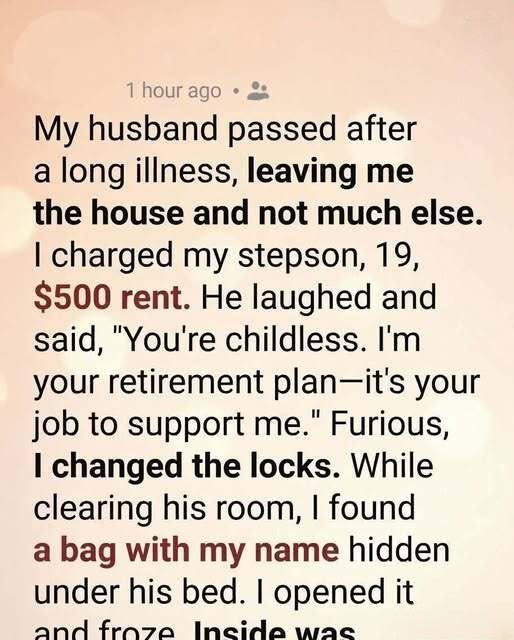
A canvas bag had been pushed far underneath.
I bent down and pulled it out.
It was old and faded, the kind of bag Daniel used to carry documents to work.
I hesitated before opening it.
Part of me knew I was invading Leo’s privacy.
Another part feared it might contain something important.
I unzipped it.
Inside were several envelopes, a bank savings book, and a folded letter.
I opened the savings book first.
The account had been created almost three years earlier.
There were dozens of deposits.
Fifty dollars.
Seventy-five.
One hundred and twenty.
Small amounts added regularly.
The entries continued month after month.
Many were made after Daniel became ill.
More followed after his death.
The current balance made my breath catch.
Leo had saved nearly eighteen thousand dollars.
I stared at the figure.
For a nineteen-year-old working part-time, it was an enormous amount.
At first, I assumed he was saving for tuition or a car.
Then I saw the handwritten label on the inside cover.
Mom’s Future Security Fund.
My hands began trembling.
I read the words again.
There had to be another explanation.
Perhaps “Mom” referred to someone else.
But there was no one else.
I reached for the envelopes.
One contained printed information about mortgage refinancing.
Another held estimates for roof repairs.
A third contained brochures from local retirement advisers.
Leo had highlighted several sentences about emergency savings, survivor benefits, and housing stability.
Beneath them was a list written in his handwriting.
Pay off overdue medical balance.
Cover one year of property taxes.
Fix leaking roof before winter.
Make sure Mom never has to sell the house because of me.
I covered my mouth.
The room blurred.
Beside the savings book was the folded letter.
My name was written across the front.
Mom.
Underneath, in smaller letters, Leo had written:
For your birthday. Do not open early.
My birthday was two weeks away.
I opened it anyway.
Mom,
I know things have been bad since Dad died.
I also know you think I don’t notice because I don’t ask many questions.
The truth is that I notice everything.
I notice when you turn the heat down and wear two sweaters.
I notice when you say you already ate even though there is only enough food for me.
I notice when bills disappear from the table because you do not want me to worry.
Dad told me before he died that you would try to carry everything alone.
He made me promise not to let you.
I started saving before he got really sick.
At first, I wanted to surprise both of you by paying for a family trip.
Then the hospital bills came.
After Dad died, I changed the plan.
I have been working extra shifts and putting most of the money away.
I wanted to give it to you on your birthday.
It is not enough to solve everything, but I hope it helps.
You did not have to become my mother, but you did.
You chose me every day.
I want you to know that I choose you too.
I am not going anywhere.
Love,
Leo
I read the letter once.
Then again.
By the third time, I could no longer see the page.
The sound Leo had made the night before replayed in my mind.
That brief, nervous laugh.
It had not been mockery.
It had been panic.
He had been trying to protect a surprise while I accused him of ignoring me.
When he said he had been planning to help soon, he had been telling the truth.
And I had told him to leave.
I pressed the letter against my chest and began sobbing.
Not the quiet tears I had grown used to after Daniel’s death.
These were deep, painful sounds that seemed to come from somewhere beneath my ribs.
I had spent months believing I was alone.
Meanwhile, Leo had been working late, saving every spare dollar, and carrying his own grief in silence.
He had not been avoiding the house.
He had been trying to save it.
I called him immediately.
Voicemail.
This time, I left a message.
“Leo, please call me. I found the bag. I know I should not have opened it, but I did. I was wrong. I am so sorry. Please come home.”
I sent another message.
Then another.
Hours passed.
Each one made my fear worse.
What if he had decided not to return?
What if my words had destroyed something we could not repair?
By late afternoon, I heard a car outside.
I rushed to the porch.
Leo stepped from an old sedan I did not recognize.
One of his coworkers was driving.
He had the same backpack over one shoulder.
When he saw me waiting, he stopped.
I held the canvas bag in both hands.
His face changed.
“You found it.”
“Yes.”
“You read the letter?”
“I did.”
He looked away.
“It was supposed to be a surprise.”
“I know.”
For several seconds, neither of us moved.
Then I walked down the steps.
“I am sorry.”
He stared at the driveway.
“I shouldn’t have laughed.”
“You were nervous.”
“I didn’t know how to explain without ruining it.”
“I should have given you the chance.”
He finally looked at me.
“You told me to leave.”
The words were quiet.
They hurt more than if he had shouted.
“I know.”
“Did you mean it?”
“No.”
“Then why did you say it?”
I held the bag tighter.
“Because I was frightened, exhausted, and angry at your father for dying.”
Leo’s eyes filled.
I continued before shame could stop me.
“I could not admit I was angry at him, so I became angry at the person standing in front of me.”
He swallowed.
“I’m angry at him too.”
The confession surprised both of us.
Leo wiped his face with the back of his hand.
“He promised he would be at my graduation.”
“I know.”
“He told me we had time.”
“I know.”
“I keep thinking that if I had noticed how sick he was earlier, maybe—”
“No.”
I stepped closer.
“That was not your responsibility.”
“He told me to take care of you.”
“And I think I turned that into another burden for you.”
He shook his head.
“It wasn’t a burden.”
“You are nineteen. You should not have felt responsible for saving my future.”
“You saved mine.”
The words broke whatever distance remained between us.
I put down the bag and wrapped my arms around him.
For a moment, he stood rigidly.
Then he held me.
We cried on the driveway as neighbors passed and pretended not to notice.
Neither of us cared.
Later, we sat at the kitchen table with the savings book between us.
The same table where we had argued the night before.
This time, neither of us raised our voice.
Leo explained that Daniel had spoken to him privately during the final weeks of his illness.
He had not asked Leo to become the man of the house.
He had told him something simpler.
“Do not let grief convince either of you that you are alone.”
Leo admitted that he had failed to understand the advice.
He had hidden his plans because he wanted to protect me.
I had hidden the bills because I wanted to protect him.
We had both been suffering quietly, believing silence was an act of love.
Instead, it created distance.
“I don’t want all your savings,” I told him.
“It’s for you.”
“It is also your money. You worked for it.”
“I want to help.”
“And I will let you. But not by taking everything.”
We agreed to use part of the fund to pay the most urgent medical balance and bring the property taxes current.
The rest would remain in Leo’s name for school and emergencies.
He also began contributing a small amount toward groceries each month.
Not because I demanded it.
Because we discussed what he could realistically afford.
I showed him the bills.
He showed me his income.
For the first time since Daniel died, the problems became shared facts instead of private fears.
The following week, we met with a financial adviser.
We learned that I was eligible for benefits I had not applied for.
We refinanced one portion of the mortgage and arranged a payment plan for the remaining medical debt.
Nothing was magically fixed.
But the weight became manageable once I stopped carrying it alone.
On my birthday, Leo gave me the letter properly.
He placed it inside a simple wooden frame.
At the bottom, beneath his signature, he added one more sentence.
Dad was right. We still have each other.
I keep that letter on the shelf beside Daniel’s photograph.
The canvas bag remains in Leo’s closet, but it is no longer hidden.
Sometimes grief makes people suspicious of love.
It convinces us that every silence is rejection, every mistake is betrayal, and every person who cannot read our pain has chosen not to care.
I looked at Leo and saw a careless boy refusing responsibility.
The truth was that he had been carrying more responsibility than I ever wanted for him.
He looked at me and saw a strong woman who could survive anything.
The truth was that I was barely holding myself together.
We had both mistaken silence for strength.
We do not do that anymore.
When the bills arrive, we open them together.
When one of us misses Daniel, we say his name.
When anger appears, we ask what fear is hiding beneath it.
Our home is still filled with memories.
Daniel’s coffee mug remains in the cabinet.
His roses still bloom outside the kitchen window.
Some evenings, the silence still feels heavy.
But it no longer feels empty.
Leo and I understand now that we were never two people abandoned inside the same house.
We were a family grieving in separate rooms.
All we needed was the courage to open the door.