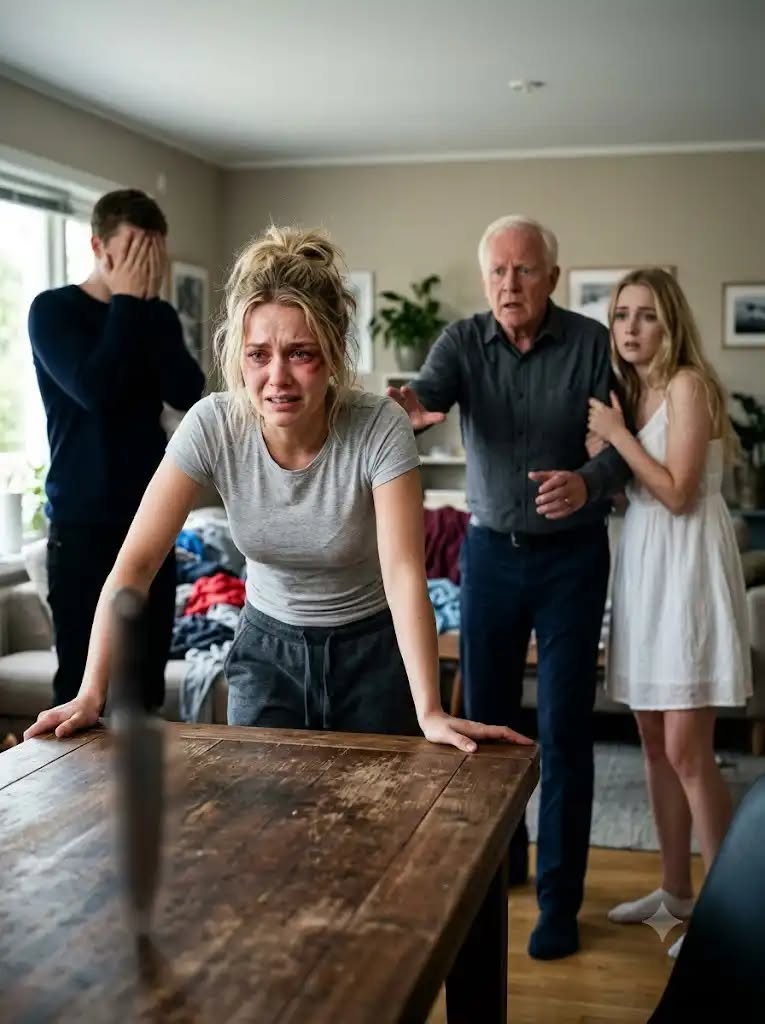
I refused.
Not rudely. Not dramatically. I simply told them that I was Ryan’s wife, not their servant, and that respect would need to exist in both directions.
Brenda’s face hardened. Megan scoffed. Then Charles, Ryan’s father, stepped in and crossed a line that could not be softened or explained away. His anger became physical, and in that moment, whatever fragile hope I had for peace in that family broke completely.
I looked at Ryan.
He did not defend me.
He looked away.
Then he blamed me for making things worse.
There are moments when love asks for patience. There are also moments when dignity asks you to leave.
I chose dignity.
I packed my belongings and walked out of that house. By the next morning, I was preparing to file for divorce. I was grateful for one thing: a small living room camera I had bought earlier had recorded the entire encounter.
That recording became important during the divorce.
It allowed me to secure a quiet settlement and require a formal apology from Megan. It did not erase what had happened, but it kept the truth from being reshaped into something more convenient for them.
While packing the last of my things from the apartment Ryan and I had shared, I found an old wooden box hidden at the back of a closet.
Inside was a photograph from 1998.
Ryan was a child in the picture, standing beside a man named Arthur.
There was also a letter.
It was written from Arthur to Charles, and the truth inside it changed everything we thought we knew about Ryan’s life. Arthur was Ryan’s biological father. Before he died, he had left behind five hundred gold coins buried in Flagstaff, meant to provide for his son.
But Ryan had never received them.
According to the letter and the documents tucked beneath it, Charles and Brenda had taken the inheritance for themselves. They had used the wealth to fund their own comfort while raising Ryan to believe he was a financial burden they had generously endured.
It was a cruel kind of theft.
Not only of money, but of identity.
I could have thrown the box aside and told myself Ryan was no longer my responsibility. Part of me wanted to. He had failed me when I needed him most.
But the truth did not belong to me to hide.
So I gave him the box.
Ryan sat for a long time without speaking. I watched the weight of the years settle over him: the criticism, the guilt, the feeling of always owing people who had already taken what was his.
Then he hired attorney Rachel Eaton.
Rachel began tracing the stolen inheritance with patience and precision. She found an old jeweler named Samuel, who confirmed that Charles had sold him gold coins between 1998 and 1999. More records followed. Property purchases. Land transfers. Houses bought with money that should have belonged to Ryan. Assets later moved into Megan’s name to keep them out of reach.
The story that had held Ryan captive for twenty-seven years began to collapse under the evidence.
With financial records, witness statements, and a recorded confession from Charles and Brenda, Ryan took them to court.
The judge ruled in his favor.
Properties were ordered returned. Stolen wealth had to be restored. Charles and Brenda faced serious legal consequences for the deception they had carried for most of Ryan’s life.
It was justice, but not the kind that heals everything at once.
Ryan had recovered money, yes. But he had also lost the story he had been given about his own childhood. He had to face the painful truth that the people who raised him had used him, lied to him, and trained him to feel grateful for what they had stolen.
In time, he used part of the recovered funds to create a charity in Arthur’s name.
It helped children who had been denied security by the adults meant to protect them. That choice mattered. Ryan could not change what had been done to him, but he could decide that the inheritance would finally become something clean.
He eventually moved to a quiet beach town and began again.
I did too.
I built a life far from that house in Phoenix. Later, I married a kind architect named Justin, a man whose strength did not need to announce itself by overpowering anyone. We had a daughter, Stella, and I learned that peace in a home is not silence. It is safety.
Five years after that first confrontation, I saw Megan again.
She was working an honest job and trying, slowly, to become someone different from the person she had been. I did not forget what she had done, but I could see that life had humbled her.
Brenda, on the other hand, had lost nearly everything. The wealth she had taken, the image she had guarded, the control she had confused with importance — none of it had lasted.
Looking back, I do not think freedom came from the court ruling alone.
It began the day I walked out.
It began when I stopped trying to make mistreatment more understandable than it was. It began when I accepted that love cannot survive where respect is absent, and family does not become sacred by demanding silence from the person being harmed.
Ryan found the truth about his father.
I found the truth about my own worth.
And in different ways, we both learned that walking away from cruelty is not failure.
Sometimes it is the first honest step toward a life that no longer has to be built around someone else’s deceit.