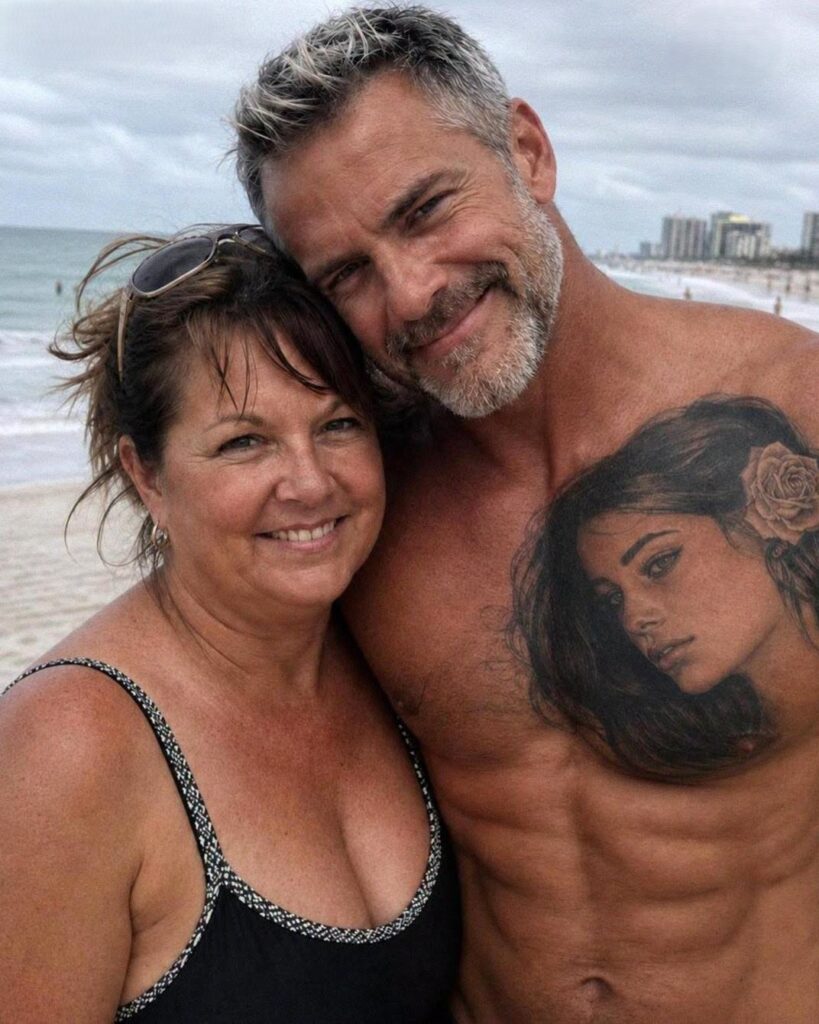
Then I saw the woman.
She was younger than the face tattooed across Richard’s chest, but there was no question that it was her.
The same dark eyes.
The same long hair falling over one shoulder.
The same tiny rose tucked behind her left ear.
But it was what she held in her arms that made my knees give way.
A newborn baby wrapped inside a cream-colored blanket.
Claire’s blanket.
The blanket our daughter had been wearing the day Richard and I brought her home from the hospital.
I lowered myself onto the cold concrete floor because my legs had stopped cooperating.
Rain tapped against the garage roof. The air smelled of sawdust, motor oil, and damp earth drifting through the half-open door.
For several seconds, I could hear nothing except my own breathing.
Then I turned the photograph over.
Richard’s handwriting covered the back.
Six words.
Forgive me, Rose. She can’t know.
I read them once.
Then again.
My hands began to shake.
Twenty years earlier, during the second night of our honeymoon, Richard had stepped out of the hotel bathroom with a towel wrapped around his waist.
That was the first time I had seen the tattoo clearly.
A young woman’s portrait covered the left side of his chest, directly above his heart.
She was beautiful.
Not glamorous or dramatic, but unforgettable.
Her expression was gentle and sad, as though she knew something the rest of us did not.
A small rose rested behind her ear.
“Who is she?” I asked.
Richard glanced down at the tattoo as if he had forgotten it existed.
“Nobody.”
I laughed because I thought he was joking.
“Nobody gets tattooed over your heart, Richie.”
He pulled on a shirt and smiled.
“The artist invented her. I was nineteen and stupid. I asked him to draw someone beautiful.”
“Why the rose?”
“He liked roses.”
I should have asked more questions.
But we were newly married, deeply in love, and still inside that fragile period when suspicion felt like betrayal.
So I believed him.
Or at least I decided to.
I carried that explanation through five failed fertility treatments.
Through years of injections, surgeries, blood tests, and waiting rooms filled with women who avoided looking at one another.
I held onto it the afternoon a doctor gently told us that another treatment would probably cause more damage than hope.
Richard held my hand as I cried in the parking lot.
“We’ll still be a family,” he promised.
And we were.
Six months later, an adoption agency called.
A premature baby girl had been abandoned after birth.
She had spent months in neonatal care and was finally strong enough to leave the hospital.
Richard and I arrived terrified.
Claire was tiny, angry, and wrapped in a cream-colored blanket with a faded satin border.
She had dark eyes and a stubborn cry.
The first time I held her, her hand closed around my finger, and something inside me settled into place.
I stopped caring how she had come to us.
She was ours.
At least, that was what I believed.
Now, twenty years later, I was sitting on the garage floor staring at a photograph of the woman from Richard’s tattoo holding our daughter before I ever knew she existed.
I searched the toolbox with frantic hands.
Beneath a tray filled with screws and drill bits, I found an old black address book.
Its spine was cracked. Most of the names had been crossed out.
One had not.
Rose.
A phone number was written beside it.
I carried the photograph and address book into the house.
Richard was expected home in less than an hour.
I considered waiting for him.
I imagined placing the picture on the kitchen table and asking him to explain everything.
But the words on the back stopped me.
She can’t know.
Who was she?
Me?
Claire?
Both of us?
I lifted the landline receiver and dialed before fear could stop me.
The phone rang five times.
Then a woman answered.
“Hello?”
Her voice was older than I expected.
Soft.
Cautious.
I could not speak.
“Hello?” she repeated.
Silence stretched between us.
Then her breathing changed.
“Richard?” she whispered.
She recognized our number.
“Is that really you?”
My fingers tightened around the receiver.
“This isn’t Richard.”
There was a pause.
“It’s his wife.”
Something touched a hard surface on her end of the line, perhaps a coffee cup or glass.
Then the woman began crying.
Not loudly.
It sounded like the kind of crying someone does after holding everything inside for far too long.
“You found me,” she said. “I thought this day would never come.”
My stomach twisted.
“Who are you?”
She inhaled sharply.
“My name is Rose.”
“I know your name.”
Another silence.
“What does Claire have to do with you?”
Her breathing slowed.
“I can’t tell you over the phone.”
“You can tell me right now.”
“No.”
Her voice remained gentle, but firm.
“Some truths should not arrive without a face attached to them.”
“You have been tattooed on my husband’s chest for twenty years. Your photograph was hidden in his toolbox. You are holding my daughter in it. I think I have earned an answer.”
“You have.”
“Then give me one.”
“I will. In person.”
Rose gave me the address of a diner in the next town.
I hung up, took the photograph, and drove away before Richard came home.
The rain had become heavier.
My hands shook so badly that I missed the correct exit twice.
Every possible explanation competed inside my mind.
An affair.
A secret child.
A stolen adoption.
Had Richard known Claire’s birth mother?
Had Rose given birth to her?
Had my husband arranged the adoption without telling me?
Had I spent twenty years raising another woman’s baby while sleeping beside the man who had deceived us both?
By the time I reached the diner, I felt sick.
Rose was already there.
She sat in the last booth near the window with both hands wrapped around a coffee cup.
Her hair had gone silver, but I recognized her immediately.
The tattoo had not captured every detail.
It had not shown the fine lines around her mouth or the slight bend in her shoulders.
But it was unquestionably her.
She stood when she saw me.
“You’re Evelyn.”
“And you’re the woman on my husband’s chest.”
Her fingers tightened around the cup.
I slid into the booth and placed the photograph between us.
“What is this?”
Rose looked at it.
Her shoulders dropped, not from fear, but from something that looked almost like relief.
Before she could answer, the bell above the diner door rang.
Richard walked in.
He saw me first.
Then Rose.
His face went white.
He did not look like a man who had been caught with a lover.
He looked like a man who had finally reached the end of a promise.
Rose rose halfway from the booth, then sat again.
“I called him,” she told me.
I looked at Richard.
“You followed me?”
“She told me where you were.”
He remained beside the table, his coat dripping onto the floor.
Rose looked at him.
“Did you keep it?”
Richard reached into his wallet.
“Every day.”
He removed a folded piece of paper.
The creases were worn nearly transparent.
He placed it beside the photograph.
Rose did not touch it.
I unfolded the note.
Promise me she’ll always grow up believing she was wanted. Never make her feel like someone gave her away.
I read the words twice.
Then I looked from Rose to Richard.
“Who is she?”
Neither answered.
The waitress approached carrying a coffeepot, took one look at our faces, and quietly turned away.
“Richard.”
He sat beside me, leaving several inches of space between us.
His gaze remained fixed on the note.
“Claire,” he said.
Her name landed gently.
But inside me, everything shifted.
I turned to Rose.
“Is Claire your daughter?”
“No.”
The answer came from Richard immediately.
“Is she your daughter?”
Rose looked toward the rain-streaked window.
“No.”
“Then why are you holding her?”
Richard rubbed his thumb across the edge of the note.
“Because Rose was one of Claire’s nurses.”
For several seconds, the explanation did not fit anywhere inside the story I had already constructed.
“A nurse?”
Rose stared into her coffee.
“Claire was born more than ten weeks early,” she said. “She spent almost four months in the neonatal unit.”
“I know.”
“You know what the agency told you.”
“They said she had been abandoned shortly after birth.”
Rose’s spoon clicked softly against the saucer.
“No one came back for her,” she whispered.
The diner seemed suddenly louder.
Cutlery struck plates.
A chair scraped across the floor.
A child laughed near the entrance.
But inside our booth, the world narrowed to Rose’s voice.
“She was barely three pounds when she arrived,” she continued. “She could only wrap two fingers around the tip of mine.”
Her expression softened.
“She hated the monitoring leads. She would work one foot out of her blanket no matter how carefully we tucked her in.”
I remembered that habit.
Claire had done it for years.
Even as a toddler, she slept with one bare foot poking out from beneath the covers.
“The other nurses called her stubborn,” Rose said.
“What did you call her?”
“Determined.”
I looked at the photograph again.
Rose was not looking at the camera.
She was staring down at Claire with an expression I recognized immediately.
I had worn the same expression during night feedings.
During fevers.
During long car rides when Claire fell asleep against my shoulder and I was too afraid to move.
“Why were you holding her?”
Rose placed the cup down.
“Because babies need to be held, even when nobody has arrived for them yet.”
Some of the anger left me.
Not all of it.
“Were you assigned to her?”
“At first.”
“And after that?”
“I volunteered.”
Richard unfolded the old note and smoothed it against the table.
“Rose sang to her during procedures,” he said. “She read beside the incubator. She celebrated every ounce Claire gained.”
Rose looked uncomfortable.
“Anyone would have done it.”
“No,” Richard said quietly. “Not everyone did.”
Rose had been working nights at the hospital while caring for her terminally ill mother during the day.
She lived in a small one-bedroom apartment.
Her savings were disappearing into medication, transportation, and rent.
When Claire became eligible for adoption, Rose asked whether she could apply.
“I thought loving her would be enough,” she said.
Her eyes remained on the window.
“It wasn’t.”
The social worker had explained that Rose lacked the financial stability, space, and support system required for a medically fragile infant.
“You tried to adopt Claire?”
“Yes.”
“Why didn’t anyone tell us?”
“You were the approved parents. My application never got far enough to matter.”
“It mattered to you.”
Rose’s mouth tightened.
“It mattered more than I knew how to survive.”
I looked at Richard.
“How did you meet her?”
“The day we brought Claire home.”
Memory returned slowly.
The neonatal unit.
Pale green walls.
A carrier placed on a table.
Claire sleeping beneath a knitted hat.
A nurse adjusting the blanket around her.
Someone saying she liked humming.
Someone warning us she would kick one foot free if she became too warm.
A woman had stood near the doorway after the final papers were signed.
I remembered her only as a shape.
I had been too focused on Claire to study anyone else’s face.
“That was you,” I said.
Rose nodded.
“I couldn’t stay.”
“Why?”
“Because you were becoming her mother.”
Her gaze met mine.
“And I had already taken up enough space in that room.”
Richard touched the note.
“She gave this to me in the hallway.”
“Why you?”
“Because you were holding Claire,” Rose said. “Richard was carrying the bags. I thought he could hide it more easily.”
I almost laughed at the terrible simplicity of that explanation.
Instead, I looked at my husband.
“She asked you to make Claire feel wanted, and you decided that meant lying to me?”
His jaw tightened.
“I told myself she was too young to understand the story.”
“Claire was too young. I wasn’t.”
“I know.”
“Then a year passed?”
“Yes.”
“And another?”
“Yes.”
“Until twenty years passed.”
Richard lowered his eyes.
“I was afraid that telling you would make you question whether Claire was truly ours.”
“You thought I would feel threatened by a nurse who loved an abandoned baby?”
“At first.”
“And later?”
“Later, I was ashamed that I had waited.”
Rose turned toward him.
“You should have told her.”
“I know.”
He did not defend himself.
That silence was the first honest thing he had given me since I found the photograph.
I pointed toward his chest.
“Why is her face tattooed over your heart?”
Rose looked down.
Richard placed one hand against the portrait hidden beneath his shirt.
“The day Claire came home, Rose gave me two things.”
“The note and the blanket?” I asked.
“The blanket and a drawing.”
Rose closed her eyes briefly.
“Another nurse sketched me during a night shift,” she explained. “I was sitting beside Claire’s incubator.”
“What were you doing?”
“Reading.”
“What book?”
A small smile appeared on her face.
“Goodnight Moon.”
Of course it was.
Claire had demanded that story every night until she was six years old.
Richard and I could still recite most of it without opening the cover.
“In the sketch,” Richard said, “Rose was sitting beside the incubator. You could barely see Claire. Just one foot sticking out of the blanket.”
He looked at Rose.
“On the back, she had written, ‘Someone loved her before you found her. Now love her forever.’”
I pressed my fingertips against the table.
“So you tattooed her portrait on your chest.”
“Not because I was in love with Rose.”
“You lied about her existence.”
“Yes.”
The admission was quiet.
Unprotected.
“When Claire had no parent beside her, Rose showed up,” he said. “I never wanted to forget that our family began before we entered the room.”
“You wanted to remember her while making sure Claire and I never knew she existed.”
His face tightened.
“I understand how wrong that was.”
“Do you?”
“Yes.”
Rose reached beside her and lifted a canvas bag.
From inside, she pulled the cream-colored blanket.
My breath caught.
The satin border had faded almost white.
A small stain remained near one edge.
A loose thread hung from the corner Claire had rubbed between her fingers whenever she was tired.
“Why do you have that?” I asked.
“Richard brought it to me last week,” Rose said. “He wanted me to repair the corner before Claire’s birthday.”
I lifted the blanket.
Near the hem was a tiny embroidered rose.
I had washed that blanket hundreds of times.
I had wrapped Claire in it during fevers.
Packed it for vacations.
Placed it over her knees on the night she left for college.
I had noticed the flower.
But I had never asked who stitched it.
“One corner kept fraying in the hospital,” Rose said. “I fixed it during my break.”
Her finger hovered over the embroidery.
“I wanted to leave something small enough not to interfere.”
The bell above the diner door rang again.
Claire walked in.
Richard had texted her from the parking lot, telling her only that we needed to speak.
She spotted us in the last booth.
Then she saw the blanket in my hands and stopped.
“Why do you have that, Mom?”
She approached slowly.
Her eyes moved from me to Richard, then toward Rose.
“Mom? Dad?”
I placed the photograph in front of her.
Claire stared at it.
“That’s my blanket.”
“Yes.”
She looked at Rose.
Rose placed both hands flat against the table.
They were no longer trembling.
“I was one of your nurses,” she said. “When you were very small.”
Claire’s lips parted.
No words came.
“You kicked one foot free every night,” Rose continued. “You slept best when someone hummed. And you gained three ounces the week before you left, so we celebrated with terrible cupcakes from the vending machine.”
Claire touched the embroidered flower.
“You made this?”
Rose nodded.
“Why?”
The diner seemed to quiet around the question.
Rose waited several seconds before answering.
“Because I got to love you first.”
Her voice cracked.
“Your parents got to love you forever.”
Claire’s hand stopped over the stitching.
Then she stood.
She moved around the table and wrapped both arms around Rose.
Rose remained still for half a second.
It was as though she had spent twenty years teaching herself not to reach for the child she could not keep.
Then her arms closed around Claire.
She held her carefully at first.
Then desperately.
Claire cried against her shoulder.
Rose whispered something I could not hear.
Perhaps Claire’s name.
Perhaps a prayer.
Perhaps the words she had been waiting two decades to say.
When Claire finally sat down, she reached toward Richard and touched his shirt over his heart.
“The tattoo,” she said.
“It’s Rose.”
Richard covered her hand with his.
“Yes.”
“Why didn’t you ever tell me?”
He looked at her with tears in his eyes.
“Because I made a promise to make sure you never felt abandoned. And somewhere along the way, I confused protecting you with hiding the truth.”
Claire pulled her hand away.
“You should have trusted us.”
“Yes.”
She looked at Rose.
Then back at Richard.
“Did you see her all these years?”
“No,” Rose answered before he could. “Not like that.”
Richard nodded.
“We exchanged a card once a year. I sent a photograph and a few sentences telling her you were healthy.”
“You sent her pictures of me?”
“One each year.”
Claire absorbed that slowly.
“Why didn’t you let her meet me?”
Richard had no answer that could repair twenty years.
Rose answered instead.
“Because I asked him not to.”
We all looked at her.
“I was afraid,” she said. “I told myself you had a family and I had no right to interfere. Every year I thought I would be ready. Every year I convinced myself staying away was the kinder choice.”
Claire wiped her eyes.
“Was it?”
Rose’s face broke.
“No.”
Claire reached across the table and took her hand.
Every family has someone history almost forgets.
Richard had once told Claire that when she asked about the tattoo as a child.
At the time, he claimed the woman represented an imaginary ancestor.
Now the words finally made sense.
Rose had nearly disappeared from our family’s story, not because she had not mattered, but because the people who remembered her had been too afraid to speak.
That evening, I sat alone at our dining room table with Claire’s baby blanket spread before me.
Richard stood in the doorway.
He did not ask whether I forgave him.
He understood that a secret could begin with compassion and still become a betrayal.
“You should have told me,” I said.
“I know.”
“You made me feel foolish every time I asked about that tattoo.”
“I know.”
“You let me believe she was imaginary.”
“Yes.”
I looked down at the small embroidered rose.
“Did you love her?”
Richard did not answer immediately.
“I loved what she did for Claire,” he said. “I loved that when our daughter had nobody, Rose refused to let her feel alone.”
“That isn’t what I asked.”
He stepped closer but did not sit.
“No. I was never in love with her.”
I believed him.
But belief did not erase the lie.
“I don’t know what happens to us now,” I said.
“I understand.”
“I need time.”
“You can have all the time you need.”
The next few weeks were difficult.
Claire visited Rose often.
At first, I worried the relationship would threaten my place in her life.
Then I hated myself for feeling that way.
But motherhood is not a clean, noble emotion at every moment.
Sometimes love is mixed with fear.
Sometimes gratitude stands beside jealousy.
Sometimes the heart needs time to understand that another person’s love does not reduce its own.
Rose never tried to call herself Claire’s mother.
She never asked Claire to choose.
She answered questions carefully.
She shared memories from the hospital.
The songs she sang.
The tiny socks Claire kicked off.
The first day she breathed without assistance.
Claire learned that her earliest months had not been an empty space.
Someone had celebrated her long before she came home with us.
Several months later, the four of us returned to the hospital.
The neonatal unit had been renovated, but one of the older nurses still remembered Rose.
She brought out a binder filled with photographs from past reunions.
Inside was another image of Rose seated beside Claire’s incubator.
A book rested open in her hands.
One tiny foot protruded from beneath the blanket.
Claire laughed when she saw it.
Then she cried.
I stood beside her and wrapped an arm around her shoulders.
Rose remained on her other side.
For the first time, the arrangement did not frighten me.
It felt complete.
Richard later removed none of the tattoo.
But beneath Rose’s portrait, he added a short line in small lettering.
Someone loved her before we found her.
This time, he showed me the design before the appointment.
He asked whether I thought it was right.
I told him the sentence needed one more word.
Someone loved her before we found her too.
Because Rose’s love had not ended when ours began.
And ours did not become less meaningful because hers came first.
For twenty years, I believed Richard carried another woman over his heart.
In one sense, I had been right.
But she was not a secret lover.
She was a nurse who had held a premature baby when no parent was there to do it.
A woman who tried to adopt her and lost.
A woman who stitched a tiny rose into a blanket because it was the only part of herself she believed she was allowed to leave behind.
Richard had carried her sacrifice.
Claire had carried her stitching.
And without knowing it, I had carried the life she helped protect.
I folded the cream blanket carefully and placed it inside Claire’s keepsake box.
My fingers paused over the embroidered flower.
For years, it had looked like a simple decoration.
Now I understood that it marked the beginning of our family.
Not the beginning recorded on adoption papers.
The earlier beginning.
The one inside a neonatal unit where a lonely woman sat beside an incubator, reading Goodnight Moon to a baby she already knew she could not keep.
A baby who had never truly been abandoned.
Because before Richard and I found Claire, Rose had already made sure she was loved.