That day, he brought Simon’s old blue shovel.
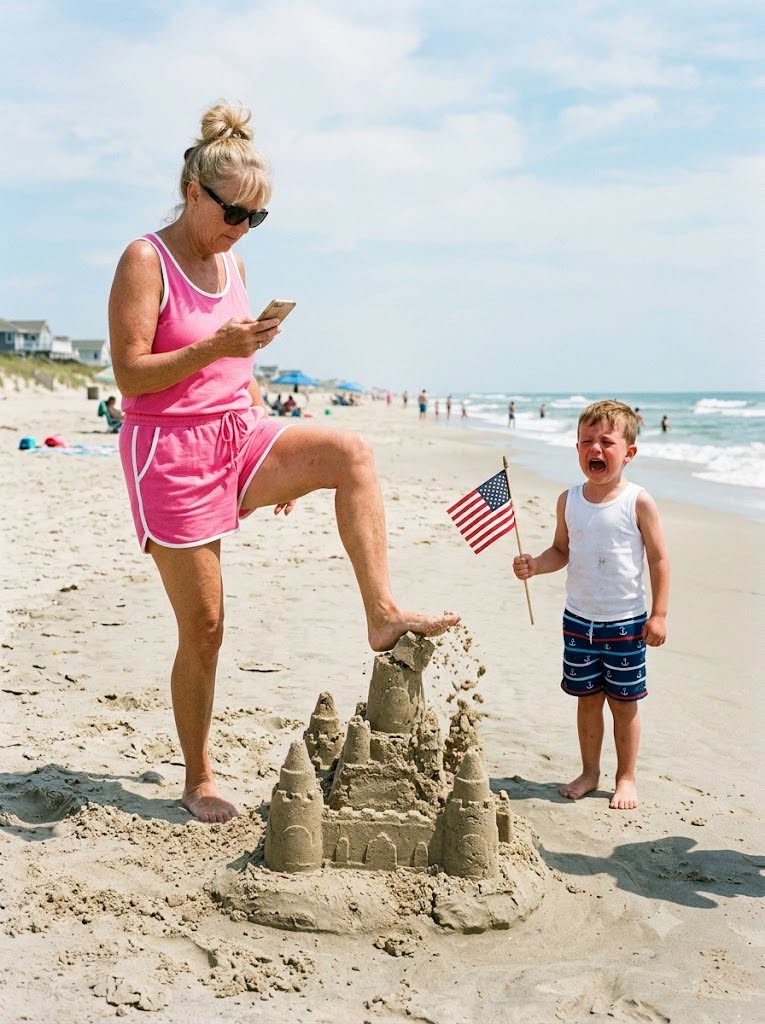
For three careful hours, Noah worked near the water, building a sandcastle in his father’s memory. He shaped towers, pressed walls into place, dug a small moat, and smoothed the sides with the seriousness of a child giving love the best form his hands could manage.
When he finished, he placed a faded American flag on the highest peak.
He stepped back and smiled.
For the first time that day, he looked lighter.
Then a woman approached, holding her phone out as she filmed herself.
She was irritated before she even reached us. She complained that Noah’s sandcastle was ruining her view of the ocean, as if a grieving child’s small tribute were an inconvenience placed there to offend her.
Before I could stop her, she kicked the castle.
Once.
Then again.
The towers broke apart. The walls collapsed. The flag fell into the wet sand as the surf pulled pieces of Noah’s work away.
Noah did not scream.
He simply stood there, silent, his face crumbling in a way I will never forget.
I pulled him into my arms.
Around us, people stared in shock. No one seemed to know what to say. The woman, still without shame, turned and walked back to her blanket as though she had only cleared space for herself.
Noah cried into my shirt, quietly, with the kind of sadness that has already learned life can be unfair.
I wanted to be angry loudly.
But he needed me steady more than the woman needed my rage.
About twenty minutes later, a senior lifeguard came down from his tower. His name was Captain Reyes. He walked across the sand carrying a golden box tied with a navy ribbon.
To everyone’s surprise, he stopped in front of the woman.
With formal politeness, he told her she had been selected for a special beach prize.
Her expression changed immediately. She sat up, pleased and ready to be admired.
When she opened the box, there was no prize meant to flatter her.
Inside was a brass compass and a handwritten note.
The words were simple, but they carried weight. They reminded her that she had not destroyed sand. She had interrupted a grieving boy’s attempt to feel close to his father. She had mistaken a child’s love for an inconvenience.
By then, the people around her were no longer silent in confusion. They were looking directly at her.
For the first time, she seemed to understand what she had done.
She closed the box, gathered her things, and left the beach quickly, her face flushed with shame.
Captain Reyes did not follow her.
He came to Noah instead.
He knelt beside him on the wet sand and spoke gently.
“I knew your dad,” he said.
Noah looked up.
From beneath the velvet lining of the golden box, Captain Reyes pulled out an old photograph.
It showed a younger Simon standing beside a huge sandcastle, smiling in the early morning light. The structure was bigger than anything Noah had built that day, with towers, arches, and a long wall curving toward the water.
Noah took the photo carefully, as if it might disappear.
Captain Reyes explained that Simon used to come to the beach early, before the crowds. He would build beautiful things near the shoreline, knowing the tide would eventually take them.
“He told me once,” Captain Reyes said, “that if people only build things that last forever, they miss half the beauty of life.”
Noah stared at the ocean.
The waves kept moving, soft and patient, reaching for what remained of the castle.
Captain Reyes continued.
“Your dad knew the water would take his work. He built anyway. Not because it would stay, but because making it mattered.”
Something in Noah’s face changed then.
Not all at once. Grief does not lift that quickly.
But the sharpest part of his pain softened.
He looked at the broken sandcastle, then at the waves, then back at the photo of his father.
“Maybe the ocean wanted to see it too,” he said.
I swallowed hard.
“Maybe it did,” I whispered.
A few minutes later, Noah stood and walked back toward the damp shoreline. He picked up Simon’s blue shovel and began shaping a small tower of sand.
It was not careful like before.
It was free.
When the next wave came in and washed it away, Noah did not cry.
He laughed.
Then he reached into the foam and rescued the little flag.
The next day, we returned to the beach.
This time, Noah built another castle with a few children who had watched him from nearby. They worked together, digging, shaping, decorating, rebuilding when the walls leaned too far.
Noah told them the tide would take it later.
He said it with peace, not sadness.
I sat nearby holding Simon’s old photograph, watching my son build something beautiful even though he knew it would not stay.
And I understood the lesson Simon had left behind without meaning to.
Love does not lose its meaning because time changes its shape.
Some things are built to last.
Some things are built to teach us how to let go.
And some things, even after the tide takes them, remain quietly alive in the hands that made them.