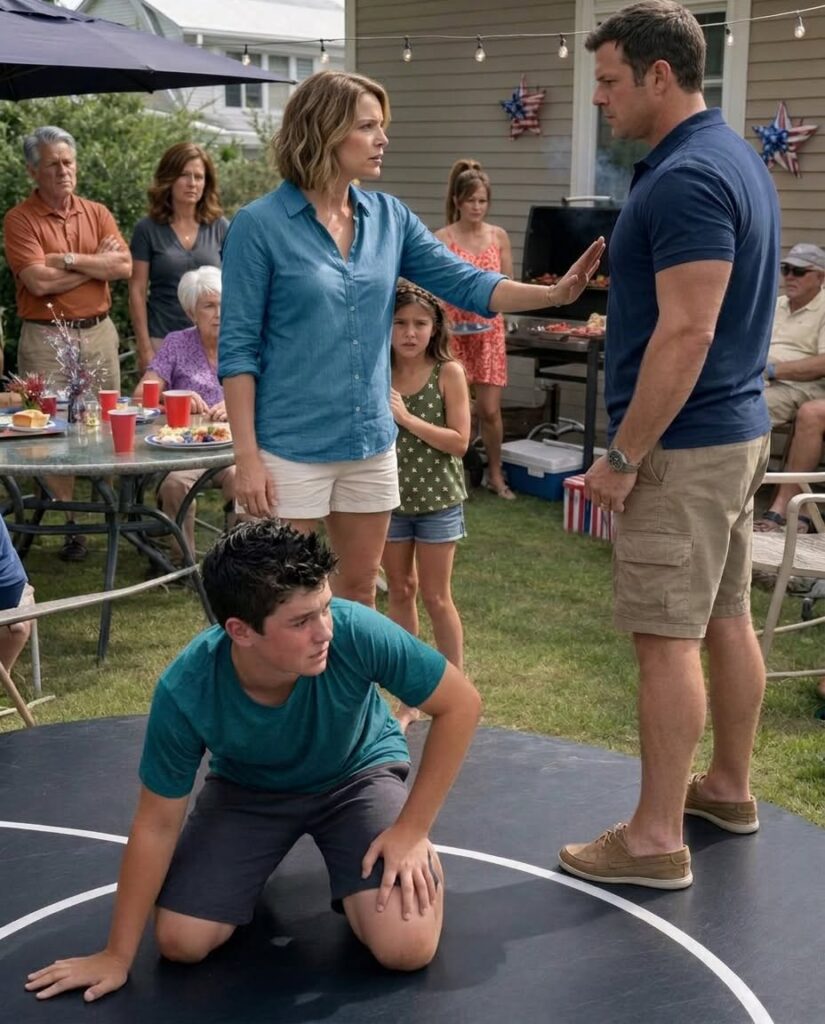
For one long moment, the entire Fourth of July gathering went silent.
Then Derek laughed.
“Come on, kid,” he said, spreading his arms as though the whole thing had been harmless fun. “You’re never going to become a man if you fall apart every time somebody touches you.”
Caleb stood slowly.
Grass clung to the knees of his shorts. His palms were red from catching himself against the rough surface of the mat.
He did not cry.
That almost made it worse.
Instead, he lowered his eyes and gave the small, embarrassed smile he always used when he wanted adults to believe something had not hurt him.
My nine-year-old daughter, Emma, stepped closer to me.
“Mom,” she whispered, “why does Uncle Derek always treat him like that?”
I looked at my son.
Then at my brother-in-law.
And I realized there was no honest answer I could give my daughter that would not make me ashamed of myself.
Derek treated many people that way.
He targeted anyone he believed would not challenge him.
Waiters.
Young employees.
Quiet relatives.
Children who were too polite to talk back.
He was loud, arrogant, and endlessly proud of his brief military service. He mentioned it at almost every family gathering, usually while explaining what was wrong with younger generations.
According to Derek, boys were too soft, women were too sensitive, and anyone who disagreed with him lacked discipline.
He liked to talk about strength.
But what he truly enjoyed was making other people feel weak.
And for years, I had allowed him to do it.
I smiled when he mocked my career.
I looked away when he referred to me as an “office Marine.”
I ignored him when he told relatives I had spent twenty-two years hiding behind paperwork while people like him had done the “real work.”
I never corrected him when he suggested my retirement benefits were money I had not earned.
My name is Laurel Bennett.
At the time, I was forty-four years old and a retired lieutenant colonel in the United States Marine Corps.
My family knew I had served.
They did not know much more than that.
They did not know about the dangerous deployments.
They did not know about the convoy rescue.
They did not know about the night I carried an injured Marine through gunfire because the evacuation vehicle could not reach us.
They did not know about the metal fragments still lodged near my hip or the pain that woke me during cold weather.
They had never seen the medals stored in a plain box at the back of my closet.
Bronze Star with valor.
Purple Heart.
Humanitarian Service Medal.
Commendations that represented moments I rarely discussed because each one came attached to people who had not made it home.
I had never wanted praise.
I did not enjoy telling war stories.
I did not need my children to think of me as a hero.
But somewhere along the way, humility had turned into silence.
And my silence had taught my family something dangerous.
It had taught them that I would tolerate anything.
Derek slapped both hands against the wrestling mat.
“Maybe your mother should show you how it’s done,” he called to Caleb. “Unless the paperwork department is too delicate.”
Several relatives laughed nervously.
Not because the joke was funny.
Because laughing was easier than confronting him.
My younger sister, Mallory, stood beside the grill pretending to arrange hamburger buns.
She had heard him.
Everyone had.
My mother, Elaine, remained seated at the patio table, holding a sweating glass of iced tea.
“Derek, that’s enough,” she said weakly.
But she did not stand.
She never did.
She had stayed seated when Derek insulted me at Christmas.
She had looked away when he mocked Caleb for crying after our dog died.
She had said nothing when he told Emma that girls only joined sports because schools were afraid of lawsuits.
My mother hated conflict.
At least, that was the excuse she used.
But avoiding conflict does not eliminate it.
It only leaves the quietest person to carry it alone.
Mallory was no better.
She complained privately about Derek’s temper, but defended him publicly.
She called me after their mortgage payment was late.
She asked me to help cover medical bills.
She borrowed money for car repairs and school expenses while allowing Derek to tell everyone he supported the family without assistance.
I always helped.
Then I kept quiet so he could preserve the image he had built.
I had protected his pride at the expense of my own dignity.
Now my son was standing on a mat with his shoulders curved inward, carrying the same humiliation I had spent years pretending not to feel.
That was the moment something inside me changed.
Not dramatically.
Not with anger.
It felt more like a lock turning.
A simple internal click.
Enough.
I removed my watch and handed it to Emma.
“Stand beside Grandma.”
Her eyes widened.
“Mom?”
“I’m all right, sweetheart.”
I stepped onto the mat.
Derek grinned.
He thought I had finally agreed to become part of the afternoon’s entertainment.
“You really want to do this?”
“You asked for a round.”
Someone near the grill muttered my name.
Mallory shook her head slightly, warning me not to cause a scene.
That almost made me laugh.
Derek had spent years causing scenes.
But the moment I stepped forward, I became the problem.
He rolled his shoulders and adopted a wide stance.
He was larger than I was.
Several inches taller and at least fifty pounds heavier.
He expected me to hesitate.
I did not.
Derek moved first.
He reached for me carelessly, relying on size instead of technique.
I stepped outside his line.
Caught his wrist.
Shifted my weight.
Turned my hips.
Then I used his momentum against him.
Within seconds, Derek was facedown on the mat with his arm controlled safely behind his back.
The backyard froze.
Even the children stopped moving.
Derek twisted beneath me.
“Get off.”
“Say you’re finished.”
He tried to force his way up.
I adjusted my position slightly.
Not enough to injure him.
Only enough to remind him that he was no longer in control.
“Finished,” he muttered.
I released him immediately and stepped back.
Derek scrambled to his feet.
His face had turned a deep, furious red.
“That was a dirty move.”
“It was a controlled move.”
“You embarrassed me in front of my family.”
I looked toward Caleb.
He had lifted his head.
For the first time that afternoon, he was looking directly at me.
“You embarrassed yourself when you pushed my son.”
Derek stepped toward me.
His hands tightened into fists.
Before he could speak, a firm voice came from the gate.
“Step back, Corporal Vaughn.”
Everyone turned.
Silas Mercer, my mother’s elderly neighbor, stood beside the fence.
He wore a faded Marine Corps cap and leaned heavily on a wooden cane. He was in his seventies, and one leg no longer moved properly.
But his voice still carried command.
Derek scoffed.
“This is family business.”
Silas opened the gate.
“No,” he said. “This is about respect.”
Then he looked around the backyard.
At my mother.
At Mallory.
At the relatives who had laughed.
“You people have no idea who you’ve been insulting.”
My stomach tightened.
“Silas, please.”
He ignored me.
“In 2011, my convoy was disabled in hostile territory. We were pinned down, injured, and running out of time.”
The backyard became completely silent.
“Lieutenant Colonel Bennett’s unit reached us when no one else could.”
Mallory stared at me.
Silas continued.
“She coordinated the rescue under fire. Six Marines came home because of her.”
His fingers tightened around the handle of his cane.
“When my leg stopped working, she carried me.”
Emma looked up at me.
Silas’s voice broke slightly.
“I am alive because she refused to leave me behind.”
Nobody moved.
Mallory whispered, “Lieutenant colonel?”
Caleb pulled out his phone.
His fingers moved quickly across the screen.
I wanted to tell him to stop.
I had spent years keeping those parts of my life separate from my children.
But it was too late.
A few seconds later, he held up the phone.
An old article from a veterans’ association showed a photograph of me standing stiffly in my dress uniform while a general pinned a medal to my chest.
The headline mentioned the Bronze Star with valor.
Below it were references to a Purple Heart, combat deployments, and a humanitarian evacuation mission.
Caleb stared at the image.
Then at me.
“Mom,” he whispered, “is this really you?”
“Yes.”
Emma leaned over his arm to see the screen.
“You were hurt?”
Her voice reached the part of me I had been trying to protect for years.
I had believed hiding my pain made me strong.
I thought shielding my children from the difficult parts of my service allowed them to have an ordinary life.
But by remaining silent while Derek diminished me, I had taught them the wrong lesson.
I had taught them that dignity should be sacrificed to preserve peace.
Mallory stepped closer.
“Why didn’t you ever tell us?”
I looked around the backyard.
At the people who had called me whenever they needed money.
At the relatives who trusted me to solve emergencies but never bothered to ask what my life had cost.
“Because whenever I tried to be anything other than useful, this family became uncomfortable.”
My mother’s eyes filled with tears.
“That isn’t fair.”
“No,” I said. “It isn’t.”
I left before the fireworks began.
Emma fell asleep in the truck with my jacket folded beneath her head.
Caleb remained awake in the passenger seat, staring through the windshield as the road stretched ahead of us.
For nearly twenty minutes, neither of us spoke.
Then he asked, “Why did you let Uncle Derek talk to you like that for so long?”
I tightened my hands around the steering wheel.
I wanted to give him the excuses I had repeated to myself for years.
Family was complicated.
My mother was getting older.
Mallory was trapped in a difficult marriage.
Derek was insecure.
I was strong enough to ignore him.
None of those explanations were good enough.
“Because I thought staying quiet proved I was strong.”
Caleb turned toward me.
“Did it?”
The question was simple.
The answer was not.
“No,” I said. “It made me forget that I deserved respect.”
He looked down at his hands.
“I don’t want to learn that.”
His words struck harder than anything Derek had ever said to me.
“Then I’ll stop teaching it.”
The next morning, I called my closest friend, Tasha Reed.
She had served with me years earlier and helped me through the difficult transition into civilian life.
She answered on the first ring.
“Silas called me.”
“Of course he did.”
“I heard you put Derek on the mat.”
“I did.”
“Good.”
“Tasha, my mother cried.”
“People often cry when the person carrying everything finally puts the weight down.”
After the call, I opened my banking app.
For years, I had quietly paid part of my mother’s utilities.
When her roof needed replacing, I covered most of the cost.
When Mallory and Derek fell behind on their mortgage, I transferred money without asking questions.
I had created an emergency fund for them that somehow turned into a monthly obligation.
Every payment had begun as help.
But generosity without boundaries had slowly transformed me into a resource instead of a person.
I canceled every automatic transfer.
Then I wrote an email to my mother and sister.
I told them I loved them.
I told them I did not regret helping when help was genuinely needed.
But I would no longer provide financial support while being mocked, dismissed, or valued only for what I could fix.
Any future relationship with me would require honesty, respect, and clear boundaries.
Before sending it, I attached a public summary of my military record.
Not because I needed admiration.
Because I was done allowing Derek’s version of me to be the only one my family heard.
Mallory called less than an hour later.
She was crying so hard that I could barely understand her.
“I knew Derek went too far,” she said.
“You always knew.”
“I thought you didn’t care.”
“Why?”
“You smiled. You never reacted. You always acted like it didn’t bother you.”
“That made everything easier for you.”
She became quiet.
“Yes.”
It was the first honest answer she had given me in years.
“I let him turn you into the family joke because it kept peace in my house.”
“At my expense.”
“Yes.”
I waited.
“I’m sorry,” she whispered.
“I cannot repair your marriage for you.”
“I know.”
“Do you?”
Another long silence followed.
“I’m trying to.”
It was not enough to restore everything.
But it was enough to leave the door unlocked.
My mother called three days later.
She did not begin with an apology.
Instead, she asked, “When you paid for my roof, were you still recovering from the injury mentioned in your service record?”
“Yes.”
“You told me you fell down the stairs.”
“I didn’t want you to worry.”
Her breathing became uneven.
“I let you carry everything.”
“Yes.”
Normally, I would have rushed to comfort her.
I would have told her she had done her best.
I would have softened the truth until she no longer had to feel it.
This time, I stayed quiet.
Her discomfort was not an emergency I needed to solve.
Two months later, my former unit held a recognition ceremony at Quantico.
I had avoided similar events for years.
Public praise made me uncomfortable, especially when the stories behind the medals involved people I still missed.
This time, I invited my family.
Mallory asked whether Derek could come.
“Only if he understands that the day is not about him.”
She promised he did.
He arrived wearing a dark suit and an expression I had never seen on him before.
Restraint.
My mother sat between Caleb and Emma, gripping the ceremony program with both hands.
When the speaker began reading my service record, I kept my eyes forward.
Bronze Star with valor.
Purple Heart.
Special operations deployments.
Humanitarian evacuation command.
Mentorship work with wounded veterans.
The words felt too large for the quiet life I had built after retirement.
Emma leaned toward my mother.
“Grandma, Mom is really brave.”
My mother covered her mouth.
“Yes,” she whispered. “She is.”
After the ceremony, Derek approached me near a hallway window.
He stopped several feet away.
That distance mattered.
“I was wrong,” he said.
I waited.
He swallowed.
“I made you seem smaller because I wanted to feel larger.”
His eyes shifted toward the floor.
“I did it in front of your children. And I kept doing it because everyone let me.”
For once, there was no joke hidden inside his apology.
“I’m sorry, Lieutenant Colonel.”
“I accept your apology.”
Relief flickered across his face.
Then I continued.
“But accepting an apology does not restore trust.”
He nodded.
“I understand.”
“Trust will depend on what you do when no one is watching.”
Mallory stepped beside him.
“Derek is moving into the guest room,” she said. “We’re starting counseling next week.”
Derek looked uncomfortable, but he did not interrupt her.
“That sounds like a beginning,” I said.
During the drive home, Caleb held the ceremony program in his lap.
“Can I tell people about you?”
“You can tell them the truth.”
He smiled.
“All of it?”
“The parts that are mine to share.”
He nodded.
Then I added, “But remember, the medals aren’t the most important thing.”
“What is?”
“Real strength protects people. It doesn’t humiliate them.”
Caleb considered that.
“That’s better than Uncle Derek’s version.”
By Thanksgiving, I agreed to host the family at my house.
This time, hosting did not mean paying for everything.
I sent a message explaining what I planned to cook and asked everyone to bring something.
I did not send Mallory grocery money.
I did not cover anyone’s travel expenses.
When my mother mentioned that her winter utility bills were increasing, I listened without immediately reaching for my checkbook.
They all brought something.
My mother arrived with sweet potato casserole.
Mallory brought two pies.
Derek carried folding chairs inside without announcing how much effort it required.
Dinner was awkward.
But it was honest.
Nobody mocked my career.
Nobody asked me to solve a financial crisis.
Nobody treated my silence as permission.
At one point, Derek began telling a loud story about a coworker he considered weak.
Halfway through, he noticed Caleb watching him.
Derek paused.
Then he lowered his voice and changed the way he described the man.
It was a small improvement.
But small improvements matter when they continue.
After dinner, my mother joined me at the sink.
For years, she had allowed me to wash dishes alone because I was supposedly better at keeping things moving.
This time, she rolled up her sleeves.
“I should have asked more questions about your life,” she said.
“Yes.”
“I think I was afraid of the answers.”
I handed her a plate.
“Why?”
“If you were stronger and more burdened than I understood, then I had fewer excuses for depending on you so much.”
I considered her words.
“I also made being needed too important.”
She looked at me.
“Why?”
“Because being needed felt safer than being known.”
My mother began crying quietly.
But she kept washing the plate.
For once, her tears did not end the conversation.
Later, I found Caleb and Emma standing in front of the framed photograph from the Quantico ceremony.
I had placed it on the living room shelf instead of hiding it in a drawer.
Emma looked at me.
“Were you ever scared when you were a Marine?”
“Many times.”
She frowned.
“But brave people aren’t scared.”
Before I could answer, Caleb spoke.
“Brave people do the right thing even when they are scared.”
I looked at my son.
He had learned the lesson I had nearly failed to teach him.
The following spring, I began mentoring younger veterans adjusting to civilian life.
Some had medals they never mentioned.
Some carried pain no one could see.
Many had families who wanted heroic stories but did not understand the complicated person who had returned home.
At our first meeting, I stood in front of the group and said something I wished someone had told me years earlier.
“Humility is a virtue. Disappearing is not.”
Derek changed slowly.
He apologized to Caleb without being asked.
Not a vague apology.
Not “I’m sorry you were upset.”
He told him directly that pushing him onto the mat had been cruel and humiliating.
He admitted he had targeted Caleb because he believed the boy would not fight back.
Caleb listened.
Then he said, “I forgive you, but don’t ever do it again.”
Derek nodded.
“I won’t.”
He stopped challenging younger relatives to prove themselves.
He still spoke too loudly sometimes.
He still tried to dominate conversations when he felt insecure.
But Mallory no longer laughed to keep him comfortable.
When he crossed a line, she corrected him immediately.
Sometimes family relationships are repaired through one dramatic moment.
Ours was repaired through dozens of small choices.
Every Fourth of July, we now meet at a public park instead of my mother’s backyard.
There is no wrestling mat.
Derek grills because he is genuinely good at it.
Mallory brings salads.
My mother sits beneath a canopy while Emma listens to stories about my father, an aircraft mechanic who taught me the value of quiet service.
One year, as fireworks began opening above the trees, Caleb stood beside me with his hands in his pockets.
He was taller then.
Almost grown.
“Do you ever wish Silas hadn’t told everyone the truth?” he asked.
I watched a burst of gold spread across the sky.
“Sometimes I wish I had told them first.”
“You speak up now.”
“I’m learning.”
Derek called from the grill.
“Burgers are ready, Colonel. Whenever you are.”
There was no mockery in his voice.
No challenge.
Only respect.
I walked toward the picnic table with my children beside me.
And for the first time, I understood what those few seconds on the wrestling mat had truly meant.
They were not important because I defeated Derek.
They mattered because my children watched me stop accepting disrespect.
For years, I believed strength meant carrying every burden quietly.
I thought it meant absorbing every insult without reacting.
I believed protecting the family required me to make myself smaller.
Now I knew better.
Strength meant knowing when to help.
When to forgive.
When to demand accountability.
When to establish a boundary.
And when to refuse to disappear.
That was the victory worth keeping.