She survived.
So did I, though not without cost.
The fire left me with scars, limited mobility, and a body that had to learn life again in ways no teenager expects. But for years, I told myself it had been worth it because Emily was alive.
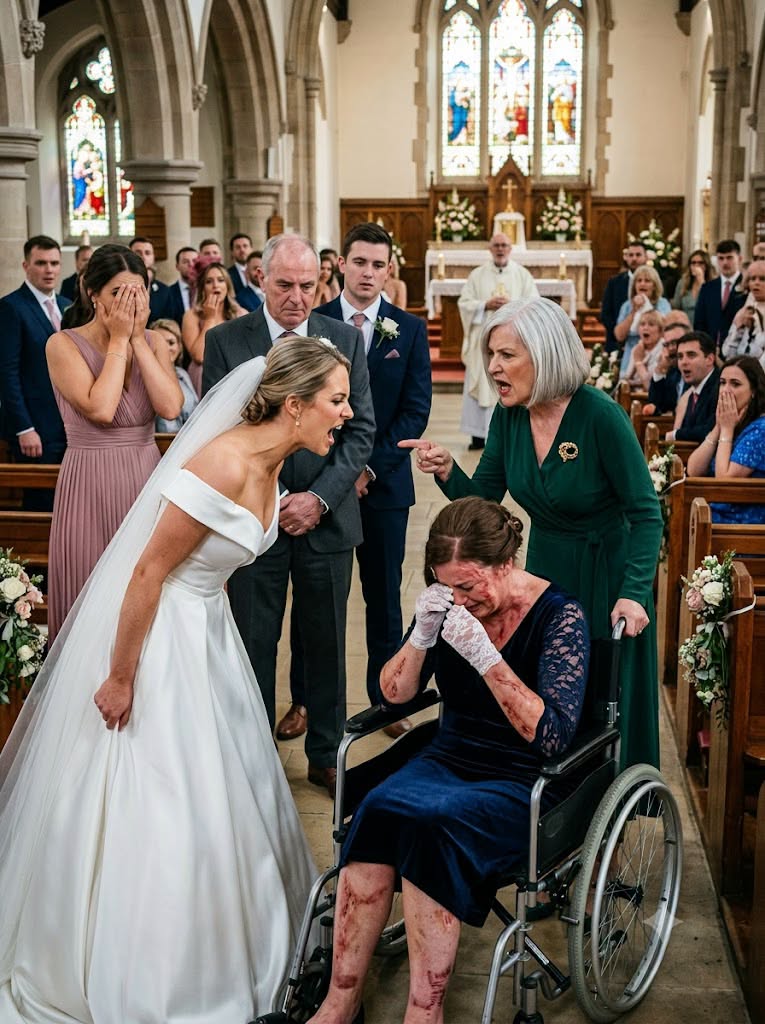
That day, in the church, I sat near the front and watched her in her wedding dress. She looked beautiful. For a moment, I let myself feel only that.
Then she came toward me.
She leaned down close enough that only I could hear.
“Can you move to the back?” she whispered. “Your scars are ruining the aesthetic.”
At first, I thought I had misunderstood her.
But her face told me I had not.
I looked toward our parents, Linda and Mark. They had heard. I knew they had heard.
Neither of them spoke.
The silence hurt almost as much as Emily’s words.
I sat there, hands folded in my lap, wondering when the wounds I had accepted for her survival had become something shameful. Wondering when my presence had turned from proof of love into an inconvenience people wished they could hide.
The moment did not stay hidden for long.
Before I could answer, Daniel’s mother, Margaret, stood.
Her voice was steady, but full of feeling.
“I need everyone here to understand something,” she said. “This woman saved the bride’s life.”
The church went quiet.
Margaret explained that she had been one of the nurses who treated me the night of the fire. She remembered the burns. She remembered the pain. But most of all, she remembered that my first question had not been about myself.
It had been, “Is Emily alive?”
A silence settled over the room, deeper than embarrassment.
Daniel turned to Emily.
“Is that true?” he asked.
Emily’s face tightened. For a moment, she looked like a child caught between shame and anger.
Then she began to speak, not with apology, but with resentment.
She said my medical needs had taken over her childhood. She said every family gathering became about my recovery, my surgeries, my pain, my scars. She said she wanted one day where people looked only at her.
There was truth inside her pain, but it had grown crooked over the years. A child can feel overlooked. A sister can carry jealousy. But suffering does not give anyone the right to turn another person’s sacrifice into a source of humiliation.
Daniel listened.
Then he stepped back.
“I don’t think I know you,” he said quietly.
And with that, the wedding ended.
The weeks that followed were painful in a different way.
Daniel canceled everything and ended the relationship. Emily moved back in with our parents. She sent short apology messages at first, but they felt more like panic than understanding.
Our family began to fracture, not because the truth had destroyed it, but because the truth had finally revealed what had already been broken.
My father, Mark, sent me a long letter. Most of it was explanation. He wrote about fear, exhaustion, medical bills, trauma, and not knowing how to hold the family together after the fire. Near the end, however, he admitted what mattered most.
He had failed me because silence was easier.
My mother, Linda, tried to apologize too, but her words came in pieces. She could not fully face how often she had protected Emily’s comfort while leaving me alone with my dignity injured.
I realized then that I had spent years helping my family avoid the truth. I had covered my scars, softened my needs, accepted awkward silences, and pretended not to notice when people treated my survival as something uncomfortable.
I could not keep doing that.
So I began again.
I moved into a bright apartment with wide windows and morning light across the floor. It was quiet, but not empty. For the first time in years, the space felt like mine.
I began advising hospitals on patient dignity, especially for people living with visible injuries, disabilities, and long recoveries. I spoke with staff about small things that are not small to patients: how to enter a room, how to ask before helping, how to see the person before the wound.
Margaret stayed in my life.
She became a friend, not out of pity, but out of respect. She encouraged me to speak to nursing students and tell the truth plainly — not only about pain, but about dignity, identity, and the quiet harm of being treated like something difficult to look at.
A year later, Emily asked to meet me at a cafe.
I almost said no.
But I went.
She looked different. Not fixed. Not suddenly wise. Just more honest than I had seen her before.
This time, she did not make excuses.
She said she had hated how invisible she felt after the fire, and instead of facing that pain, she had blamed me. She said she had turned my scars into the symbol of everything she resented, even though those scars were the reason she was alive.
Then she said the words I had needed to hear without decoration.
“I was cruel to you. You saved me, and I treated your body like an embarrassment. I am sorry.”
It did not repair everything.
Some wounds need more than one conversation. Trust does not return simply because someone finally names what they broke.
But her honesty gave us a place to begin.
I left that cafe without pretending we were healed. Still, I felt lighter.
Not because Emily had apologized.
Because I had stopped waiting for my family to give me permission to exist fully.
I stopped wearing gloves every day. I stopped choosing seats in corners. I stopped treating my scars like a disturbance.
They were not the whole story of my life.
But they were part of it.
And I no longer felt ashamed of the proof that I had survived, loved, suffered, and still chosen to stand in the world.
I had once thought dignity meant enduring quietly.
Now I understand it differently.
Dignity is not hiding so others feel comfortable.
Dignity is taking your place without apology, even when your presence reminds people of truths they would rather not face.