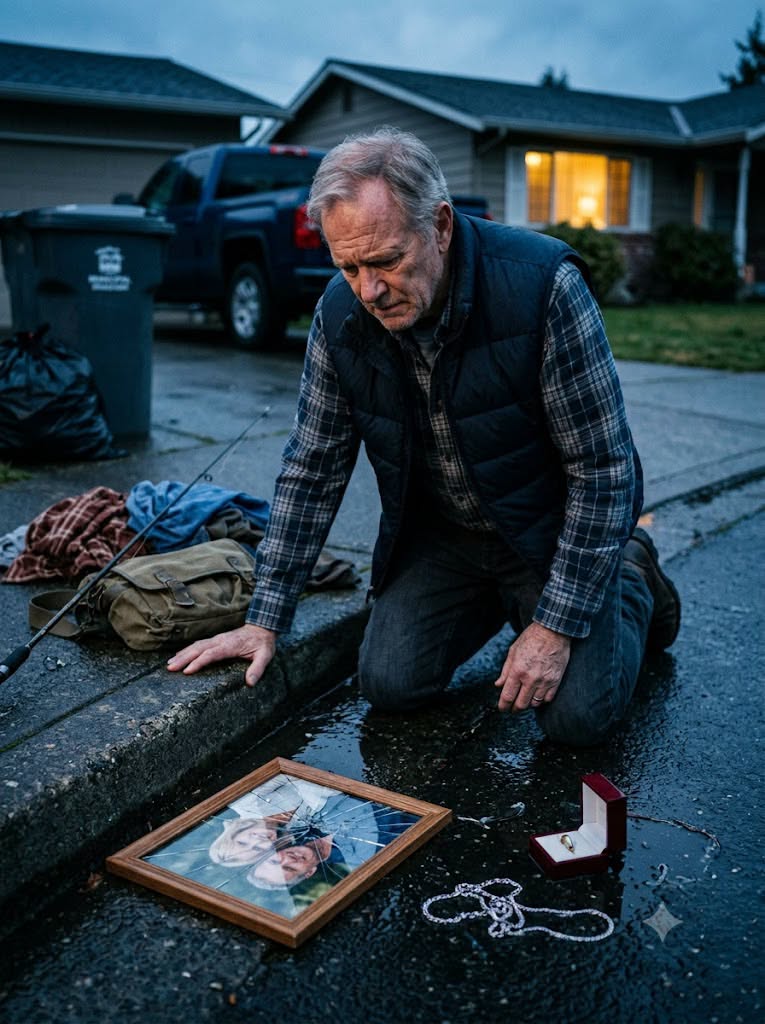
Forty years of memories lay there like garbage.
For a moment, I could not move.
Then I walked to the front door and tried my key.
It did not turn.
The locks had been changed.
I sat outside in the cold, waiting for an explanation I already knew would not be kind. When my son Floyd arrived with his wife, Pamela, she stepped out of the car with a look that carried no shame.
“We don’t need your mortgage payments anymore,” she said. “You should leave.”
I looked at Floyd.
He would not meet my eyes.
I reminded them of the years I had helped them. The bills I had covered. The sacrifices I had made so they could stand on steadier ground. But some people accept help for so long that they begin to mistake it for something owed to them.
Pamela’s answer was simple.
“If you don’t leave, we’ll call the police.”
That night, I slept in a motel.
Not much sleep came. I sat on the edge of the bed, thinking through the years, trying to understand how a father becomes a stranger at his own front door.
By morning, the grief had settled into something quieter.
I called a property lawyer named Robert Chen.
He reviewed my loan documents, title records, and ownership papers. Then he looked up at me and said the words my family had failed to consider.
“You are the sole legal owner of the property. Your son and daughter-in-law have no legal claim to the home.”
I sat back in the chair and let that truth reach me slowly.
They had changed the locks.
They had thrown out my belongings.
They had threatened me in front of the home I owned.
But they had not taken away my rights.
That same day, I met with real estate agent Sandra Walsh. I told her I wanted the house listed as soon as possible.
She walked through the property, took notes, and said she could have it on the market within days.
For the first time since I had seen my belongings on the pavement, I felt something inside me loosen. Not joy exactly. Not revenge.
Relief.
The kind that comes when a person realizes he does not have to keep living where he is tolerated only when he is useful.
I booked a flight to Cancun.
I did not do it to disappear dramatically. I did it because I needed distance. I needed warmth. I needed to hear the ocean instead of Pamela’s voice telling me I had no place in my own home.
On a balcony overlooking the water, I finally breathed without feeling like a burden.
For several days, I left my phone off.
When I turned it back on, dozens of messages appeared.
At first, they were angry. Then confused. Then frightened. Floyd and Pamela had discovered that a realtor was showing the house to buyers. The confidence they had shown while throwing my things outside had disappeared once they realized the house was never theirs to command.
They begged me to call.
They asked what I was doing.
They said we needed to talk as a family.
But a family conversation should have happened before the locks were changed. Before my wedding photo was thrown near a dumpster. Before my son stood silent while his wife threatened to call the police on his father.
I did not answer.
Instead, I listened to Sandra’s updates.
A young couple named David and Jennifer had seen the house. They loved it. They spoke about raising children there, planting a garden, and fixing the small things that needed care.
That mattered to me.
A home should belong to people who understand what it is.
Three weeks later, I returned to Boise.
I saw Floyd and Pamela in a parking lot. They looked exhausted, as if the life they had planned without me had begun to collapse under its own selfishness.
Floyd apologized. Pamela cried. They offered to pay rent. They said they had acted out of stress. They said they had made a mistake.
I listened.
Not because I owed them the comfort of being heard, but because I wanted to leave without bitterness ruling me.
Then I reminded them of what they had chosen.
“You put my belongings outside,” I said. “You changed the locks. You threatened to call the police. You did all of that because you believed I had no power left.”
Neither of them answered.
There was nothing useful left to say.
The following Tuesday, I signed the final paperwork transferring ownership of the house to David and Jennifer. I accepted the check, shook their hands, and wished them well.
Then I packed only what I truly needed into my truck.
The rest, I donated.
I did not want to drag every object from that old life into the next one. Some things deserve to be kept. Some things deserve to be released.
Before leaving, I held Martha’s cracked wedding photo one last time. I kept the picture, but not the broken frame.
That felt right.
Then I drove north toward Coeur d’Alene.
The road opened ahead of me, quiet and wide. I was not young. I was not untouched by what had happened. A wound like that does not vanish because papers are signed and boxes are packed.
But I was free.
Free from being treated as useful but unwanted.
Free from giving endlessly to people who had forgotten gratitude.
Free to build a peaceful life where my presence did not have to be begged for or justified.
I had spent years sacrificing for family.
Now I was learning that love does not require a person to remain where he is dishonored.
Sometimes reclaiming your life begins with one locked door, one clear truth, and the courage to keep driving.