I remember the condensation dripping over my fingers and the fries turning soft inside the bag while I stood at the edge of the sand, slowly realizing the woman I loved had disappeared.
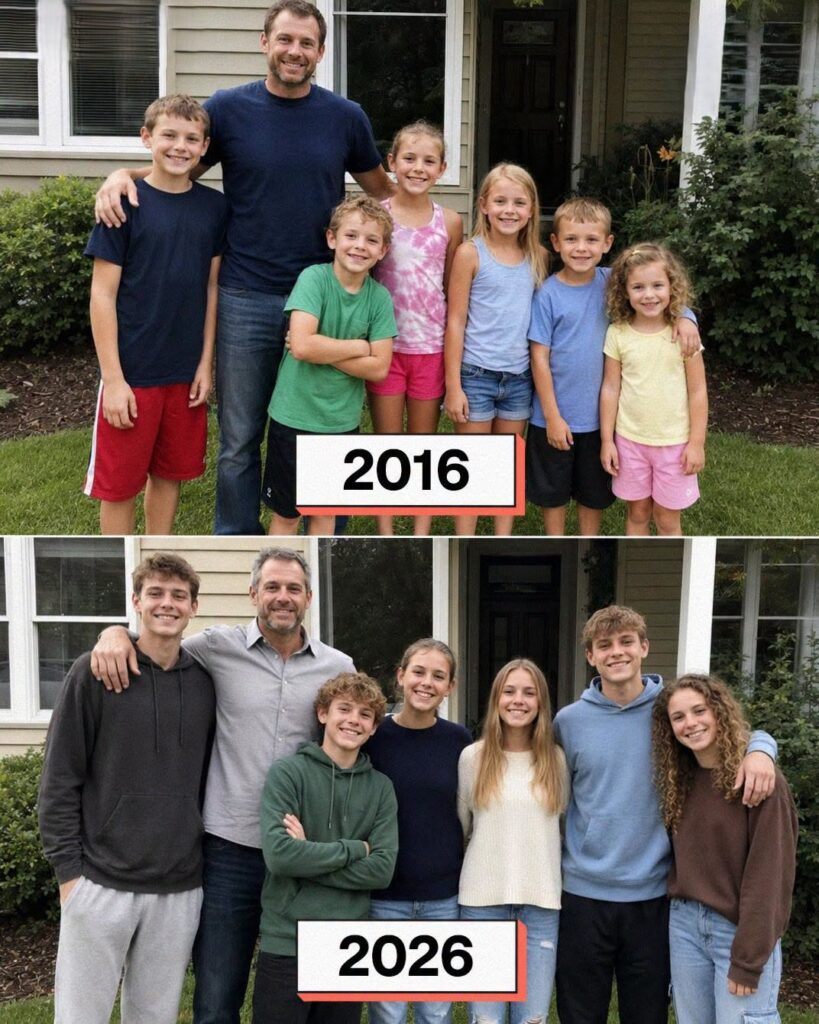
Claire and I had brought her six children to Pelican Cove for one final weekend before school started.
We were engaged, although we had not chosen a wedding date yet. That did not matter to me. I already thought of the children as mine.
The youngest still called me “Mr. Ryan,” as if she had not decided whether I was permanent.
Noah, the oldest, was nine. He often watched me from across the room with his arms folded over his chest, studying every promise I made and waiting to see whether I would eventually break it.
Around noon, the line at the refreshment stand near the pier began growing longer.
Claire said she would stay with the children while I bought drinks.
She kissed my cheek and smiled.
“Go before the line gets worse.”
I walked away because I had no idea those would be the last ordinary words I would ever hear her say.
I was gone for twelve minutes.
When I returned, the children were still building a crooked sandcastle near the shoreline.
Claire’s towel remained spread across the sand.
Her sunglasses rested on top of her paperback novel, exactly where she had left them. Her sandals sat beside the cooler.
But Claire was gone.
At first, I assumed she had entered the water.
I scanned the waves, shielding my eyes from the bright afternoon sun and waiting for her head to appear between the swimmers.
Then I saw Noah.
He stood at the shoreline without moving.
His face was pale.
“Where is your mother?” I asked.
He did not answer.
He simply stared at the ocean.
By sunset, tourists, lifeguards, and police officers were searching the beach.
By midnight, investigators were calling it a possible drowning.
The coast guard searched for four days.
They found no body, no clothing, and no sign that Claire had ever entered the water.
Eventually, the world decided she was dead.
I could have walked away.
I was twenty-nine years old. Claire and I had not married, and I had no legal responsibility for her children. Nobody would have blamed me for grieving and then rebuilding my own life.
In fact, several people quietly suggested that I should.
Then I looked at the six children sitting together during Claire’s memorial service.
The youngest leaned against my arm and whispered, “When is Mommy coming back?”
Something inside me settled.
I stayed.
I sold my truck to cover the first few months of household expenses. I worked extra shifts and learned how to prepare six different lunches before sunrise.
I watched videos that taught me how to braid hair.
I signed school forms, attended parent-teacher conferences, treated fevers, cleaned scraped knees, and drove frightened children to emergency rooms in the middle of the night.
I sat beside their beds when nightmares woke them.
I held them when they cried for a mother whose body had never been found.
Noah made everything difficult at first.
He challenged my rules and tested every boundary. If I promised to attend a school event, he acted as though he expected me to forget. When I grounded him, he reminded me that I was not his real father.
Still, I stayed.
Then, one afternoon several years later, he called me Dad.
The word slipped naturally into a sentence.
Neither of us stopped to acknowledge it.
But I went into the garage afterward and cried where the children could not see me.
Ten years passed.
The little girl who once called me “Mr. Ryan” was twelve. Two of the children were in high school. The others were beginning to build lives that Claire would never see.
Noah left for college.
He had grown into an intelligent, stubborn, compassionate young man.
He also had his mother’s eyes.
One Friday in October, he came home unexpectedly.
He dropped his travel bag beside the front door and found me lying on the kitchen floor with a flashlight between my teeth, trying to repair a leaking pipe beneath the sink.
“Noah?”
I slid out and sat up.
One look at his face made me put the wrench down.
He looked exhausted.
“Dad,” he said, “I think you deserve to know the truth about Mom.”
The room seemed to tilt.
Noah had spent the previous weekend in a seaside town called Cresthollow, four hours away. He had gone with friends for a short break from college.
They walked along the boardwalk, visited shops, and ate fried seafood near the harbor.
Then Noah heard a woman laughing in the crowd.
He froze before he even saw her.
“I know how this sounds,” he told me. “But I would recognize that laugh anywhere.”
He turned and saw a woman walking beside a man he did not know.
She wore a wide sun hat and a loose patterned dress.
Her face looked exactly like Claire’s.
I told him he was mistaken.
I said grief could distort memories.
I said people often resembled one another.
I gave him every logical explanation I could produce because beneath all of them was a possibility too terrifying to accept.
The younger children heard us arguing and entered the kitchen one by one.
“You cannot come home and say things like that,” I told him. “You cannot joke about seeing your mother with another man.”
One of his sisters began to cry.
Noah’s face tightened.
“I knew you wouldn’t believe me.”
He removed his phone from his pocket and placed it on the table.
“So I took a picture.”
The photograph was blurred around the edges because the woman had been moving through a crowd.
But her face was clear.
The hat.
The dress.
The curve of her mouth.
The face belonged to a woman we had buried in our hearts ten years earlier.
Then Noah played a short video.
It lasted only five seconds.
The woman stood beside a man, laughing with her head tilted back in the exact way Claire used to laugh.
A cold feeling spread through my stomach.
If that woman was Claire, then she had not drowned.
She had abandoned us.
Noah and I drove to Cresthollow the following morning.
The younger children stayed with my friend Marcus and his wife.
For the first two hours of the journey, Noah and I barely spoke.
I stared at the highway and tried to understand what ten missing years would mean.
Claire had been alive while her children cried for her.
She had been alive during birthdays, graduations, injuries, nightmares, and holidays.
She had chosen clothes, ordered meals, walked beaches, and perhaps built another family while I raised the six children she had left behind.
The anger that filled me was so intense that it frightened me.
I thought about every unpaid bill and every night I had sat beside a sick child.
I thought about the youngest asking when her mother would return.
How could Claire have left them as though they meant nothing?
The manager of the resort in Cresthollow was a quiet woman named Diane.
When we showed her Noah’s photograph and explained why we were there, she studied us for several seconds before leading us into a small office.
She opened the resort’s security recordings and searched through footage from the weekend.
Eventually, she stopped the video.
There she was.
The same woman.
She crossed the courtyard beside the same man, smiling and completely at ease.
Alive.
I pressed my fist against my mouth.
“You know her?” Diane asked gently.
“I thought I did.”
We spent the next day visiting market stalls, restaurants, souvenir stores, and beach shops.
We showed the picture to anyone willing to look.
Most people shook their heads.
Others studied the image for a little too long before saying they could not help us.
By late afternoon, I began to feel as though we were chasing a figure that disappeared every time we approached it.
I sat on a bench near the water, staring at the sand.
Then I heard Noah shout my name.
He stood inside a small shop selling painted seashells, handmade jewelry, and personalized gifts.
An elderly woman with silver hair and paint-stained fingers held his phone in front of her face.
“Yes,” she said when I entered. “I know her.”
My heart began pounding.
“She visits regularly. A lovely woman. She always orders engraved shells with children’s names on them.”
“Do you know where she lives?” Noah asked.
The woman thought for a moment.
“She once requested a home delivery.”
She searched through an old notebook, copied an address onto the back of a receipt, and handed it to me.
My fingers shook as I took it.
The address led us to a pale yellow bungalow two blocks from the ocean.
Wind chimes moved above the porch.
Noah and I stood outside the door without speaking.
Then he knocked.
Footsteps approached.
The lock turned.
The door opened.
And I stopped breathing.
Claire stood in front of us.
Older, certainly, but unmistakable.
The same eyes.
The same mouth.
The same small line between her eyebrows.
She looked at me.
There was no shock in her expression.
No guilt.
No recognition.
“Can I help you?” she asked.
Noah’s voice cracked.
“Mom?”
The woman stared at him in confusion.
“I’m sorry?”
A man appeared behind her and rested one hand protectively on her shoulder.
“Who are they?”
Noah raised his phone and began explaining.
The woman watched the video.
Something changed in her expression, but it was not guilt.
It looked like grief.
“Please come inside,” she said.
Her name was Matilda.
She sat across from us at the kitchen table. The man beside her introduced himself as William, her husband.
Matilda held his hand as she spoke.
“I have known all my life that I had a twin sister,” she said. “We were separated as infants in foster care. Different homes and different states.”
Her voice trembled slightly.
“I spent years looking for her. Every lead failed. Eventually, I stopped because searching was destroying me.”
She looked at Noah.
“What was your mother’s name?”
“Claire.”
Matilda closed her eyes.
Suddenly, a memory surfaced.
Several months after Claire vanished, I had discovered old foster care records inside a folder in her desk. Most of the names had been removed, and some sections were nearly unreadable.
One line mentioned a possible biological sibling.
I had been too consumed by grief to investigate further.
Claire had once told me she searched for information about her biological family, but nothing ever came from it.
Noah leaned forward.
“Claire had six children.”
Matilda’s eyes opened.
“She had six children who grew up without her,” he continued.
A tear moved down Matilda’s cheek.
Two weeks later, a DNA test confirmed the truth.
Matilda was Claire’s identical twin sister.
The woman Noah saw in the crowded market was not Claire.
She was not proof of betrayal or abandonment.
She was a woman who carried Claire’s face without carrying her memories.
We returned home and explained everything to the other children.
It was one of the most painful conversations I had ever faced.
Some of them cried.
One became angry.
Another remained silent for nearly an hour.
Yet beneath their confusion was something fragile and unexpected.
Hope.
Two days later, Matilda and William came to visit.
I stood in the kitchen doorway as she entered the living room.
One by one, the children stared at her face.
The youngest went completely still.
Then she crossed the room and wrapped her arms around Matilda.
Matilda held her tightly, closing her eyes as though she had been waiting for that embrace her entire life.
I turned away.
Noah found me standing near the kitchen window, looking into the backyard where Claire used to push the children on the old rope swing.
“You all right, Dad?”
“Eventually.”
He stood beside me without speaking.
That had always been one of Noah’s greatest gifts. He knew when words would not help.
Matilda is not Claire.
She never will be.
But sometimes she laughs, and the children stop what they are doing.
Sometimes she tilts her head or raises one eyebrow, and for a second, the past walks into the room.
The world decided Claire was dead ten years ago.
Most days, I have accepted it too.
But there are still nights when the house becomes quiet and the wind moves outside the windows.
On those nights, I sometimes listen toward the hallway.
I imagine hearing the front door open.
I imagine Claire calling my name as though she has only been gone for an afternoon.
I know she will not return.
Still, some part of me continues listening.
I think some part of me always will.