That fear became reality when I found a final eviction notice taped to our apartment door.
I tried to hide it before Owen saw it, but he spotted the paper immediately.
“Is it bad?” he asked quietly.
“It’s just paper,” I replied. “Paper likes to pretend it’s important.”
He wasn’t fooled.
A few hours later, I received a phone call that would change everything.
The caller worked for a wealthy woman named Celeste. Her son, Jonah, was serving a prison sentence, and Celeste wanted to meet me.
Under normal circumstances, I would have hung up.
But desperation has a way of keeping people on the line.
The next day, I found myself sitting across from Celeste in a luxurious office that smelled of polished wood and expensive perfume.
She got straight to the point.
“I’ll pay you two thousand dollars a month,” she said.
“For what?”
“Your name.”
I stared at her.
“My son needs a wife,” she explained. “A legal wife. Someone who will visit, write letters, and show the court he still has family support.”
“You want me to marry a prisoner?”
“I want you to make a practical decision.”
I should have walked away.
Instead, I thought about Owen pretending he wasn’t hungry so I could eat dinner.
“I want the first payment before the wedding,” I said.
Celeste smiled.
“Done.”
When I told Owen, he looked heartbroken.
“You’re selling yourself?”
“I’m keeping a roof over our heads.”
“I can get a job.”
“No,” I said firmly. “You finish school. That’s your job.”
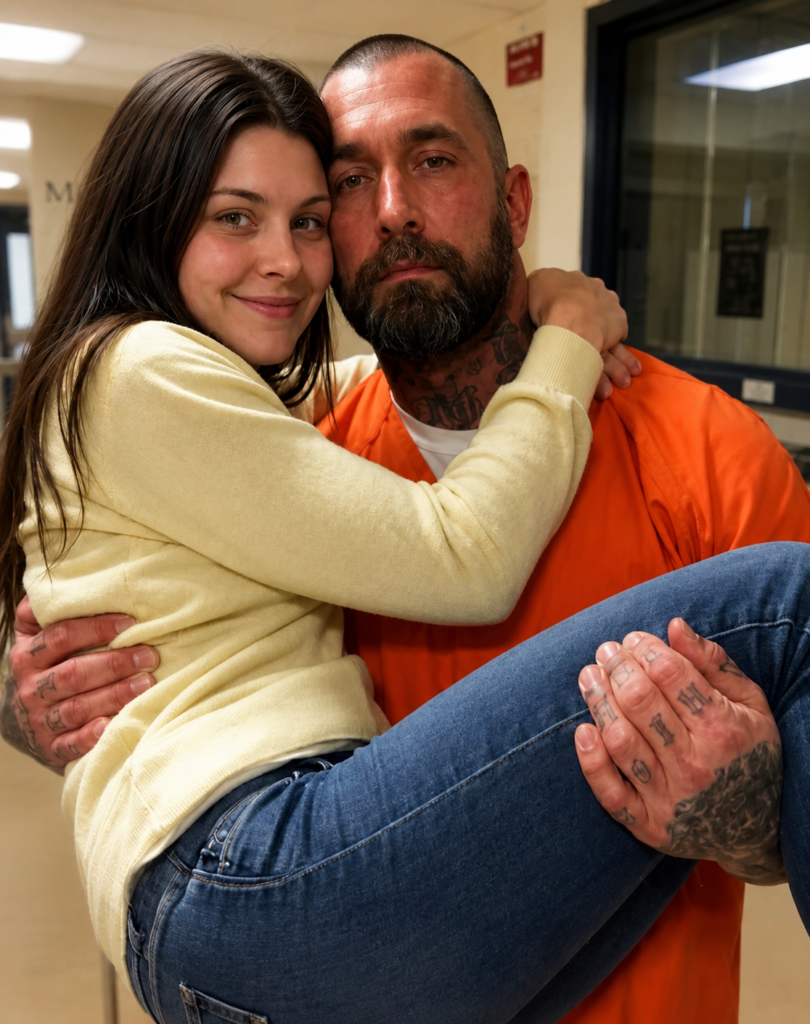
A week later, I stood inside a prison visiting room and married Jonah through a sheet of scratched security glass.
He wasn’t what I expected.
Instead of arrogance, I found guilt.
Instead of anger, I found regret.
“I stole money,” he admitted during our first conversation as husband and wife. “Eighteen thousand dollars.”
“At least you’re honest.”
“But I didn’t steal six hundred thousand.”
That caught my attention.
Jonah explained how his cousin Dean had allegedly moved far larger amounts of money and used Jonah’s smaller crime as cover.
“Why didn’t you fight back?” I asked.
He looked away.
“Because part of me believed I deserved it.”
For the first few months, our marriage remained exactly what I intended it to be.
A transaction.
I visited twice a month because the checks kept arriving.
I wrote letters because I was being paid.
Nothing more.
But Jonah always answered.
His letters were thoughtful, funny, and unexpectedly kind. He remembered small details about Owen’s exams, my work schedule, and even stories I’d forgotten telling him.
Slowly, the distance between us began to shrink.
One evening, after a long shift, I sat on the kitchen floor reviewing documents from Jonah’s case.
Something didn’t make sense.
A transfer authorization carried Jonah’s signature on a date when he was already in custody.
Owen crouched beside me.
“So he couldn’t have signed it?”
“No.”
“Then somebody else did.”
That discovery became the beginning of a three-year fight.
Together, Owen and I built timelines, collected records, compared signatures, and met with lawyers willing to listen.
Piece by piece, a different story emerged.
Dean had forged documents.
Records had disappeared.
Evidence had been buried.
Even Jonah begged me to stop.
“You’re wasting your life,” he told me during one prison visit.
“No,” I replied. “I’m choosing how to spend it.”
It was during that conversation that I realized I loved him.
Not because he was perfect.
Not because he was innocent.
But because he had finally started telling the truth.
Eventually, the appeal succeeded.
The conviction connected to the larger theft was overturned, and Jonah walked free.
I expected relief.
Instead, he looked terrified.
For the first time in years, he had to live outside prison walls.
I invited him home.
For a week, we tried to build a normal life.
Then, on the eighth night, Jonah carried a black box into my kitchen.
He set it carefully on the table.
“What’s in it?” I asked.
“The truth.”
My stomach tightened.
“Open it.”
Inside was a cream-colored notebook.
I opened the first page and felt the air leave my lungs.
The notes were about me.
No active parents.
Minor brother dependent.
Behind on rent.
Likely compliant if payments remain consistent.
My hands started shaking.
“She investigated me.”
Jonah lowered his eyes.
“Yes.”
Every hardship I’d endured had been documented.
Every weakness had been measured.
To Celeste, I hadn’t been a person.
I had been a strategy.
Beneath the notebook sat another document.
A trust agreement.
My name appeared on it.
According to the paperwork, Jonah’s father had established a safeguard years earlier. If Jonah’s conviction was ever overturned, his legal spouse would automatically gain co-trustee authority over substantial family assets.
Suddenly everything made sense.
Celeste hadn’t chosen me because I was responsible.
She had chosen me because she believed I was poor enough to control.
“You knew?” I asked Jonah.
His silence answered first.
“Six months,” he finally admitted. “I’ve known for six months.”
The betrayal hurt more than I expected.
I had spent years fighting for him.
Years standing in prison lines.
Years defending him.
And he had kept this secret.
“You made me part of your family’s war,” I said.
“I thought I was protecting you.”
“No. You were protecting yourself.”
That night, I told him to leave.
For the first time since we met, Jonah obeyed without argument.
The next morning, Celeste called.
She invited me to her office.
Waiting on her desk was a check for one hundred thousand dollars.
“Sign the resignation papers,” she said. “Walk away.”
The amount could have solved nearly every problem in my life.
Owen’s education.
Reliable transportation.
Financial security.
Everything.
But I pushed the check back across the desk.
“You thought I’d disappear once I got paid,” I said.
Celeste’s smile vanished.
A few weeks later, during a donor event for the foundation, I walked onto the stage carrying the black box.
The room fell silent.
I revealed the notebook.
I read her notes aloud.
I exposed the manipulation, the forged records, and the years of deception.
People who had admired Celeste suddenly saw her differently.
Board members demanded answers.
Lawyers got involved.
Investigations followed.
Within months, Dean faced criminal charges, Celeste lost control of the foundation, and the truth finally surfaced.
Life didn’t magically become perfect afterward.
Trust takes longer to rebuild than reputations.
Jonah apologized countless times.
But apologies weren’t enough.
He had to prove himself.
Every day.
Slowly, he did.
One evening, months later, he stood in my doorway while I reviewed scholarship applications.
“I should have trusted you,” he said.
“Yes,” I replied.
“I’ll spend the rest of my life proving I’ve learned that.”
For once, I believed him.
The first time I married Jonah, I did it because fear left me no other option.
The second time I chose him because I wanted to.
And that choice, unlike the first one, belonged entirely to me.
{"post":106033,"page":2,"next":[{"id":106030,"title":"My Five-Year-Old Daughter Tugged My Arm in the Swimming Pool Changing Room and Whispered, \u0027Mommy, We Have to Save Daddy! That Lady Put Him in Her Locker!\u0027","url":"https:\/\/new24.info\/106030"},{"id":106027,"title":"My Mom Cooked Meals for a Homeless Man Who Lived Behind Our House for 20 Years \u2013 The Day After Her Passing, He Took My Hands in His and Said Something That Changed My Life","url":"https:\/\/new24.info\/106027"},{"id":106021,"title":"I Married a Janitor to Spite My Wealthy Dad \u2014 When My Dad Came to Speak with My Husband, He Fell to His Knees at His Words","url":"https:\/\/new24.info\/106021"},{"id":106023,"title":"Giant Eagle captured in Bro!","url":"https:\/\/new24.info\/106023"},{"id":106019,"title":"Benefits of Drinking Water on an Empty Stomach: Morning Hydration, Energy Boost, and Digestion Support Explained While Separating Health Facts From Myths About Detox, Metabolism, and Wellness, Emphasizing That Consistent Daily Hydration Matters More Than Timing for Long-Term Health, Focus, and Overall Body Function \ud83d\udca7","url":"https:\/\/new24.info\/106019"},{"id":106012,"title":"He Invited His \u201cChildless\u201d Ex-Wife to Christmas to M0ck Her\u2014Then She Walked In with the Quadruplets He Abandoned.","url":"https:\/\/new24.info\/106012"},{"id":106009,"title":"Dog Barks at Coffin during Funeral, Suspicious Son Opens It and Finds It Empty","url":"https:\/\/new24.info\/106009"},{"id":106006,"title":"Mom Installs Baby Monitor in Son\u2019s Room and Gets Scared When She Sees Movement There","url":"https:\/\/new24.info\/106006"},{"id":106003,"title":"I OVERHEARD MY NEIGHBOR\u2019S DAUGHTER AND MY HUSBAND DISCUSSING THEIR AFFAIR \u2013 INSTEAD OF MAKING A SCENE, I INVITED HER TO OUR HOUSE THE NEXT DAY","url":"https:\/\/new24.info\/106003"},{"id":106000,"title":"Mocked for Marrying Her, Years Later They Regret Their Words","url":"https:\/\/new24.info\/106000"},{"id":105997,"title":"From Fear to Joy: How One Mom Overcame Pregnancy Challenges","url":"https:\/\/new24.info\/105997"},{"id":105994,"title":"David Letterman\u2019s question that left Jennifer Aniston very uncomfortable","url":"https:\/\/new24.info\/105994"},{"id":105990,"title":"US Senator and close Trump Ally Lindsey Graham Dead at 71","url":"https:\/\/new24.info\/105990"},{"id":105987,"title":"I Thought I\u0027d Be Alone at Graduation After My Parents Passed Away \u2013 Then Someone Covered My Eyes","url":"https:\/\/new24.info\/105987"},{"id":105980,"title":"Why Daily Showers After 65 May Do More Harm Than Good","url":"https:\/\/new24.info\/105980"},{"id":105981,"title":"If You Get Leg Cramps at Night, You Need to Know This Immediately","url":"https:\/\/new24.info\/105981"},{"id":105977,"title":"An Elderly Woman Asked Me to Marry Her as Her Final Wish \u2013 After She Passed Away, Her Lawyer Handed Me Her Hospital Bag and Said, \u2018She Chose You for a Reason\u2019","url":"https:\/\/new24.info\/105977"},{"id":105972,"title":"My Husband Returned from His Cruise with Shocking Surprise \u2014 He Missed One Tiny Detail That Made His Smile Disappear in Seconds","url":"https:\/\/new24.info\/105972"},{"id":105968,"title":"His Father Burned His Life, Then a Letter Arrived Years Later","url":"https:\/\/new24.info\/105968"},{"id":105957,"title":"\u201cShe Married an African Man at 21 and Left Us\u2026 But Every Year She Sent the Same Message\u201d","url":"https:\/\/new24.info\/105957"}]}