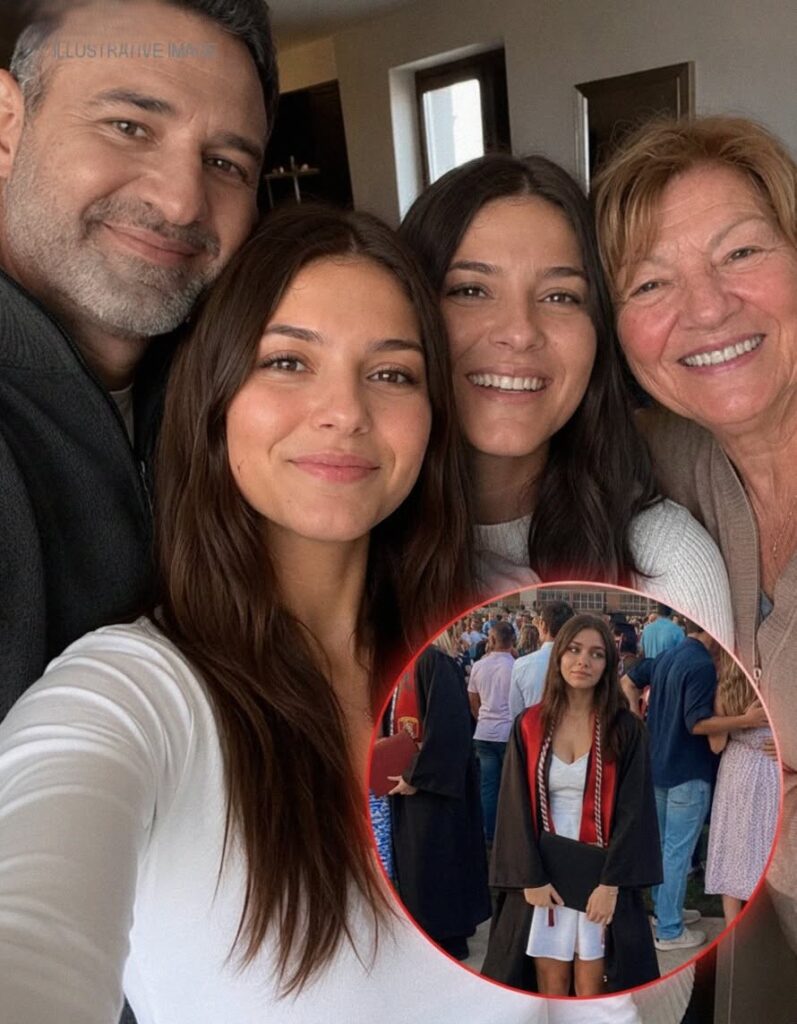
Then, just as I was slipping out of the ceremony, two warm hands covered my eyes from behind.
The voice that followed changed everything.
The house still smelled like cinnamon and old paper, even months after the funeral.
Every afternoon, I came home from school, dropped my backpack beside the door, and found Nana Ruth sitting at the kitchen table.
Her reading glasses usually rested halfway down her nose. A pen shook slightly between her fingers.
Whenever I entered, she hurried to hide whatever she had been writing beneath a dish towel.
“You’re home early, sugar,” she would say.
“It’s 4:15, Nana. I come home at the same time every day.”
“Do you?”
She would look toward the clock and smile.
“My goodness. Time gets away from me.”
I never asked what she was writing.
I assumed it was a bill, a grocery list, or one of the long letters she sometimes mailed to her sister in Georgia.
November had taken both of my parents on a rain-soaked highway.
By March, I had learned how to move through life without drawing attention.
I went to school.
I completed my homework.
I answered questions when teachers called on me.
But most days, I felt less like a person and more like a shadow pretending to be one.
“Did you eat lunch?” Nana asked one afternoon.
“Yes.”
“With anyone?”
“Some kids.”
It was not exactly a lie.
There had been children in the cafeteria.
They simply had not been sitting with me.
I had eaten a tuna sandwich alone at the corner table beside the vending machines, reading a paperback I had already finished four times.
At school, graduation was the only thing anyone talked about.
“My grandparents are flying in from Phoenix,” Madison announced during homeroom. “My mom already ordered six bouquets.”
“My entire family rented a house for the weekend,” Jacob added. “Even my cousins from Texas are coming.”
Then Madison turned toward me.
“What about you, Emily? Is your grandmother coming?”
“She’s going to try,” I said. “Her knees are bad.”
“That’s so sweet.”
I gave her the smile I had practiced in the bathroom mirror.
The smile that said I was fine.
The smile that asked people not to look any deeper.
That evening, Nana placed a plate of mashed potatoes in front of me and watched as I moved them around without eating.
“You still haven’t tried on your graduation gown.”
“I will.”
“The ceremony is in eleven days.”
“I know.”
She reached across the table and covered my hand with hers.
Her skin felt thin and warm.
“Your mother would have been unbearable right now,” she said with a quiet laugh. “She would have cried every morning and bought every flower in town.”
“Please don’t.”
“Emily—”
“I don’t want to talk about it.”
Nana nodded slowly.
Then she rose from the table and shuffled toward the counter.
An old blue cookie tin sat beside the bread box.
She opened it, slipped something inside, and pressed the lid closed with unusual care.
“What’s in there?” I asked.
“Recipes.”
“Since when do you hide recipes?”
“Since you became nosy.”
She winked, but something about her answer felt strange.
I let it go.
Back then, I let almost everything go.
Later that night, I heard her talking quietly on the telephone in her bedroom.
The walls were thin.
“I know it’s a lot to ask,” she whispered. “She won’t admit it, but she’s drowning. If there is any way at all…”
I pressed my forehead against the wall and closed my eyes.
When she emerged, I was waiting in the hallway.
“Who were you talking to?”
“Wrong number.”
“Nana.”
“Go to bed, sweetheart. You have school tomorrow.”
I returned to my room and stared at the cap and gown hanging from the closet door.
The gold tassel moved gently in the draft.
From the kitchen, I heard the cookie tin open again.
Then Nana’s voice floated through the house, barely more than a whisper.
“Please come home for her. Just once.”
I pulled the blanket over my head and pretended I had heard nothing.
The next morning, the kitchen smelled like burned toast and old coffee.
“I’m not going,” I announced.
Nana lowered her cup.
“To school?”
“To graduation.”
Her expression changed.
“Emily.”
“There’s no point.”
“You worked four years for that diploma.”
“I worked four years so Mom and Dad could see me get it.”
Her eyes softened.
“I know.”
“They won’t be there.”
“I know that too.”
“So why should I walk across a stage just to look at an empty chair?”
“The point is that you finish what you started.”
I pulled my hand away when she reached for it.
I regretted it immediately.
“Everyone else will have someone,” I said. “Parents, brothers, grandparents, aunts with glitter signs.”
“You’ll have me.”
“You can’t walk to the mailbox without stopping twice.”
The words came out more sharply than I intended.
Nana flinched.
I hated myself the moment I saw it.
“I’m sorry.”
“No,” she said quietly. “You’re right.”
“Nana—”
“My knees will not let me sit through a two-hour ceremony.”
“Then why are you pushing me to go alone?”
She looked toward the blue cookie tin.
“Because some things are done for the people who cannot be there.”
“That isn’t fair.”
“Life has never promised to be fair.”
I stood and walked toward the window.
Across the street, a boy in his graduation gown was practicing throwing his cap while his mother laughed and took pictures.
“Everyone will notice me,” I whispered. “They’ll know I’m the only person there without anyone.”
“They won’t be watching you.”
“They will.”
“Emily, look at me.”
I turned.
“Your mother chose your school colors the day you were born.”
I frowned.
“What?”
“She held you up and said, ‘My daughter is going to wear navy and gold one day.’”
“Nana, stop.”
“Your father saved every report card you ever brought home. They’re all in a box beneath my bed.”
My throat tightened.
“Why are you telling me this?”
“Because you think walking across that stage means nothing.”
“They’re gone.”
“Love isn’t.”
The room became very quiet.
“Get the diploma,” she whispered. “One last day. That’s all I am asking.”
I looked at her.
Her shoulders had become more rounded since the accident. Her hair had turned completely white.
“Okay.”
Her eyes widened.
“You’ll go?”
“I’ll go.”
Her smile made it seem as though I had handed her the world.
The night before graduation, I ironed my gown in the living room.
The television played an old game show neither of us watched.
I put on the gown and studied myself in the hallway mirror.
My smile looked wrong.
Like a mask that had been made for someone else.
“You’ll do wonderfully tomorrow,” Nana called from her chair.
“Sure.”
“I mean it.”
“I know.”
I stared at the girl in the mirror and thought, One last day.
Then I could disappear into the rest of my life.
The auditorium was already crowded when I arrived.
Families whispered, laughed, waved, and took photographs.
I sat in row G with the gown sticking to my back.
A girl beside me turned and smiled.
“Is your family here? I saw a huge group near the front holding a banner.”
“No.”
Her smile faltered.
“It’s just me today.”
“Oh. Well, good luck.”
“Thanks.”
She immediately turned around and waved to her parents.
I pressed my hands against my knees and tried to breathe.
The ceremony began.
One by one, students crossed the stage.
Each name was followed by cheers.
“That’s my baby!”
“We love you!”
“Go, Mia!”
I closed my eyes.
“Mom. Dad,” I whispered. “I’m here.”
Then the principal called my name.
“Emily Carter.”
My legs moved automatically.
The stage seemed much longer than it had during rehearsal.
I shook the principal’s hand and accepted the diploma.
When I turned toward the audience, I heard polite applause.
It was soft.
Distant.
The kind people gave a stranger because silence would seem cruel.
I forced myself to smile.
“Do not cry,” I whispered. “Not here.”
I stepped off the stage and held the diploma so tightly that the paper bent beneath my fingers.
The exit was only twenty feet away.
I could make it.
A classmate passed me with her mother.
“Mom, this is Emily. We had chemistry together.”
The woman smiled brightly.
“Where are your parents, sweetheart? You should join our photograph.”
“They couldn’t make it.”
My voice cracked.
“You go ahead.”
“Are you sure?”
“I’m sure.”
I kept walking.
Just reach the door.
Behind me, someone called my name.
“Emily! Wait!”
I did not turn.
If one more person gave me that sympathetic look, I knew I would fall apart in the middle of the gymnasium.
Five steps.
Four.
Three.
Then two large hands covered my eyes.
I froze.
The hands were warm and strangely familiar.
A man spoke close behind me.
“Guess who finally made it?”
The voice was deep and rough, as though its owner had not slept in days.
My heart slammed against my ribs.
“Who are you?”
“Take a guess, kiddo.”
My hands moved to his wrists.
They were solid and calloused.
“I don’t know that voice.”
“You did when you were six. You used to fall asleep on my shoulder during fireworks.”
The diploma slipped from my fingers.
“That’s impossible.”
My knees weakened.
“You’re overseas. Nana said no one could reach you.”
“Nana said a lot of things.”
The noise of the gymnasium faded around me.
For one impossible moment, the entire world became two warm hands and a voice I had not heard in almost two years.
“Are you really here?” I whispered.
“I’m here, Em.”
“How?”
“Turn around.”
His hands lifted.
I spun toward him.
Standing behind me in a crisp military dress uniform was my mother’s younger brother.
“Uncle Daniel?”
His smile trembled.
“Hello, kiddo. Sorry I’m late.”
I stared at him.
He had my mother’s eyes.
“You’re supposed to be overseas.”
“I was.”
“They said you couldn’t come.”
“A lot of people said a lot of things.”
He wiped at one eye.
“But your grandmother said something louder.”
“Nana?”
“She wrote me a letter several weeks ago. She said her granddaughter was about to walk across a stage without anyone there to cheer.”
“She asked you to come?”
“She did not ask.”
He smiled.
“She told me. There is a difference. When Ruth tells you something, you listen.”
The tears I had been holding back all morning finally escaped.
“I almost didn’t come.”
“I know.”
He opened his arms.
“That is why I had to.”
I fell against him.
The rough fabric of his uniform pressed against my cheek.
“I am so proud of you,” he whispered. “Do you understand me?”
“You came all this way just for this?”
“Just for you. And there is no ‘just’ about it.”
I cried against his shoulder the way I had not allowed myself to cry since my parents’ funeral.
“Your mother would have been causing a scene,” he said softly. “She would have been louder than every person in this building.”
“I miss her.”
“So do I.”
He pulled back and held me by the shoulders.
“But listen carefully. You are not alone. Not today, and not tomorrow.”
I nodded.
“Now,” he said, “there is someone else who wants to see your diploma.”
He turned me toward the lawn outside the auditorium.
Under the shade of a large oak tree sat Nana Ruth in a folding chair.
A tiny American flag rested in one hand.
A tissue was crumpled in the other.
She was smiling as if the sun had finally returned.
“Nana!”
“I told you I would find a way,” she called. “Did you really think I would miss this?”
I ran to her.
I did not care that my cap nearly fell off or that the gown tangled around my legs.
I dropped to my knees and buried my face in her lap.
“You wrote to him.”
Her fingers moved gently through my hair.
“Some surprises are worth keeping.”
“You knew the entire time.”
“I hoped.”
“You were right.”
She smiled.
“I’m right more often than you think.”
Uncle Daniel knelt beside us and rested a hand against my back.
For the first time since the accident, we felt like a family again.
Not the same family.
Not the one I had lost.
But something real.
Something strong enough to hold the broken pieces.
I looked toward the bright blue sky.
It was exactly the kind of sky my mother had loved.
“Mom. Dad,” I whispered. “I wasn’t alone after all.”
No answer came from above.
There was no sudden wind or perfect sign.
There was only Nana’s hand in my hair, Uncle Daniel’s arm around my shoulders, and my diploma resting in the grass beside us.
But somehow, that was enough.
Because for the first time in months, I could imagine my parents watching.
And in my heart, I knew they were cheering louder than anyone.
{"post":105987,"page":2,"next":[{"id":105980,"title":"Why Daily Showers After 65 May Do More Harm Than Good","url":"https:\/\/new24.info\/105980"},{"id":105981,"title":"If You Get Leg Cramps at Night, You Need to Know This Immediately","url":"https:\/\/new24.info\/105981"},{"id":105977,"title":"An Elderly Woman Asked Me to Marry Her as Her Final Wish \u2013 After She Passed Away, Her Lawyer Handed Me Her Hospital Bag and Said, \u2018She Chose You for a Reason\u2019","url":"https:\/\/new24.info\/105977"},{"id":105972,"title":"My Husband Returned from His Cruise with Shocking Surprise \u2014 He Missed One Tiny Detail That Made His Smile Disappear in Seconds","url":"https:\/\/new24.info\/105972"},{"id":105968,"title":"His Father Burned His Life, Then a Letter Arrived Years Later","url":"https:\/\/new24.info\/105968"},{"id":105957,"title":"\u201cShe Married an African Man at 21 and Left Us\u2026 But Every Year She Sent the Same Message\u201d","url":"https:\/\/new24.info\/105957"},{"id":105954,"title":"NBC and CBS Acto, at 39\u2026 -","url":"https:\/\/new24.info\/105954"},{"id":105951,"title":"At 55 Years Old, Jennifer Lopez Stuns Fans with Bold On-Stage Kiss During Pride Celebration -","url":"https:\/\/new24.info\/105951"},{"id":105946,"title":"Desperate Young Woman Escapes Abusive Stepmother And Encounters Powerful Mysterious Billionaire","url":"https:\/\/new24.info\/105946"},{"id":105942,"title":"For Twelve Years She Hid a Tiny Tattoo\u2014Then a Stranger Recognized It and Changed Everything","url":"https:\/\/new24.info\/105942"},{"id":105939,"title":"I returned home from military service, hoping to see my wife\u2019s smile. Instead, I found a coffin in the middle of the living room. \u201cShe d:ied in childbirth\u2026\u201d","url":"https:\/\/new24.info\/105939"},{"id":105930,"title":"While I was on vacation with my cousins, my phone lit up with one message: \u201cGet on a plane home. Don\u2019t tell your parents you\u2019re coming.\u201d When I landed, an attorney and two investigators","url":"https:\/\/new24.info\/105930"},{"id":105935,"title":"These are the signs that he is cr\u2026 See more -","url":"https:\/\/new24.info\/105935"},{"id":105932,"title":"THEY FINALLY ADOPTED THEIR DR -","url":"https:\/\/new24.info\/105932"},{"id":105927,"title":"My mother-in-law hid my wedding dress and left me a maid\u2019s uniform along with a note that read, \u201cKnow your place\u201d; in front of 200 guests, I wore that outfit, held my father\u2019s hand, and walked down the aisle without crying, revealing a secret that would ruin their lives forever.","url":"https:\/\/new24.info\/105927"},{"id":105924,"title":"A widowed father was turned away at his own hotel with his sleeping daughter in his arms\u2026 but by the time the staff realized who he truly was, it was already too late.","url":"https:\/\/new24.info\/105924"},{"id":105921,"title":"He Told Me to Raise the Baby Alone\u2014Eighteen Months Later, He Saw Three Toddlers at Boston Logan Airport and Realized What He Had Lost","url":"https:\/\/new24.info\/105921"},{"id":105918,"title":"With deep sadness, we announce the passing of a multi-talented actor at the age of 82","url":"https:\/\/new24.info\/105918"},{"id":105916,"title":"Police are urging everyone to stay away from this area \ud83d\udc47\ud83d\ude28\ud83d\udea8 Full story below -","url":"https:\/\/new24.info\/105916"},{"id":105913,"title":"If your veins are visible in your hand, it is a signal of ca\u2026 See more\ud83d\udc47\ud83c\udffb -","url":"https:\/\/new24.info\/105913"}]}