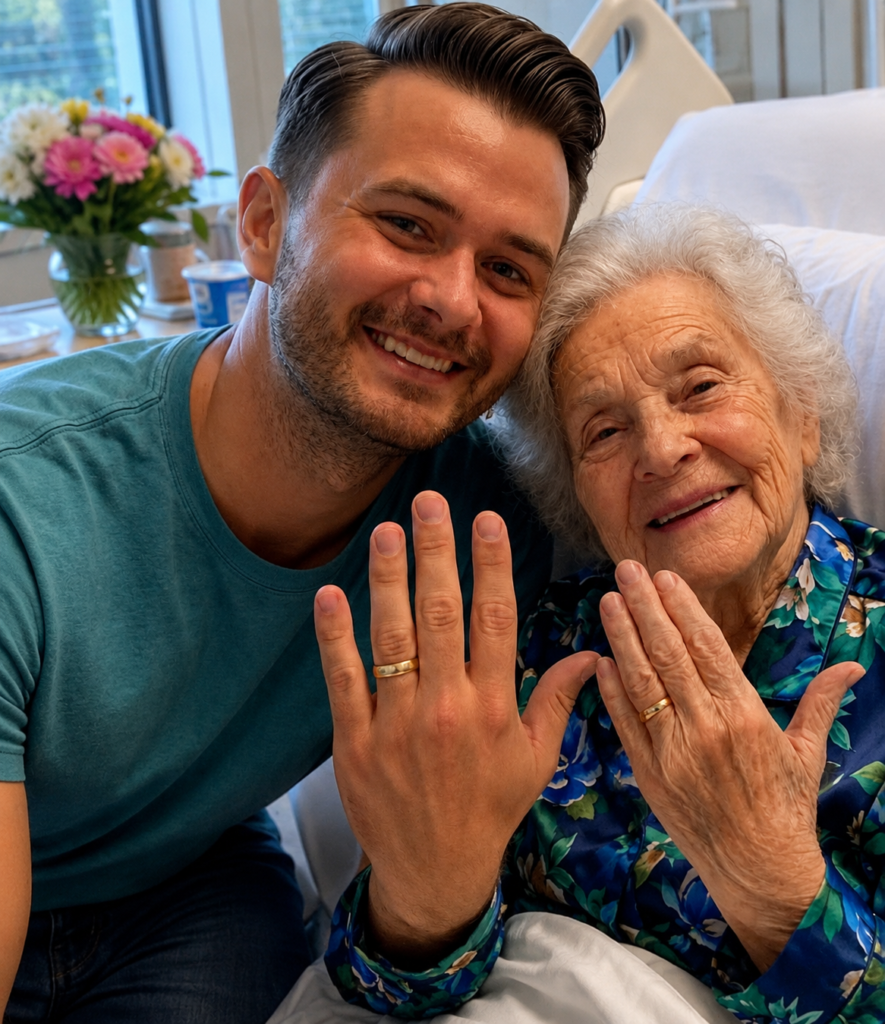
After a year of working there as an orderly, it had begun to feel more like home than most places I had known.
I grew up in foster care.
That kind of childhood teaches you to recognize kindness in small things.
A cup of coffee left waiting for you.
Someone remembering your birthday.
A person asking how you are and actually waiting for the answer.
The nursing home had plenty of those moments.
But most of the residents barely noticed me when I first arrived.
Except Gloria.
Gloria was eighty-two years old, stubborn, sharp-minded, and somehow capable of making everyone around her smile without even trying.
The first time I brought her breakfast tray, she studied me carefully.
“You’re new,” she said.
“Yes, ma’am.”
“But you don’t move like someone new.”
I smiled. “What does that mean?”
“You carry that tray like you’ve been carrying things for people your whole life.”
Her words caught me off guard.
“Something like that,” I said. “I’m Daniel.”
“Well, Daniel,” she replied, patting the chair beside her bed, “sit down for a minute and tell me about yourself.”
No one had asked me that in years.
From that morning on, sitting with Gloria became part of my routine.
I brought her tea after my shift, and she told me stories about growing up on a farm, dancing in the kitchen with her late husband, and sneaking apples from a neighbor’s orchard when she was a child.
She spoke about almost everything.
Except family.
No one ever came to see her.
One evening, while stirring her tea, she said, “I had a nephew once. Marcus.”
“Once?”
“He stopped visiting when he realized I wasn’t going to die quickly.”
I didn’t know what to say.
Gloria smiled faintly.
“He’ll come back when he hears I’m gone. People have a way of remembering you when they think there’s something to collect.”
“You don’t sound angry.”
“Bitterness is a house I refuse to live in.”
That was Gloria.
She could make pain sound like wisdom.
The only thing I never understood was the old canvas bag she carried everywhere.
It was faded, frayed, and much too worn to be valuable.
If a nurse tried to move it, Gloria immediately reached for it.
“Is that bag special?” I asked once.
“Everything that matters to me is inside it.”
“Can I see?”
She smiled gently.
“Maybe one day.”
So I never asked again.
Everyone deserves one corner of the world that belongs only to them.
Sometimes, I saw the edge of a small photograph tucked near the top of the bag.
Whenever Gloria noticed me looking, she closed it quickly.
Sarah, another orderly and my closest friend at the home, teased me about Gloria one afternoon.
“You know she’s basically adopted you, right?”
“She’s lonely.”
Sarah raised an eyebrow.
“Daniel, that woman lights up every time you walk into the room.”
I looked away.
I wasn’t used to being anyone’s favorite person.
A few weeks later, I noticed Gloria’s hands shaking during a routine check.
Her skin looked pale.
Her breathing had changed too.
There was a faint rattle in her chest that made my stomach tighten.
She noticed me watching and pulled the old bag closer.
Three weeks later, an ambulance took her to the hospital.
I rode with her because there was no one else to call.
During her stay, I visited every day.
One afternoon, she patted the mattress beside her.
“Sit down, Daniel.”
I sat.
Her hand found mine.
It was thin, fragile, but still warm.
“I need to ask you something.”
“Anything.”
She looked directly into my eyes.
“I have one last wish.”
The room suddenly felt too quiet.
“I don’t think I have much time left,” she continued. “And I don’t want to leave this world knowing I never had someone I could call my husband.”
I thought I had misunderstood her.
Then she asked:
“Will you marry me?”
For several seconds, I couldn’t speak.
The heart monitor continued beeping beside us.
“Gloria…”
“Don’t answer now,” she said softly. “Go home. Sleep on it. But don’t say no just because you’re afraid of what people will think.”
That was exactly what frightened me.
That night, I didn’t sleep.
By sunrise, I drove to the nursing home and found Sarah in the break room.
“I need to tell you something,” I said. “And please don’t laugh.”
She lowered her coffee.
“You look terrible.”
“Gloria asked me to marry her.”
Sarah didn’t laugh.
She didn’t even blink.
Instead, she rubbed her forehead.
“Please tell me you said no.”
“I haven’t answered.”
“Daniel, do you understand how this will look?”
“I know.”
“No, I don’t think you do. You’re thirty-four. She’s eighty-two. You work at the home where she lived. People will say you manipulated her.”
“I know.”
“Management could fire you.”
“I know.”
“You could lose your career.”
I stared at the floor.
“She’s dying, Sarah. She’s alone. She asked me for one thing.”
“She could have asked for anything else.”
“But she didn’t.”
Sarah studied me for a long moment.
“You’re going to say yes.”
“I don’t know if what I might lose matters more than what she has already lost.”
Sarah sighed.
“That’s always been your problem.”
“What is?”
“You never think you have anything worth protecting.”
That afternoon, I returned to Gloria’s hospital room.
She was sitting upright with a paperback open in her lap.
When she saw me, she smiled.
“You came back quickly.”
“I have my answer.”
She closed the book.
“I want to do it.”
Her eyes filled with tears.
“Then yes?”
“Yes.”
She squeezed my hand with the little strength she had left.
Beside her bed, the old canvas bag rested beneath her arm.
One week later, Gloria and I were married in her hospital room.
A chaplain performed the ceremony.
Sarah stood as our witness.
Gloria wore a soft pink cardigan and the same determined smile she had worn the day we met.
I knew people would never understand.
But I wasn’t marrying her for romance.
I was giving a lonely woman one final moment of belonging.
Three days later, Gloria died in her sleep.
My hand was resting beneath hers.
At her funeral, I stood in a borrowed black coat, feeling hollow and unsure of what would happen next.
That was when an older man approached me across the wet grass.
“My name is Mr. Charleston,” he said. “I was Gloria’s attorney.”
He carried the old canvas bag.
Then he placed it in my arms.
It felt heavier than it should have.
“She chose you for a reason,” he said.
Before he could explain, another man stepped between us.
He wore a gray suit and carried himself like he owned the cemetery.
He was around fifty, with thinning hair and a tight expression.
“You must be Daniel,” he said.
I already knew who he was.
“I’m Marcus. Gloria’s nephew.”
“She mentioned you.”
“I’m sure she did.”
His eyes traveled over me with open disgust.
“A thirty-four-year-old orderly marrying an eighty-two-year-old woman days before her death.”
“It wasn’t like that.”
“It never is.”
Mr. Charleston tried to interrupt, but Marcus continued.
“I’ll contest the marriage. The will. Everything. You took advantage of a vulnerable woman, and I’ll make sure everyone knows it.”
My fingers tightened around the bag.
“I didn’t take anything from her.”
“Then give me that.”
I looked at Mr. Charleston.
He gave the smallest shake of his head.
“I need time to think,” I said.
Then I walked away.
By Monday, everyone at the nursing home seemed to know.
Conversations stopped when I entered rooms.
People stared.
Even some of the residents looked at me differently.
Sarah found me inside a supply closet folding towels.
“Management wants to meet with you on Wednesday,” she said. “Formal inquiry.”
“I expected that.”
“You need a plan.”
“I’m giving everything back.”
She stared at me.
“Whatever Gloria left,” I continued. “Marcus can have it.”
“That’s exactly what he wants.”
“He’s family.”
“You were her family.”
“He’s blood.”
“So what?”
I kept folding towels.
“I don’t want anyone believing I married her for money.”
That night, I sat on my bed with the canvas bag in front of me.
I still had not opened it.
The zipper seemed to accuse me.
As though the moment I looked inside, I would become exactly what Marcus had called me.
Then my phone rang.
It was Mr. Charleston.
“Daniel, I didn’t get to finish speaking at the funeral.”
“What were you going to say?”
“Gloria expected Marcus to appear.”
I looked at the bag.
“She planned for everything,” he said. “Please open it before you make any decisions.”
“Planned for what?”
“You’ll understand when you read the letter.”
After the call ended, I stared at the bag for a long time.
Then I pulled the zipper open.
There was no money inside.
No jewelry.
No house keys.
No bank documents.
Only letters.
Hundreds of them.
Some were tied with faded ribbon.
Some were yellow with age.
The earliest was dated 1972.
The most recent had been written only months before Gloria died.
Beneath the letters was a cracked photograph of a young woman holding a baby.
And resting on top was a sealed envelope.
My name was written across it in Gloria’s trembling handwriting.
I opened it slowly.
The first sentence changed everything.
My dearest Daniel,
When I was seventeen years old, I gave birth to a baby boy and gave him away.
My hands began to shake.
I kept reading.
For fifty years, Gloria had written letters to the son she never got to raise.
She wrote on his birthdays.
At Christmas.
Whenever she wondered what kind of man he had become.
But she never knew where to send them.
By the time she finally found his records, he was already dead.
He had left behind one child.
A boy raised in foster care.
A boy who grew up to become an orderly in a nursing home.
Me.
The next day, Mr. Charleston arranged a meeting at his office.
Marcus sat across from me with his arms folded.
I took out Gloria’s letter and began reading aloud.
“I recognized you the moment you first walked into my room, Daniel. I had a photograph of your father. You have his eyes.”
My voice cracked.
“But I did not want you to come to me because of duty or pity. I wanted to know you as yourself.”
I lowered the letter.
The room was silent.
“The marriage,” I whispered. “She did it to protect me.”
Mr. Charleston nodded.
“If she had named you in the will, Marcus could have challenged your identity for years. But as her legal spouse, you became her immediate next of kin.”
Marcus leaned forward.
“This is ridiculous.”
Mr. Charleston slid a thick folder across the desk.
“Unsealed adoption records. Birth certificates. Family records. And a DNA test Gloria arranged last spring.”
Marcus looked at the folder.
“The result is ninety-nine point nine percent,” Mr. Charleston said. “Daniel is Gloria’s biological grandson.”
The color drained from Marcus’s face.
He opened his mouth.
Closed it.
Then stood and left without another word.
I reached into the canvas bag and removed the photograph.
Young Gloria sat smiling with a baby in her arms.
My father.
“She spent her whole life looking for him,” I said.
“She did,” Mr. Charleston replied. “And when she found you, she made sure you would never doubt where you came from.”
Gloria left me her small house, her savings, and every letter she had written.
But the greatest thing she left me was not property.
It was history.
A name.
A family.
Proof that I had not been forgotten.
One month later, I stood in Gloria’s house and hung the photograph above the mantel.
I used part of the money she left me to create a volunteer visitor program at the nursing home.
No resident would sit alone for weeks without a guest.
Not if I could help it.
Sarah helped organize the first group of volunteers.
That afternoon, she watched residents laughing with college students, retirees, and families who had signed up to visit regularly.
Then she placed a hand on my shoulder.
“She chose well,” she said.
I looked at Gloria’s photograph.
For most of my life, I believed I had no family.
The truth was that someone had been searching for me all along.
Gloria had not asked me to marry her because she feared dying alone.
She asked because she wanted to leave this world knowing that, for one brief moment, she had finally brought her family home.
{"post":105977,"page":2,"next":[{"id":105972,"title":"My Husband Returned from His Cruise with Shocking Surprise \u2014 He Missed One Tiny Detail That Made His Smile Disappear in Seconds","url":"https:\/\/new24.info\/105972"},{"id":105968,"title":"His Father Burned His Life, Then a Letter Arrived Years Later","url":"https:\/\/new24.info\/105968"},{"id":105957,"title":"\u201cShe Married an African Man at 21 and Left Us\u2026 But Every Year She Sent the Same Message\u201d","url":"https:\/\/new24.info\/105957"},{"id":105954,"title":"NBC and CBS Acto, at 39\u2026 -","url":"https:\/\/new24.info\/105954"},{"id":105951,"title":"At 55 Years Old, Jennifer Lopez Stuns Fans with Bold On-Stage Kiss During Pride Celebration -","url":"https:\/\/new24.info\/105951"},{"id":105946,"title":"Desperate Young Woman Escapes Abusive Stepmother And Encounters Powerful Mysterious Billionaire","url":"https:\/\/new24.info\/105946"},{"id":105942,"title":"For Twelve Years She Hid a Tiny Tattoo\u2014Then a Stranger Recognized It and Changed Everything","url":"https:\/\/new24.info\/105942"},{"id":105939,"title":"I returned home from military service, hoping to see my wife\u2019s smile. Instead, I found a coffin in the middle of the living room. \u201cShe d:ied in childbirth\u2026\u201d","url":"https:\/\/new24.info\/105939"},{"id":105930,"title":"While I was on vacation with my cousins, my phone lit up with one message: \u201cGet on a plane home. Don\u2019t tell your parents you\u2019re coming.\u201d When I landed, an attorney and two investigators","url":"https:\/\/new24.info\/105930"},{"id":105935,"title":"These are the signs that he is cr\u2026 See more -","url":"https:\/\/new24.info\/105935"},{"id":105932,"title":"THEY FINALLY ADOPTED THEIR DR -","url":"https:\/\/new24.info\/105932"},{"id":105927,"title":"My mother-in-law hid my wedding dress and left me a maid\u2019s uniform along with a note that read, \u201cKnow your place\u201d; in front of 200 guests, I wore that outfit, held my father\u2019s hand, and walked down the aisle without crying, revealing a secret that would ruin their lives forever.","url":"https:\/\/new24.info\/105927"},{"id":105924,"title":"A widowed father was turned away at his own hotel with his sleeping daughter in his arms\u2026 but by the time the staff realized who he truly was, it was already too late.","url":"https:\/\/new24.info\/105924"},{"id":105921,"title":"He Told Me to Raise the Baby Alone\u2014Eighteen Months Later, He Saw Three Toddlers at Boston Logan Airport and Realized What He Had Lost","url":"https:\/\/new24.info\/105921"},{"id":105918,"title":"With deep sadness, we announce the passing of a multi-talented actor at the age of 82","url":"https:\/\/new24.info\/105918"},{"id":105916,"title":"Police are urging everyone to stay away from this area \ud83d\udc47\ud83d\ude28\ud83d\udea8 Full story below -","url":"https:\/\/new24.info\/105916"},{"id":105913,"title":"If your veins are visible in your hand, it is a signal of ca\u2026 See more\ud83d\udc47\ud83c\udffb -","url":"https:\/\/new24.info\/105913"},{"id":105910,"title":"My Stepdaughter Who Always Despised Me Came Back Holding Twin Babies and Begged Me to Take Her In \u2013 What I Caught Her Doing in My Husband\u0027s Workshop Left Me Speechless","url":"https:\/\/new24.info\/105910"},{"id":105897,"title":"My Father Kicked Me Out After I Married His Driver \u2013 8 Years Later, He Came to Meet His Grandchildren for the First Time and Screamed, \u0027How Is This Possible?\u0027","url":"https:\/\/new24.info\/105897"},{"id":105902,"title":"Claudia Cardinale: See the Italian Film Legend at 86","url":"https:\/\/new24.info\/105902"}]}