
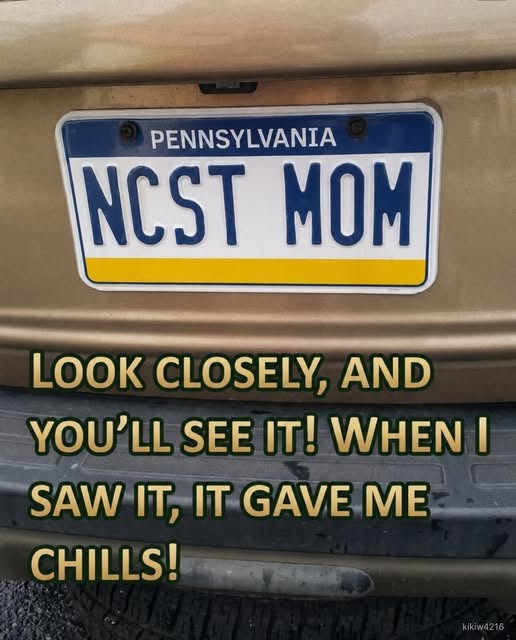
The plate, reading “370HSSV,” appeared to be nothing more than a random, government-issued sequence of characters. It lacked the flair of a vanity plate and the obviousness of a joke. For days, it sat in plain sight, a silent witness to the daily grind of city life, until a local resident named Jeffrey snapped a photo and uploaded it to the popular “The Bell Tower Times 2.0” Facebook page. He didn’t offer a hint or a caption explaining the humor; he simply let the image speak for itself, waiting to see if the internet’s collective curiosity would crack the code.
The reaction was instantaneous. Thousands of users flocked to the comment section, debating the meaning of the sequence. Some analyzed the letters for hidden initials, while others speculated about secret government codes. The tension in the thread grew as people realized they were missing something obvious. Then, the breakthrough happened: a user flipped the image upside down. Suddenly, the letters and numbers transformed. The “370HSSV” inverted to reveal a cheeky, unmistakable word that had been staring everyone in the face the entire time. The realization triggered a wave of laughter that rippled across social media, turning a boring piece of metal into a viral sensation.
This clever prank—whether intentional or a stroke of pure, accidental genius—exposed the limitations of bureaucratic oversight. Transport authorities in Western Australia maintain rigorous standards, rejecting hundreds of personalized plate applications every year for being inappropriate, offensive, or otherwise unsuitable for public display. They employ both automated filters and human eyes to scrub the roads of anything that might cause a stir. Yet, this particular plate had slipped through the cracks, bypassing every safety net designed to prevent exactly this kind of mischief.
The incident serves as a fascinating reminder of how we interact with the world around us. We often move through our days on autopilot, scanning our environment for patterns we expect to see while ignoring the subtleties that might challenge our perceptions. It took a digital community, armed with the simple ability to rotate an image, to reveal the truth hidden in plain sight. It was a moment of collective joy, a reminder that even in the most regulated and mundane aspects of our lives, there is always room for a little bit of human wit to break the monotony.
As the post continued to circulate, it sparked a broader conversation about the nature of humor and the evolution of public expression. What was once a private joke between a driver and the road had become a global talking point, proving that in the age of social media, the smallest, most ordinary discovery can capture the imagination of millions. The Kia Sportage and its infamous plate became more than just a vehicle; they became a symbol of the unexpected, a testament to the fact that sometimes, the best way to see the world clearly is simply to look at it from a different angle.