
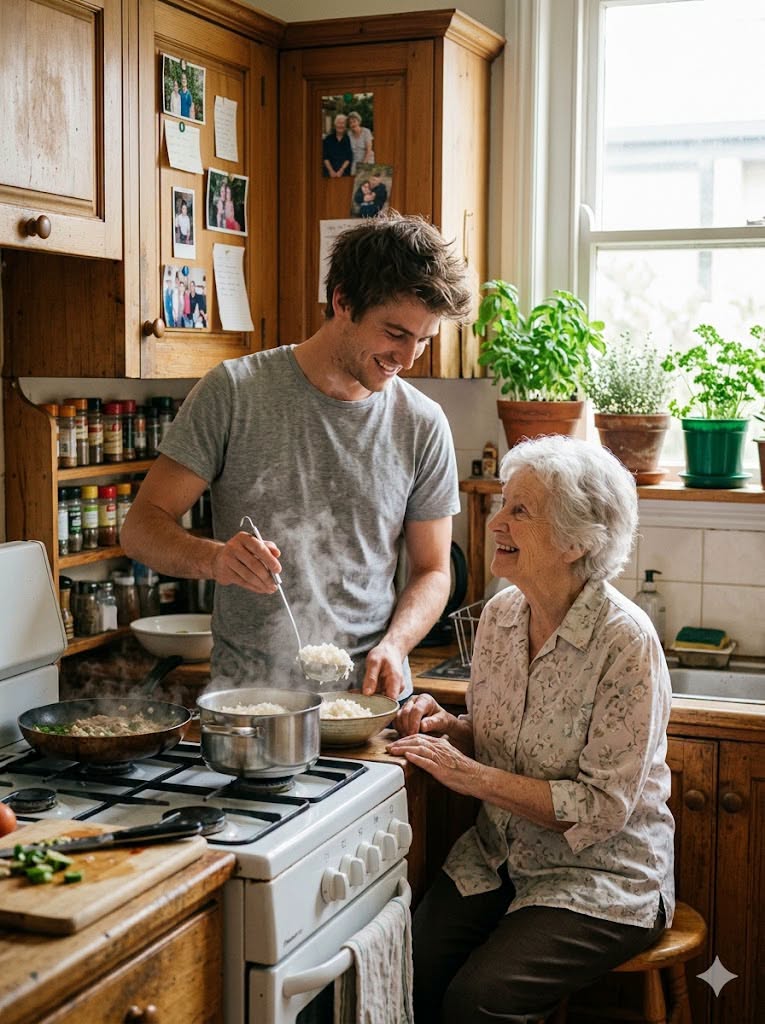
The following week I returned.
Partly because I still hoped we would resolve the misunderstanding.
Partly because something about Josephine stayed with me.
As the weeks passed, I noticed her cupboards were often nearly empty.
She struggled to carry groceries.
Simple household tasks had become exhausting.
Gradually, I began helping with small things beyond cleaning.
A few groceries.
A warm meal.
Collecting prescriptions.
Driving her to medical appointments when necessary.
None of it felt extraordinary.
It simply seemed like the natural response when another person needed help.
An Unexpected Friendship
Our conversations slowly became the best part of each visit.
Josephine spoke often about her late husband, the neighborhood as it once was, and the seasons of life that had shaped her.
She also spoke with sadness about the growing distance between herself and her adult children.
I tried not to judge them.
Families are often more complicated than they appear from the outside.
Distance, misunderstandings, old hurts, and busy lives can slowly separate people who once loved one another deeply.
Still, I could see that loneliness had become one of Josephine’s greatest burdens.
Sometimes what she needed most was simply someone willing to sit and listen.
Walking Beside Her
As her health declined, the practical responsibilities increased.
One afternoon she became seriously ill, and I called for emergency medical help.
After her hospitalization, she returned home for a time, where I continued helping however I could.
Her attorney also visited during this period to ensure that her wishes were clearly understood and properly documented.
Josephine approached those conversations with calmness and clarity.
She wanted her affairs to reflect the relationships that had sustained her during the final season of her life.
A Final Expression of Gratitude
After Josephine passed away peacefully, her attorney invited everyone together to read her final letter.
She had chosen to leave her home to me.
Her words made it clear that the house was not intended as payment for kindness.
Kindness cannot truly be purchased.
Rather, she hoped the home would continue serving others through someone she believed would care for it responsibly.
Her children struggled to understand the decision.
The legal process that followed focused on ensuring that Josephine’s documented wishes were respected.
It was a difficult season for everyone involved.
Carrying Her Legacy Forward
When everything was settled, I moved into the house.
Before long, I transformed the front sitting room into a quiet study space where neighborhood children could read, complete homework, and find encouragement.
The old house gradually became filled with new conversations, young voices, and steady hope.
Each child who walked through the front door reminded me of something Josephine had once taught me without ever saying it directly.
A home becomes meaningful not because of its size or value, but because of the welcome it offers.
What Endures
Looking back, I no longer think of Josephine’s house as the greatest gift I received.
The greater gift was learning that faithful care often grows through ordinary routines rather than dramatic moments.
Preparing a meal.
Running an errand.
Listening patiently.
Showing up again the following week.
Many acts of compassion are small enough that the world never notices them.
Yet they quietly restore dignity to another person’s life.
Josephine’s home continues to stand on Oak Street.
Its walls shelter different people now, but its purpose remains much the same.
It is still a place where someone is welcomed, where loneliness is met with companionship, and where simple acts of kindness continue to bear fruit long after the one who first inspired them has gone.
In the end, that is the legacy Josephine entrusted to me.
And it is worth far more than the house itself.