At first, I thought he was just being stubborn.
Then our nine-year-old son, Dylan, reached for the hem of Mark’s shirt.
And everything Mark had been hiding came into the light.
Mark and I had been married for twenty-two years. He was the most predictable man I knew. He liked routines, quiet weekends, early bedtimes, and plans made far in advance.
So when he suddenly announced that he had booked a family trip to a huge water park resort, I stared at him like he had grown a second head.
He had not checked the calendar.
He had not asked what I thought.
He had not even mentioned wanting a trip before.
“I just wanted to do something fun for Dylan,” he said, dropping the reservation papers onto the kitchen counter.
I picked them up slowly.
“A water park? Mark, you hate crowds.”
“People change, Liv,” he said. “It’ll be good for us.”
That was all he said.
Dylan, of course, was thrilled. For three weeks, he talked about slides, wave pools, snack stands, and lazy rivers as though we were going to another planet.
Then, the night before we were supposed to leave, Mark changed.
I was in our bedroom folding beach towels into a duffel bag when he came in and sat heavily on the edge of the bed.
He didn’t look at me.
He just stared at his hands.
“I don’t think I can go,” he muttered.
I stopped folding.
“What do you mean you can’t go?”
“I’m not feeling well. I think I’m coming down with something.”
Something in his voice was wrong.
“You were fine at dinner.”
“Just tired, Olivia. Really tired. Maybe chills.”
I walked over and reached for his forehead.
He flinched before my hand touched his skin.
That small movement made my stomach tighten.
“Mark, what is going on?”
“Nothing. I just need to sleep. You and Dylan can go without me.”
“You planned this trip. Dylan will be heartbroken.”
“He’ll survive. He has you.”
I stared at him.
“If you’re sick, we’ll go to urgent care. The clinic is still open.”
His face went pale.
“No.”
The word came out sharp and panicked.
“I am not going to a doctor.”
“Why not?”
“I said no, Olivia.”
For a long moment, neither of us spoke.
Then he stood abruptly and walked to the closet. When he turned back, his expression had changed. A decision had been made.
“Fine,” he said. “I’ll go.”
“You just said you were too sick.”
“I’m not sick. I panicked.”
He pulled shirts from a drawer without looking at me.
“My skin has been sensitive lately. It burns easily now. I can’t be in direct sun.”
“Since when? You’ve never had skin problems.”
“Since recently. It’s probably my blood pressure medication. I’ll wear a long-sleeve swim shirt.”
I glanced toward the window. Even at night, the air outside looked heavy and hot.
“A long-sleeve shirt in this heat?”
“Yes,” he snapped. “Can we please drop it?”
Then he grabbed his suitcase and left the room.
The door did not slam, but it closed hard enough to feel like one.
His explanation almost made sense.
People did become sun-sensitive.
Medication could cause reactions.
It could have been nothing.
But deep in my stomach, a cold knot formed and refused to loosen.
Something was wrong.
I just didn’t know what kind of wrong.
The next day, the heat at the water park was unbearable.
Everywhere I looked, fathers were chasing kids through splash pads, laughing with towels around their necks, or standing shirtless under umbrellas with red shoulders and sunscreen streaked across their backs.
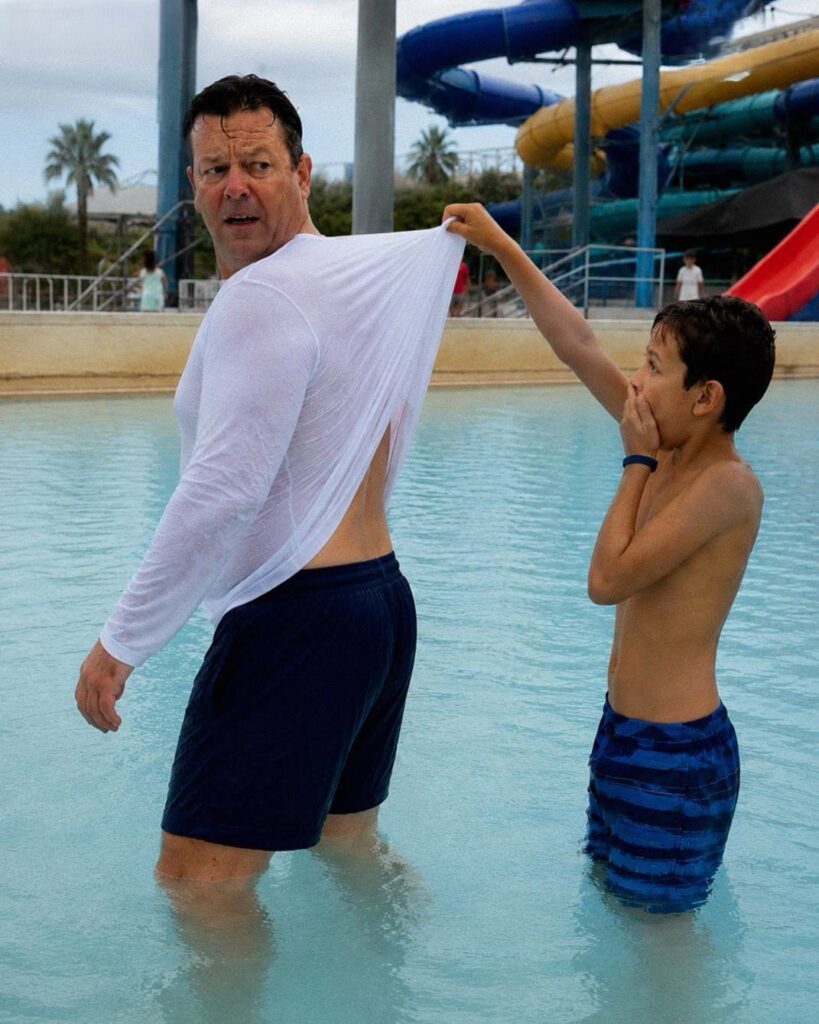
Mark stood near the lazy river in his soaked white shirt, arms folded tightly across his chest.
“Mark,” I said, shielding my eyes from the sun, “it’s too hot for that.”
“I know exactly how hot it is, Liv.”
“Then why won’t you take the shirt off?”
“I told you. My skin is sensitive.”
I had watched him all morning.
He barely spoke during the drive.
He stared out the window for miles.
He flinched every time Dylan accidentally brushed against him in the back seat.
This was not sun sensitivity.
This was fear.
“You’ve been acting strange since before we left,” I said quietly. “Are you sure you’re not sick?”
“I am not sick.”
“We can go back to the hotel. We don’t have to stay.”
“I just want to stay covered up.”
Before I could answer, cold water splashed around my ankles.
“Dad!” Dylan shouted from the edge of the lazy river. “Are you coming in?”
Mark’s face softened instantly.
“In a minute, buddy.”
Dylan climbed out, dripping and grinning, and ran toward us. His eyes landed on Mark’s shirt.
“Why are you still wearing that?”
“Protecting my skin from the sun.”
“You look ridiculous,” Dylan laughed, grabbing the wet hem. “Take it off!”
Mark jerked backward.
“Leave it alone.”
But Dylan was nine.
He saw a soggy shirt, not tension.
“It’s like a wet mop! Let me help!”
“Dylan, stop.”
“Come on, Dad!”
He tugged again, giggling.
Then Mark’s voice cracked across the noise of the water park.
“I said let go!”
Dylan froze.
The smile vanished from his face.
Several nearby families turned to look.
Mark closed his eyes. When he opened them and saw Dylan’s expression, something in his face broke.
“I’m sorry, Dyl,” he said quickly. “I didn’t mean to yell.”
“It’s okay,” Dylan whispered, looking down at his feet.
For a moment, Mark looked relieved.
Then Dylan suddenly grinned again.
“Gotcha!”
He lunged forward and yanked the bottom of Mark’s shirt up his back.
“No!” Mark gasped.
But it was too late.
The world seemed to go silent.
Across Mark’s chest and shoulders were bruises, faded yellow and purple.
And down his pale skin were long red scratches.
Fresh scratches.
Deep scratches.
The kind that did not come from slipping near a pool or bumping into furniture.
They looked intimate.
My breath left me.
“Mark,” I whispered.
He yanked the shirt down, his face chalk white.
“Olivia, don’t look at me like that.”
“What is this?”
“It’s not what you think.”
“Who did this to you?”
“Please, just let me explain.”
“You’re having an affair.”
The words left my mouth before I could stop them.
“No,” he said, eyes wide. “Liv, I swear—”
But I could not hear him.
The laughter, the water, the smell of sunscreen, the heat rising from the concrete — everything tilted around me.
My world cracked open in the middle of a crowded water park.
The drive home lasted two hours and felt like twenty.
Dylan fell asleep in the back seat, exhausted and unaware of the storm sitting in the front.
When we got home and he was upstairs, I locked our bedroom door and turned to Mark.
“Tell me right now,” I said. “Who is she?”
Mark sat on the edge of the bed with his face in his hands.
“It isn’t what you think.”
“I saw your chest. I saw the scratches. Tell me the truth.”
He looked up.
His eyes were red.
Not the red eyes of a guilty man trying to save himself.
The red eyes of someone who had been crying alone for a long time.
“I am not having an affair,” he said. “Please sit down.”
I sat.
Without another word, he pulled out his phone, tapped the screen, and handed it to me.
I braced myself for the worst.
A hotel room.
A younger woman.
A message I would never be able to forget.
Instead, I saw a photograph of an elderly woman in a wheelchair.
She looked fragile, but she was smiling. Both of her hands were wrapped around Mark’s.
“Her name is Evelyn,” he said. “She was eighty-four. She lived in a memory care facility a few towns over.”
I looked up slowly.
“My company started a volunteer program months ago. I signed up for Wednesday afternoons.”
He swallowed.
“I met Evelyn on my second visit. She had severe dementia. Most days she didn’t know where she was. But when she saw me, she looked right at me and called me by her son’s name.”
“Her son?”
Mark nodded.
“He died fifteen years ago. Her mind erased that part. She believed he had just gone missing.”
He rubbed his eyes.
“Every time the nurses corrected her, she panicked. Full panic attacks. So one day, I stopped correcting her.”
His voice cracked.
“I sat with her. I let her think I was him.”
The anger inside me was still there, but something else moved through it now.
Something quieter.
Something sad.
“As her dementia got worse,” he continued, “she became terrified of losing me again. On bad days, she would grab my arms, my shoulders, my chest. She didn’t know she was hurting me. She was just scared her son was going to disappear again.”
I looked down at the phone.
At Evelyn’s fragile hands.
At Mark’s tired face beside hers.
“Why didn’t you tell me?”
“How do I explain that I spend every Wednesday afternoon pretending to be someone’s dead son?” he asked.
His voice broke on the last word.
“The longer it went on, the harder it became to say anything.”
I thought about the past few months.
Every Wednesday he came home quieter than usual.
Every time I assumed it was work.
Stress.
Aging.
Life.
Then another realization settled over me.
“You planned the trip out of nowhere,” I said. “You’ve been miserable for weeks.”
Mark looked away.
A tear slid down his cheek, and he did not wipe it.
“She passed away,” he whispered. “Two weeks ago.”
My heart dropped.
“Oh, Mark.”
“I just wanted to be with you and Dylan,” he said. “I was grieving completely alone, and I didn’t know how to explain that either.”
He pressed both hands against his eyes.
“Who cries this hard over someone else’s mother? I felt like I was losing my mind.”
I moved across the room and sat beside him.
“Someone who loved her,” I said. “That’s who cries like that.”
He turned toward me, broken and exhausted.
“You carried her grief so she wouldn’t have to face it alone.”
For a long moment, neither of us spoke.
Then I reached for his hand.
“We’ll go to her memorial together,” I said. “Whatever her family needs. Whatever the staff needs. We’ll go.”
Three weeks later, we stood outside the memory care facility for a small memorial the staff had arranged.
The building was quiet, surrounded by flowers and soft afternoon light.
One of the nurses squeezed my hand.
“He was her whole world on Wednesdays,” she told me. “He made her last months beautiful.”
Dylan tugged on Mark’s sleeve.
“Dad?”
“Yeah, buddy?”
“Was she really your mom?”
Mark looked down at him with the careful expression parents get when a child asks something too big for a simple answer.
“No.”
Dylan frowned.
“Then why did you go every week?”
Mark thought for a moment.
“Because she needed a son for a little while,” he said. “And I wanted to be there for her.”
Dylan considered that seriously.
“Did she love you?”
Mark’s eyes filled.
“I think she did.”
He paused.
“And I loved her too.”
Dylan nodded.
“I’m glad you helped her.”
“Me too,” I said, slipping my arm through Mark’s.
For weeks, I had believed the marks on my husband’s skin were proof of betrayal.
They were not.
They were proof that a frightened old woman, lost inside her own fading mind, had found someone safe enough to hold onto.
And proof that sometimes love appears in the strangest, quietest places.
Not as romance.
Not as obligation.
But as one person choosing to stay when someone else is terrified of being left behind.
{"post":105557,"page":2,"next":[{"id":105553,"title":"My Grandma Asked Me to Find Her High School Sweetheart So She Could Dance One Last Dance with Him","url":"https:\/\/new24.info\/105553"},{"id":105548,"title":"Decades After Losing My Twin I Met A Stranger With My Face","url":"https:\/\/new24.info\/105548"},{"id":105543,"title":"Trump and Obama Exchange Heated Words During Live Appearance","url":"https:\/\/new24.info\/105543"},{"id":105539,"title":"Military Veterans Surprise Young Boy Who Carried His Disabled Friend Through Trail","url":"https:\/\/new24.info\/105539"},{"id":105534,"title":"Arrogant Husband Agreed To Divorce Before Discovering My Secret Billionaire Status","url":"https:\/\/new24.info\/105534"},{"id":105476,"title":"My Senior Prom Dance Unlocked A Stunning Police Secret Eight Years Later","url":"https:\/\/new24.info\/105476"},{"id":105529,"title":"Why More People Are Rethinking Toilet Paper and Choosing Greener Bathroom Habits","url":"https:\/\/new24.info\/105529"},{"id":105526,"title":"kaylestore.net","url":"https:\/\/new24.info\/105526"},{"id":105523,"title":"HOA Neighbor Had Our Cars Towed to Teach Us a Lesson\u2014She Had No Idea They Were Part of a Federal Assignment","url":"https:\/\/new24.info\/105523"},{"id":105517,"title":"\u2018I have a suite in his head\u2019: Barack Obama shares brutal verdict on Trump\u2019s \u201cobsession\u201d with him","url":"https:\/\/new24.info\/105517"},{"id":105513,"title":"My Maid of Honor Refused to Walk Down the Aisle 10 Minutes Before the Ceremony \u2013 When She Finally Told Me Why, I Canceled the Whole Thing","url":"https:\/\/new24.info\/105513"},{"id":105510,"title":"My husband d:ied 4 days before I gave birth to twins. Then my family stormed into my hospital room, my dad stole my newborn son, and handed him to my brother","url":"https:\/\/new24.info\/105510"},{"id":105507,"title":"Three weeks after my son\u2019s wedding, the wedding coordinator called and told me, \u201cSir, I recorded something awful. Come alone, and do not tell your children.\u201d","url":"https:\/\/new24.info\/105507"},{"id":105496,"title":"Karoline Leavitt, 28, Makes Her First Public Appearance 8 Weeks After Welcoming Baby \u2014 and Fans Can\u0027t Stop Talking About How She Looks \u2014 Photos","url":"https:\/\/new24.info\/105496"},{"id":105493,"title":"I Wanted to Impress My Classmates at Our 20-Year Reunion, So I Hired a Handsome Actor to Be My Plus-One \u2013 What Happened There Left Everyone Speechless","url":"https:\/\/new24.info\/105493"},{"id":105490,"title":"My Future SIL Planned Her Bachelorette Party at a Water Park, Certain I\u0027d Refuse Because I Was \u0027Too Big\u0027 \u2013 But What My Husband Did in Front of Everyone Made Her Gasp","url":"https:\/\/new24.info\/105490"},{"id":105477,"title":"Suri Cruise is all grown up and fans can\u2019t get over how much she looks like her dad","url":"https:\/\/new24.info\/105477"},{"id":105472,"title":"She Married an Older Man, Then Everything Changed in 10 Days","url":"https:\/\/new24.info\/105472"},{"id":105468,"title":"My husband ignored eighteen calls while our five-year-old son di3d whispering his name.","url":"https:\/\/new24.info\/105468"},{"id":105463,"title":"Why Daily Showers After 65 May Do More Harm Than Good","url":"https:\/\/new24.info\/105463"}]}