
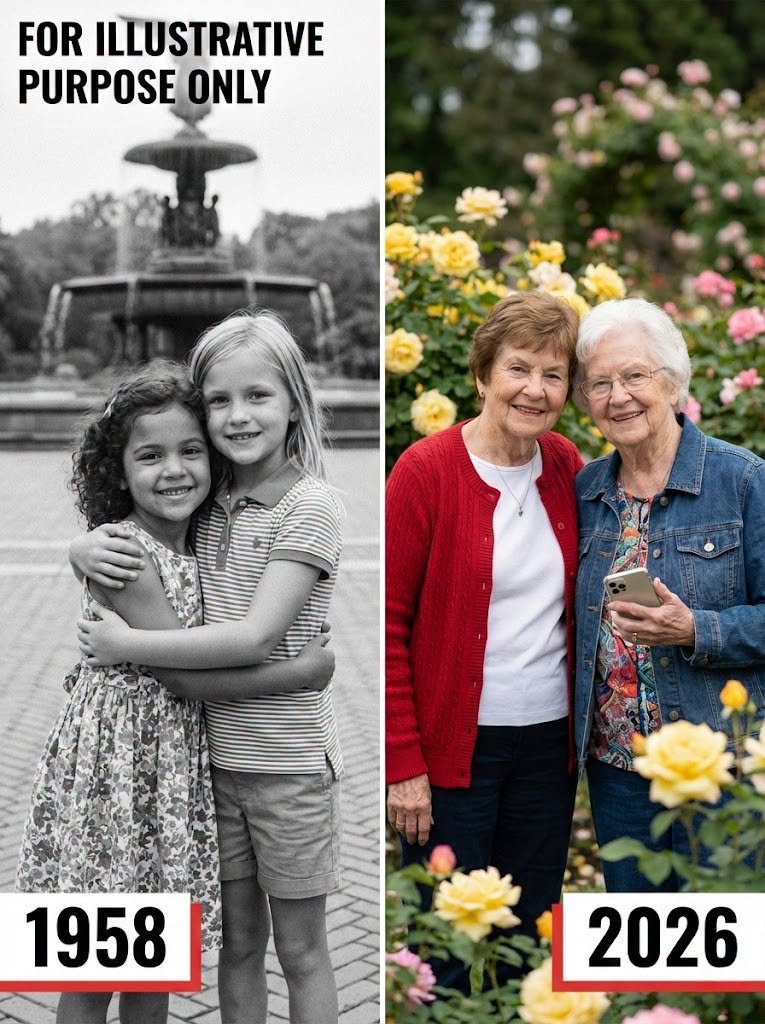
As the years passed, I built a full life.
I married, raised children, and later welcomed grandchildren.
Outwardly, life moved forward.
Inwardly, I often carried the quiet feeling that someone was missing.
There were moments when I caught myself imagining what Ella might have become.
Would we have looked alike?
Would we have remained close?
Those questions never truly disappeared.
Looking back now, I also understand my mother’s silence differently.
For many years, I interpreted it as indifference.
Age has taught me that some people become silent not because they do not love deeply, but because the weight of loss overwhelms their ability to speak.
Grief does not shape every heart in the same way.
An Unexpected Meeting
Many decades later, while visiting my granddaughter at college, I stopped at a small café.
There, I noticed a woman whose appearance stirred something familiar.
We began talking.
She introduced herself as Margaret.
As we shared pieces of our histories, similarities began to emerge that neither of us could easily explain.
Curiosity led us to search family records and eventually pursue DNA testing.
The results revealed something none of us had expected.
Margaret was not my lost twin.
She was my older sister.
Years before I was born, my mother had faced circumstances that led to placing a child for adoption.
It was a decision she had carried quietly for the rest of her life.
Seeing the Past With New Eyes
The discovery did not answer every question.
Ella remained absent from our lives.
Her loss remained real.
Yet another part of our family’s story, hidden for many years, finally came into the light.
As I reflected on everything that had happened, I found myself thinking less about secrets and more about burdens.
My mother had carried more than one profound sorrow.
The loss of one daughter.
The separation from another.
And the lifelong effort to continue living while carrying both.
I cannot fully understand every decision she made.
But I no longer judge them as quickly as I once did.
What Family Means
Meeting Margaret did not replace Ella.
No one can replace the person we have lost.
Instead, it reminded me that family stories are often more complicated than they first appear.
Some chapters are marked by joy.
Others by painful choices, unanswered questions, and wounds passed quietly from one generation to the next.
Healing begins not by pretending those wounds never existed, but by allowing truth to be spoken with compassion.
What Remains
Today, I carry memories of one sister I never had the chance to grow old with.
I also treasure the unexpected gift of getting to know another sister later in life.
Both have shaped me.
One through absence.
The other through rediscovered presence.
Life rarely unfolds according to the stories we imagine as children.
Yet even after many decades, truth still has the power to bring understanding, reconciliation, and gratitude for the relationships that remain.
Some questions are never fully answered.
Some losses are never fully healed.
But even after a lifetime of silence, a family can still discover new reasons to cherish one another while there is time.