
Nancy vanished during the early hours of February 1, 2026, from her home in Catalina Foothills, Arizona. Since then, her family has lived through a nightmare filled with false hope, dead ends, and increasingly disturbing discoveries.
Not long after her disappearance, mysterious emails began arriving at local television stations and TMZ. These messages immediately raised alarm because they contained details that were not publicly known. The sender accurately described the clothes Nancy wore the night she disappeared and mentioned a broken floodlight behind her home.
Those details suggested that whoever wrote the messages possessed firsthand knowledge of the crime.
The first email reportedly arrived on February 2, just over a day after Nancy vanished. It claimed she was “safe but scared.”
Soon afterward, a ransom demand followed.
The sender demanded $4 million in Bitcoin, giving Nancy’s family until February 5 to pay. If they failed to comply, the amount would increase to $6 million several days later. The sender emphasized that there would be no negotiations and ended the message with two chilling words:
“Or else.”
At that point, investigators had something potentially valuable. They had a ransom demand, a Bitcoin wallet, a timeline, and communications that appeared credible.
But the case would soon become even darker.
On February 6, another email arrived.
This one dramatically changed the direction of the investigation.
According to reports, the sender claimed Nancy had died accidentally and offered to return her body in exchange for money.
The message reportedly contained an unusual apology and suggested a transaction involving Nancy’s remains.
With that single email, investigators could no longer treat the case solely as a kidnapping. It now carried the terrifying possibility that Nancy had already been killed.
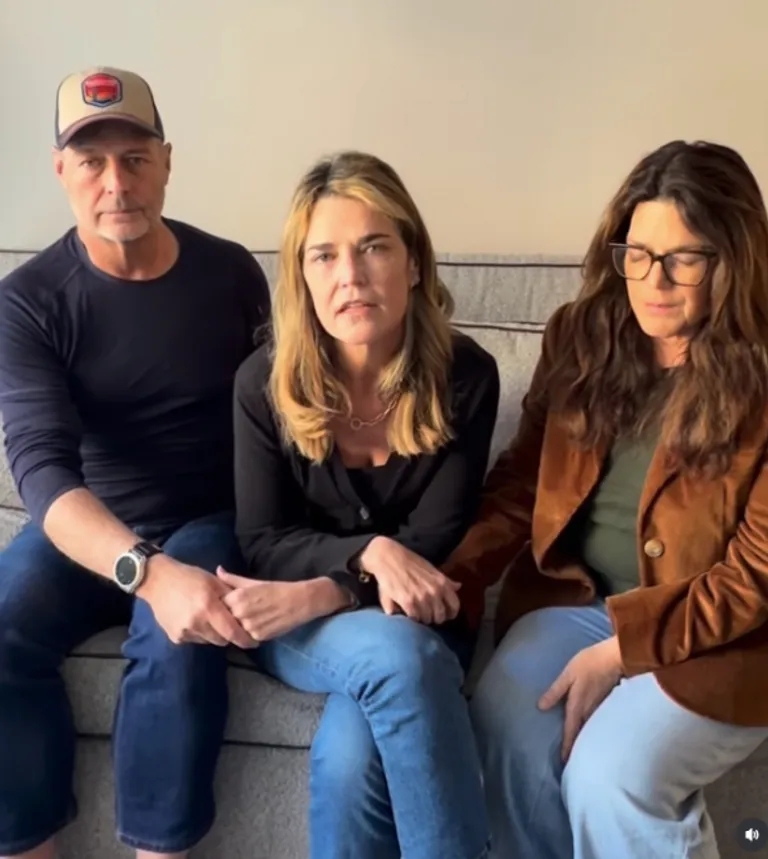
The following day, Savannah Guthrie appeared in an emotional video alongside her siblings, Camron and Annie.
Speaking directly to whoever was behind the messages, Savannah pleaded:
<blockquote>“We received your message and understand. We beg you now to return our mother to us, so that we can celebrate with her. This is very valuable to us, and we will pay.”</blockquote>
At the time, many viewers found her words unusual.
Today, they carry an entirely different meaning.
Investigators eventually categorized the communications into three groups: “the good, the bad, and the ugly.”
The “good” messages were the original ransom notes containing accurate details.
The “bad” message was the one claiming Nancy had died.
Then came the “ugly” messages — fraudulent attempts by scammers seeking to profit from the tragedy.
One alleged scammer, Derrick Callella, was accused of sending fake ransom texts to Nancy’s daughter Annie and son-in-law Tommaso demanding Bitcoin payments.
Additional con artists also emerged. In April, new emails claimed Nancy had been spotted in Mexico before later claiming she was dead.
One sender even offered to reveal the location of her body for half a Bitcoin.
Every false lead created fresh pain for a family already suffering unimaginable grief.
As the investigation stalled, authorities returned repeatedly to the original messages, hoping hidden clues remained buried inside the wording.
Working with FBI forensic psychologists, investigators developed a profile of the writer.
The person appeared educated, articulate, and knowledgeable about cryptocurrency. This profile conflicted with early assumptions that a cartel member might be responsible.
Instead, investigators began considering a different possibility.
Perhaps the abductor was an opportunist who saw a chance to exploit a wealthy, high-profile family, only for events to spiral out of control after Nancy either became ill or died unexpectedly.
One piece of evidence complicated that theory.
Doorbell camera footage reportedly showed a masked individual carrying a revolver outside Nancy’s home.
Yet the suspect behaved strangely. At one point, he attempted to hide the camera lens with a handful of weeds, making him appear clumsy rather than highly sophisticated.
That contradiction led investigators to suspect multiple people may have been involved, with one handling the physical abduction while another managed the ransom communications.
Authorities also focused heavily on the Bitcoin wallet used in the ransom demand.
Instead of paying the full amount, investigators decided to test whether the culprit was actively monitoring it.
They deposited only $152 into the account.
Then they waited.
Nothing happened.
The money remained untouched.
No one attempted to withdraw it or convert it into cash, eliminating what investigators hoped would become a trail leading directly to the perpetrator.
Today, some investigators reportedly believe this may have been a costly mistake.
They refer to it as the “Big Jake Theory,” named after the 1971 John Wayne film in which a ransom is paid as part of a larger strategy to identify and capture kidnappers afterward.
Some members of the task force believe authorities should have deposited the entire $4 million into the wallet.
Their reasoning is simple.
If Nancy had still been alive, the payment might have saved her. And once the kidnappers attempted to cash out, investigators could have traced them through the cryptocurrency transaction process.
Instead, they tested the system with a tiny amount that generated no response.
Of course, there is no guarantee paying the full ransom would have changed anything.
Real life rarely unfolds like a movie.
Still, that possibility now hangs heavily over the investigation.
The uncertainty has become one of the most painful aspects of the case.
Nancy Guthrie remains at the center of this heartbreaking mystery.
She was a mother, grandmother, and woman of faith who enjoyed dinner with family on January 31 before returning home that evening.
She never emerged again.
Months later, her disappearance continues to generate more questions than answers.
And perhaps the most difficult question of all remains impossible to answer:
Did investigators already have their best chance to save her — and let it slip away?
{"post":105402,"page":2,"next":[{"id":105400,"title":"A Nostalgic Favorite Is Back: Friendly\u2019s Brings Comfort Food and Memories Home Again","url":"https:\/\/new24.info\/105400"},{"id":105397,"title":"A Teen\u2019s Sentence Sparks Debate About Justice, Choices, and Consequences","url":"https:\/\/new24.info\/105397"},{"id":105394,"title":"My Brother Made My Prom Dress From Mom\u2019s Old Jeans \u2014 What Happened Next Surprised Everyone \u2013 New","url":"https:\/\/new24.info\/105394"},{"id":105391,"title":"Late-Night Trump Sighting Raises More Questions Than Answers","url":"https:\/\/new24.info\/105391"},{"id":105388,"title":"Bot Verification","url":"https:\/\/new24.info\/105388"},{"id":105383,"title":"I Married My School Rival \u2013 The Morning After Our Wedding, I Discovered What He Really Wanted and Turned Pale","url":"https:\/\/new24.info\/105383"},{"id":105379,"title":"My Son Vanished from School 15 Years Ago \u2013 Then I Saw a Man Who Looked Just like Him on TikTok and Decided to Meet Him","url":"https:\/\/new24.info\/105379"},{"id":105374,"title":"With heavy hearts, we announce the passing of a founding member of this legendary rock group after battling Alzheimer\u0027s","url":"https:\/\/new24.info\/105374"},{"id":105369,"title":"Relentless Mother Uses Her Secret Investigative Past To Expose Reckless Family","url":"https:\/\/new24.info\/105369"},{"id":105366,"title":"I came home two days early, expecting to surprise my boyfriend\u2014only to find my backyard glowing with wedding lights. My best friend stood in a white dress, holding his hands beneath an arch built with flowers I had chosen.","url":"https:\/\/new24.info\/105366"},{"id":105363,"title":"What I Saw Reflected in My Husband\u0027s Glasses During Our Usual FaceTime Call Made Me Contact My Lawyer","url":"https:\/\/new24.info\/105363"},{"id":105357,"title":"Iran team leave note in World Cup dressing room after being forced to follow strict rules in the U.S","url":"https:\/\/new24.info\/105357"},{"id":105352,"title":"Rejected Mother Exposes A Greedy Bride With One Devastating Wedding Day Message","url":"https:\/\/new24.info\/105352"},{"id":105348,"title":"Returning Empty Wedding Gift During Expensive Birthday Party Taught Sister Lesson","url":"https:\/\/new24.info\/105348"},{"id":105344,"title":"Finding A Hidden Box Uncovered Five Years Of Lies And Deceit","url":"https:\/\/new24.info\/105344"},{"id":105341,"title":"Is Okra Good for People With Diabetes? Benefits, Risks, and How to Eat It Right","url":"https:\/\/new24.info\/105341"},{"id":105338,"title":"I Raised My Fianc\u00e9\u2019s 10 Children After He Left Us \u2013 30 Years Later, His Attorney Appeared at My Door and Said, \u2018He Asked Me to Deliver This Envelope Today\u2019","url":"https:\/\/new24.info\/105338"},{"id":105336,"title":"How a Simple Image Can Challenge Your Perspective and Reveal Hidden Details","url":"https:\/\/new24.info\/105336"},{"id":105333,"title":"Search Results for \u201cA Baywatch Familiar Face Is Being Remembered Differently Now\u201d \u2013 Tbdig Divaxo","url":"https:\/\/new24.info\/105333"},{"id":105327,"title":"The Silent Killer on Your Dinner Plate: Why Millions Are Eating the World\u2019s Deadliest Food","url":"https:\/\/new24.info\/105327"}]}