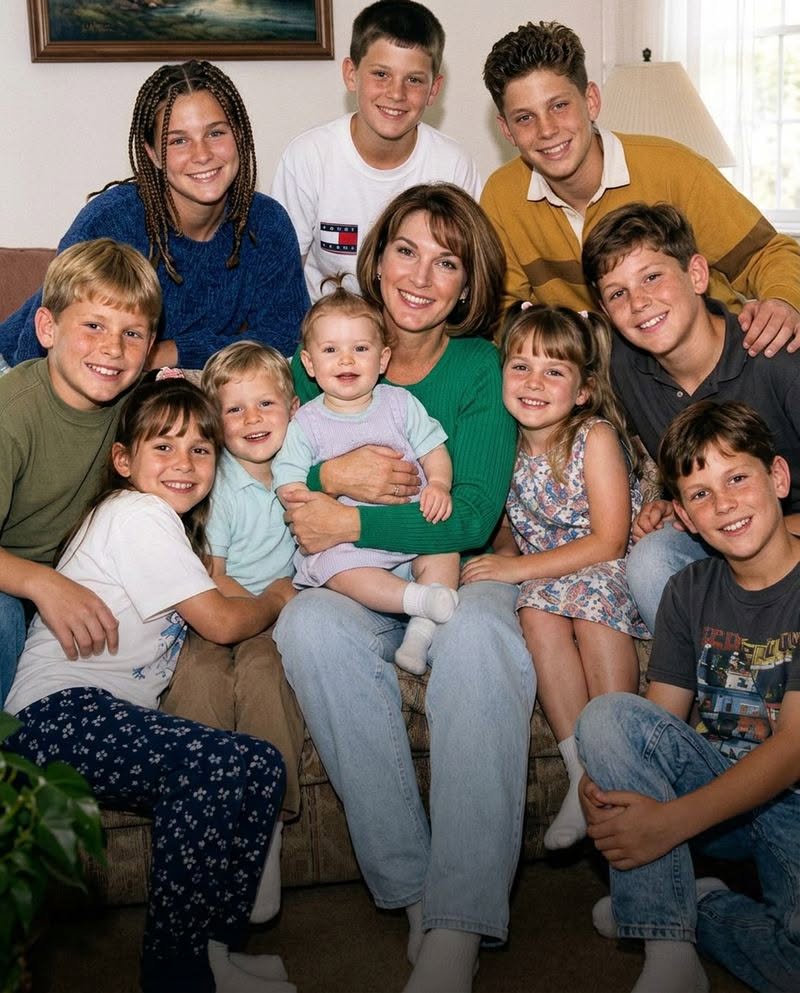
He was also raising ten children by himself after losing his wife two years earlier.
I met him inside a grocery store.
His shopping cart was overflowing with cereal boxes, bread, milk, and enough food to feed an army. A tiny toddler reached toward me with both arms while he struggled to keep everything balanced.
That little girl was Sophie.
Robert quickly scooped her into his arms and smiled apologetically.
“I’m sorry,” he said. “She does that with anyone who smiles at her.”
“Then I suppose I’ll keep smiling,” I replied.
He laughed.
It was a tired laugh, but there was warmth inside it.
And somehow, that tiny moment changed my entire life.
I didn’t simply fall in love with Robert.
I fell in love with all of them.
Amanda, who was already far too mature for her age.
Quiet Derrick, who fixed anything that broke.
Sue, who talked with her hands every time she got excited.
Jacob and David, the twins who somehow turned every chore into a competition.
The four energetic quadruplets who never stopped moving.
And little Sophie, who eventually began calling me Mama without anyone telling her to.
Before long, I was spending more evenings at their house than my own.
I helped with homework.
Cooked dinner.
Found missing socks.
Bandaged scraped knees.
Learned exactly which child needed gentle encouragement and which one needed honest truth.
It all felt strangely natural.
Six months later, Robert proposed over meatloaf and mashed potatoes while ten children pretended not to listen from the hallway.
He smiled at me.
“Will you marry us?”
I cried before I even answered.
“Yes.”
My mother thought I had completely lost my mind.
“Ten children, Margaret,” she said every chance she got. “You haven’t even lived your own life yet.”
“They are my life, Mama.”
“You’re making a terrible mistake.”
But I never listened.
Because by then, they already felt like mine.
Two weeks before the wedding, I stood in front of a mirror wearing my dress while Amanda carefully zipped the back.
Sophie clapped her hands excitedly.
The boys pretended to gag dramatically from the doorway.
Then I saw Robert standing behind me.
He looked at me in a way I couldn’t quite understand at the time.
“You look beautiful,” he said softly.
“You’re not supposed to see the dress.”
“I know.”
He smiled.
“I just wanted to remember.”
At the time, I thought he was simply being sentimental.
Years later, I realized something else entirely.
Part of him already knew he was about to leave.
The morning Robert disappeared, the house felt wrong.
Too quiet.
His truck was gone.
His side of the bed was cold.
His phone was turned off.
Then I found the note.
It sat beneath the sugar bowl on the kitchen table.
Three devastating sentences.
I’m sorry.
I can’t do this anymore.
There was nothing else.
No explanation.
No goodbye.
No mention of the children.
My entire world collapsed.
Then Sophie walked into the kitchen wearing her pajamas and wrapped herself around my leg.
“Mama, juice?”
That was the moment my life split in two.
My mother called almost immediately.
“This is a sign,” she said.
“Let the system take the children. You’re still young.”
“They’re upstairs, Mama.”
“They aren’t your responsibility.”
“I can’t leave them.”
“You’re throwing your life away.”
But when I looked around that kitchen table and saw ten frightened faces staring back at me, I knew there was no decision to make.
I loved them.
They were mine.
At the county office, a social worker looked at me carefully.
“Ten children is an enormous responsibility.”
“I know.”
“There’s no shame in stepping back.”
I shook my head.
“They already call me Mama.”
I signed the papers.
The guardianship eventually became adoption.
But in my heart, they became my children that very day.
The years that followed were the hardest of my life.
I worked at a fabric warehouse during the day.
At night, I sewed school uniforms to earn extra money.
Amanda learned to cook.
Derrick handled repairs.
Sue took charge of laundry.
The twins argued over every chore imaginable.
Life was exhausting.
Messy.
Beautiful.
Several men entered my life briefly over the years.
Every conversation ended the same way.
“Ten children?”
Then they disappeared.
Eventually, I stopped trying.
My life belonged to homework assignments, fevers, birthday parties, bills, and bedtime prayers.
And somehow, that was enough.
Years passed.
Then decades.
Amanda became a nurse.
Derrick opened an auto shop.
Sue became a teacher.
Jacob and David became engineers.
The younger children built wonderful lives of their own.
Then grandchildren arrived.
Every Saturday, my home filled with laughter again.
Thirty years passed faster than I could have imagined.
Then one ordinary Saturday, someone knocked on my front door.
A man in a gray suit stood there holding a leather folder.
“My name is Mr. Johnson,” he said. “I’m Robert’s attorney.”
My breath caught immediately.
He handed me an envelope.
My name was written across the front in familiar handwriting.
Robert’s handwriting.
“I was instructed to deliver this exactly thirty years after his departure.”
The entire room behind me fell silent.
My ten grown children watched as I opened it.
Then I began reading.
Robert had been dying.
Months before our wedding, doctors discovered a serious illness and told him he might only have months to live.
There was an experimental treatment, but no guarantees.
He wrote:
“I couldn’t bear to marry you, then make you a widow, leave you with ten grieving children, and bury all of you beneath medical debt. I thought leaving would hurt less than staying.”
Then came another revelation.
The treatment had worked.
Against every expectation.
Two years later, he returned.
He drove past the house.
He saw Amanda carrying groceries.
He saw Derrick teaching the twins how to fix a bicycle.
He saw Sophie running toward me screaming, “Mama!”
Then he drove away.
He believed coming back would destroy the stability we had built.
He wrote that he didn’t know whether he was right or wrong.
So he chose distance.
For thirty years.
He never remarried.
Never had more children.
Instead, he quietly watched over us through an investigator.
He knew everything.
Graduations.
Jobs.
Milestones.
Achievements.
He created a trust for all of us.
And then he wrote one final sentence.
“You gave them the life I couldn’t. I’m not asking you to excuse me. I only ask that someday, if your heart allows it, you forgive me.”
For thirty years, I had believed I wasn’t enough reason for him to stay.
Now I finally understood.
It had never been about not loving us.
It had been about fear.
Fear disguised as sacrifice.
Whether he had been right or wrong no longer mattered.
I looked around my table.
Ten children.
Grandchildren everywhere.
A life built from heartbreak.
I lifted my teacup.
“To Robert,” I said quietly.
Amanda smiled through tears.
“And to Mama.”
Everyone repeated it together.
“To Mama.”
And for the first time in three decades, the empty chair Robert left behind no longer felt painful.
It simply felt like part of the family we had survived long enough to become.
{"post":105338,"page":2,"next":[{"id":105336,"title":"How a Simple Image Can Challenge Your Perspective and Reveal Hidden Details","url":"https:\/\/new24.info\/105336"},{"id":105333,"title":"Search Results for \u201cA Baywatch Familiar Face Is Being Remembered Differently Now\u201d \u2013 Tbdig Divaxo","url":"https:\/\/new24.info\/105333"},{"id":105327,"title":"The Silent Killer on Your Dinner Plate: Why Millions Are Eating the World\u2019s Deadliest Food","url":"https:\/\/new24.info\/105327"},{"id":105324,"title":"Sasha Obama Appears at Presidential Center Opening in Rare Public Outing - Terbv","url":"https:\/\/new24.info\/105324"},{"id":105321,"title":"The Final Stand of a Hollywood Legend: How the Duke Faced His Last Moments - Terbv","url":"https:\/\/new24.info\/105321"},{"id":105317,"title":"One year after my divorce, my ex-mother-in-law spotted me at the clinic with a smug grin. She told me her son made the right choice leaving me and was now raising a daughter with my former friend. I stayed calm, smiled, and said","url":"https:\/\/new24.info\/105317"},{"id":105312,"title":"With broken hearts, we say goodbye to the woman who made mothers everywhere feel less alone","url":"https:\/\/new24.info\/105312"},{"id":105307,"title":"Psychologists Say This Simple Gesture May Mean More Than You Think","url":"https:\/\/new24.info\/105307"},{"id":105303,"title":"Her Fianc\u00e9 Kept Asking About Money, So She Set a Test","url":"https:\/\/new24.info\/105303"},{"id":105299,"title":"What Investigators Have Revealed About a Tragic Family Case Is Drawing Attention","url":"https:\/\/new24.info\/105299"},{"id":105295,"title":"Barron Trump\u2019s Rare Appearance Has People Looking Twice-","url":"https:\/\/new24.info\/105295"},{"id":105289,"title":"My Daughter Cut Ties with Me After Marrying a Wealthy Man \u2013 7 Years Later, a Little Girl Knocked on My Door and Said, \u0027Only You Can Help Mommy. Please, Go with Me\u0027","url":"https:\/\/new24.info\/105289"},{"id":105286,"title":"When the seamstress unzipped my daughter\u2019s custom silk wedding dress, the champagne glass slipped from my hand and shattered on the floor.","url":"https:\/\/new24.info\/105286"},{"id":105283,"title":"At 3 a.m., my phone rang. My eight-months-pregnant twin was sobbing. \u201cSis\u2026 come get me.\u201d","url":"https:\/\/new24.info\/105283"},{"id":105280,"title":"My 5-Year-Old Daughter Tugged My Wedding Dress and Whispered, \u201cMommy, New Daddy Did Something Bad\u201d \u2014 Minutes Later, I Stopped the Wedding","url":"https:\/\/new24.info\/105280"},{"id":105276,"title":"Disgusting act death row inmate did after murder as US state prepares to execute first woman in over 200 years","url":"https:\/\/new24.info\/105276"},{"id":105265,"title":"Shock poll reveals how many Americans would want Barron Trump as future President","url":"https:\/\/new24.info\/105265"},{"id":105272,"title":"todaystories.feji.io","url":"https:\/\/new24.info\/105272"},{"id":105267,"title":"My Coworkers Teased Me for Eating Lunch with the Lonely Janitor Every Day for 11 Years \u2013 At His Funeral, His Lawyer Pulled Me Aside and Said, \u2018Mr. Wilson Left This for You\u2019","url":"https:\/\/new24.info\/105267"},{"id":105263,"title":"My Family Told Me To Leave Grandma\u2019s Lake Geneva Anniversary Trip Because A Preschool Teacher Couldn\u2019t Afford A Five-Star Resort","url":"https:\/\/new24.info\/105263"}]}