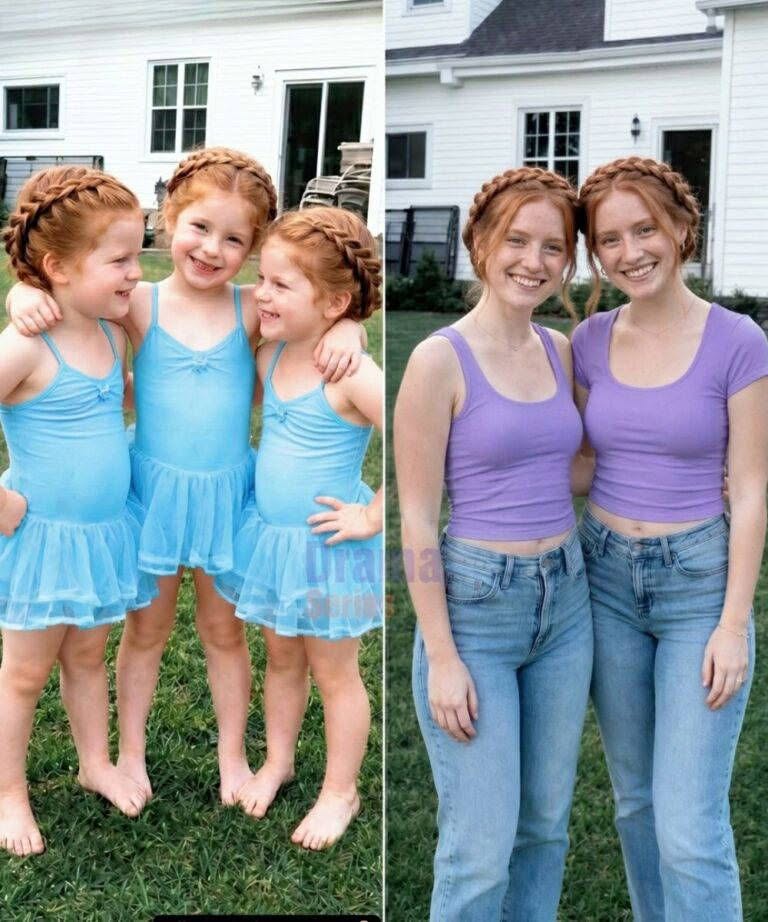
After Nora died, people started calling Leila and me twins.
It was easier for them that way.
Easier than saying there had once been three little girls with the same birthday, three sets of candles, three voices calling for our mother from different rooms.
But Leila and I never felt like twins.
We felt like two broken pieces left behind after the most important part of us was gone.
Nora had been older by seven minutes, and she treated those seven minutes like a royal title.
“I’m the oldest,” she would say, lifting her chin. “So I make the decisions.”
Leila would roll her eyes every time.
“Seven minutes doesn’t count.”
“It absolutely counts,” Nora would answer.
That argument followed us through childhood like music.
There were pillow fights in the bedroom, crayons hidden behind the couch, laughter bouncing through the hallway, and our mother calling our names in that tired voice mothers use when they love you but are very close to losing patience.
Whenever Leila and I fought over toys, clothes, or who got the best seat at dinner, Nora stepped between us like a tiny judge.
“She had it yesterday,” Leila would complain.
“And you can have it tomorrow,” Nora would say calmly. “Today it’s Gia’s turn.”
“You always take her side.”
“No,” Nora would reply. “I take the side of peace.”
Then she would cross her eyes or puff out her cheeks until both of us laughed.
That was Nora.
She carried light into every room.
She tied our shoelaces when we were late. She saved Leila’s favorite candy without telling anyone. During thunderstorms, she slept between us because, according to her, it was her responsibility to protect both sides.
One night, thunder shook the windows so hard it felt like the sky was breaking open.
Leila climbed into Nora’s bed first.
I followed a few minutes later.
Without even opening her eyes, Nora lifted the blanket.
“You two are terrible at pretending you’re brave,” she mumbled.
Leila curled against one side of her.
I curled against the other.
“You’re scared too,” I whispered.
“No,” Nora said sleepily. “I’m responsible.”
She was only a child.
But somehow, she spent her whole life trying to take care of us.
Then everything changed.
At first, adults whispered in corners.
They thought quiet voices could hide the truth from us.
But Nora always understood more than they wanted her to.
Her first hospital stay felt like stepping into another world.
The sharp smell of disinfectant.
The bright lights that never seemed to turn off.
The cartoon stickers on the walls that tried too hard to make everything feel normal.
Leila kept pulling at the sleeve of her sweater.
“What’s wrong with Nora?” she asked.
Mom forced a smile.
“She’s just tired.”
Nora rolled her eyes from the hospital bed.
“I’m not a baby, Mom.”
For one second, everyone laughed.
But even then, I knew something was wrong.
Nora looked smaller in that bed.
Her wrists looked too thin.
Her smile looked like it cost her something.
Still, she worried more about us than herself.
“Stop looking so scared,” she teased. “You both look weird.”
Leila burst into tears.
I didn’t cry.
I just stood beside the bed and gripped the metal rail so tightly my fingers hurt.
Some childish part of me believed that if I held on hard enough, nothing could change.
But I was wrong.
No matter how tightly we held on, we could not stop what was coming.
When Nora died, silence moved into our house.
It settled everywhere.
In the hallway.
At the dinner table.
Inside the bedroom we had once shared.
Her slippers stayed by the wall for weeks because no one had the strength to move them.
Her toothbrush remained beside ours.
Her bed became the first thing I saw every morning and the last thing I saw every night.
Birthdays became the hardest.
There was still cake.
Still candles.
Still decorations.
But there was always one chair missing.
Every year, Leila and I counted three places in silence, even though only two of us were left to sit down.
As we grew older, grief changed us in different ways.
Leila became sharp and distant.
I became quiet.
Pain didn’t pull us closer.
It pushed us to opposite sides of the same empty room.
By the time we turned twenty-one, we barely knew how to speak to each other without hurting each other by accident.
That morning, Mom invited us home for breakfast.
The dining room was decorated with balloons and streamers. A small birthday cake sat near the window, and on the table were three place settings.
Neither Leila nor I said anything.
We both saw it.
We both felt it.
Then Mom walked in carrying a small wooden box.
Something inside me tightened immediately.
She placed it between us with both hands, as if it were fragile.
On top of the box was an old envelope.
The handwriting made my heart stop.
Nora’s.
Across the front were four words.
OPEN ON OUR 21ST BIRTHDAY.
Leila dropped her fork.
Mom’s eyes filled with tears.
“She made this before she passed,” Mom whispered. “She asked me to keep it safe until today.”
For ten years, our mother had kept that promise.
She had never opened it.
Not once.
None of us spoke for a long moment.
Then, with trembling hands, I lifted the lid.
Inside were three bundles tied with faded purple ribbon.
One had my name on it.
One had Leila’s.
The third was addressed to both of us.
I opened mine first.
Inside was a friendship bracelet, an old photograph, and a folded letter.
The moment I touched the paper, it felt like Nora had stepped back into the room.
Dear Gia,
If you’re reading this, you’re twenty-one now. That sounds very old, but Mom says twenty-one is still young, so don’t act like you know everything.
A broken laugh escaped me through my tears.
The letter continued.
She remembered everything.
The flowers I used to draw on every blank piece of paper.
The songs I sang when I thought no one could hear me.
The way I hid my feelings when I was hurt.
People who love you should know where it hurts, she wrote.
I pressed the letter against my chest.
Even after ten years, Nora still knew me better than anyone.
Then Leila opened hers.
Inside were tiny treasures from childhood and another letter.
As she read, tears ran down her face.
You are not mean, Nora had written.
You are scared. There’s a difference.
Leila broke completely.
For years, I had mistaken her anger for resentment.
I thought she blamed me.
I thought she had closed herself off because being near me reminded her too much of Nora.
But she had only been grieving alone.
Finally, she looked at me.
“I missed her so much,” she whispered.
“I know.”
Her chin trembled.
“I missed you too.”
Those four words broke through every wall we had built between us.
I walked around the table and hugged her.
For the first time in years, neither of us pulled away.
After we finished our letters, one package remained.
The one addressed to both of us.
Inside were photographs, a folded paper crown, and one final envelope.
Across the front, Nora had written:
READ THIS OUT LOUD.
Leila laughed through her tears.
“Still bossy.”
“She was older,” I said.
“By seven whole minutes.”
For the first time in years, that old joke didn’t hurt.
It made us smile.
The letter began playfully. Nora imagined what we might be like at twenty-one and teased us exactly the way she used to.
Then her words grew quieter.
Please don’t let me become the space between you.
I’m afraid that after I’m gone, you’ll only see what’s missing when you look at each other.
But you’re not the sisters who stayed behind.
You’re Gia and Leila.
You’re my favorite people.
Tears blurred the page.
She asked us to keep celebrating birthdays.
To laugh.
To argue over silly things.
To live.
Then she gave us one final tradition.
Every birthday, save me one slice of cake.
Then tell each other one good thing that happened that year.
Not the sad things.
The good things.
I want to know you lived.
At the bottom of the letter was one last instruction.
LOOK UNDER THE PAPER CROWN.
Leila lifted it carefully.
Underneath was a small cassette tape.
Mom gasped.
“I completely forgot about this.”
We searched the house until we found an old cassette player tucked away in a closet.
When the tape began, static filled the room.
Then came a voice we had not heard in ten years.
Nora.
Small.
Fragile.
Alive.
“Hi, Gia. Hi, Leila. Hi, Mom.”
Leila grabbed my hand immediately.
Nora laughed softly on the tape.
“If this recording works, I’m basically a genius.”
For several minutes, she spoke directly to us.
She told us she wasn’t angry.
She told us she loved being our sister.
Then her voice softened.
“I heard both of you crying when you thought I was asleep.”
My breath stopped.
“Gia, you prayed that you could take my place. Leila, you wished you were the sick one because you thought you were stronger.”
Neither of us moved.
We had never told anyone those things.
Not Mom.
Not each other.
Not even ourselves, not fully.
“You were both wrong,” Nora said gently. “Nobody should have taken my place. You have lives to live. You have to stay for me.”
The tape clicked softly.
Then came her final words.
“I loved you first. I loved you last. And I am still your sister.”
The recording ended.
Nobody spoke.
We just held each other and cried.
Later that afternoon, Mom cut the birthday cake.
Three slices.
One for Leila.
One for me.
And one for Nora.
For the first time since we lost her, the empty chair did not feel like proof that death had taken something from us.
It felt like a place saved for love.
And when Leila reached across the table and took my hand, I finally understood what Nora had been trying to give us.
Not goodbye.
Not one more reason to grieve.
But a way back to each other.
{"post":105121,"page":2,"next":[{"id":105118,"title":"What Led to This Elderly Man\u2019s Motel Arrest Has People Asking Questions","url":"https:\/\/new24.info\/105118"},{"id":105114,"title":"I Gave Up 22 Years of My Life Raising My Triplet Nieces \u2013 What They Did at Their College Graduation Made Me Drop to My Knees","url":"https:\/\/new24.info\/105114"},{"id":105110,"title":"Authorities Arrest a California Man in Connection With an Unusual Meat Sales Case","url":"https:\/\/new24.info\/105110"},{"id":105108,"title":"My mother-in-law poured something filthy over my wedding dress and left a note: \u201cKnow your place.\u201d In front of 200 guests, I put it on anyway, took my father\u2019s arm, and walked down the aisle without shedding a tear.","url":"https:\/\/new24.info\/105108"},{"id":105105,"title":"My Husband Scr:eamed That Our One-Month-Old Twins Were Driving Him Crazy, Then Flew to Europe With His Friends for a Month and Left Me Alone. But When He Finally Came Home and Opened the Front Door, What He Saw Made Him Freeze in Horror: \u2018No. No Way. This Can\u2019t Be Happening.\u2019","url":"https:\/\/new24.info\/105105"},{"id":105102,"title":"Moral After eighteen months deployed overseas, I came home through a blizzard expecting warmth, but found my wife collapsed on the frozen porch, clutching our baby. \u201cYour parents said we were no longer family\u201d","url":"https:\/\/new24.info\/105102"},{"id":105099,"title":"For 12 Years I Brought Groceries to My 84-Year-Old Neighbor Every Sunday \u2013 After His Funeral, His Lawyer Handed Me a Battered Suitcase, and What Was Inside Made My Hands Shake","url":"https:\/\/new24.info\/105099"},{"id":105094,"title":"Daycare Security Footage Exposes The Heartbreaking Reason My Daughter Passed Away","url":"https:\/\/new24.info\/105094"},{"id":105090,"title":"Secret Billionaire Wife Outsmarts Cheating Husband To Reclaim Her Family Fortune","url":"https:\/\/new24.info\/105090"},{"id":105085,"title":"Deceitful Man Takes Secret Companion To Luxury Hotel Owned By His Wife","url":"https:\/\/new24.info\/105085"},{"id":105081,"title":"Startling Discovery Inside A Brookhaven Hair Salon Changes One Family Forever","url":"https:\/\/new24.info\/105081"},{"id":105077,"title":"Uncovering The Real Reason My Grandmother Smiled During A Heartbreaking Family Funeral","url":"https:\/\/new24.info\/105077"},{"id":105072,"title":"I became a mother at nineteen, facing a world that doubted my ability to provide, but my son Liam became my entire universe","url":"https:\/\/new24.info\/105072"},{"id":105069,"title":"In my private hospital suite just after giving birth, my billionaire dad asked: \u201cAre the $4,000 a month not enough for you","url":"https:\/\/new24.info\/105069"},{"id":105066,"title":"Seeing a Wire Tied Around a Car Door Handle: What It Could Mean","url":"https:\/\/new24.info\/105066"},{"id":105064,"title":"Michael Douglas reveals heartbreaking exit from acting","url":"https:\/\/new24.info\/105064"},{"id":105060,"title":"My wife got pregnant 14 years after my vasectomy, and my family told me to throw her out\u2026 \u201cyou look like a pathetic, wea","url":"https:\/\/new24.info\/105060"},{"id":105057,"title":"I married my stepdad and today he bores me\u2026 See more","url":"https:\/\/new24.info\/105057"},{"id":105054,"title":"What Does the \u201cWC\u201d Sign Outside Bathrooms Really Mean? - Terbv","url":"https:\/\/new24.info\/105054"},{"id":105050,"title":"My 12-Year-Old Daughter Cut Off Her Hair for a Girl with Cancer \u2013 Then the Principal Called and Said, \u0027You Need to Come Now and See What Happened with Your Own Eyes\u0027","url":"https:\/\/new24.info\/105050"}]}