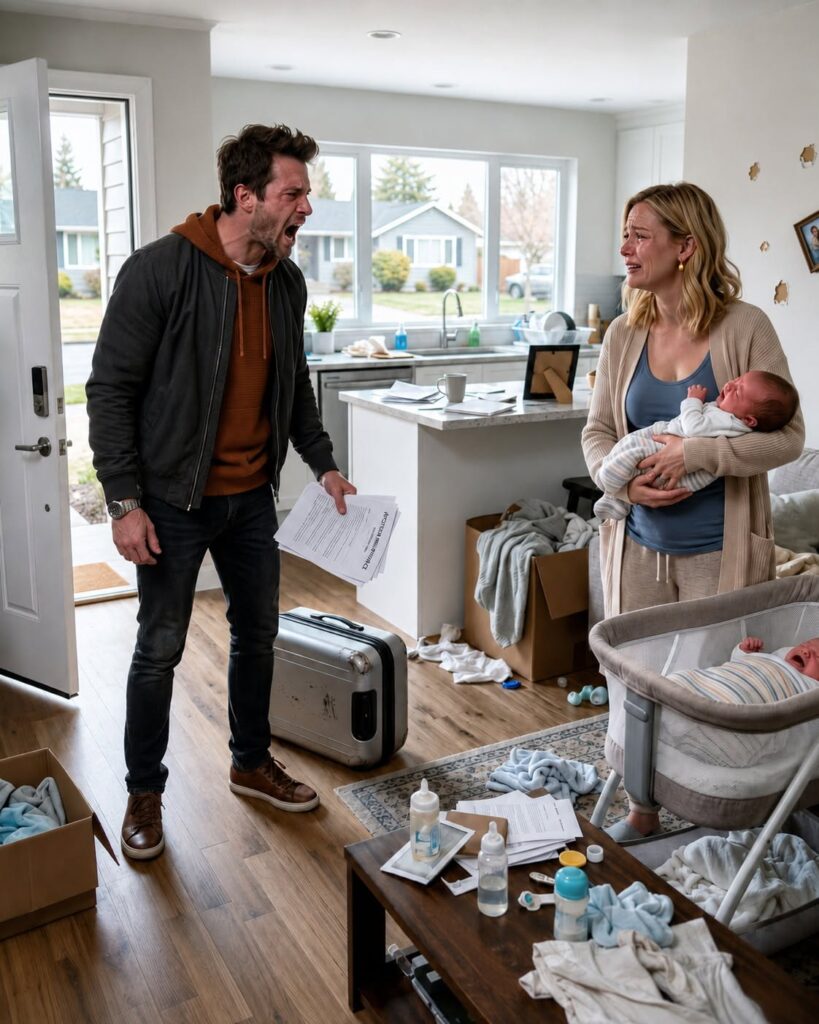
“Daniel, please,” I whispered. “I can’t do this alone.”
He laughed like I had insulted him.
“Women have babies every day, Claire. You’ll survive.”
Then his phone buzzed.
Outside, his friends were waiting in a black SUV, honking and laughing, excited for their month-long trip through Europe.
A trip Daniel had never bothered to tell me was still happening.
“You’re seriously leaving?” I asked, holding Noah against my chest.
Daniel avoided my eyes.
“I paid for it months ago.”
“We have newborn twins.”
“And I have a life too.”
Then he walked out.
The front door slammed so hard that a picture fell from the hallway wall.
That night, I sat on the nursery floor between two crying babies and cried with them.
For the first week, I barely functioned.
I forgot to eat.
I forgot to shower.
I forgot who I was outside of survival.
Daniel posted photos from Paris, Rome, and Barcelona. He smiled in every picture. He drank wine. He stood beside women I had never seen before.
He never called.
But on the eighth day, something inside me went quiet.
I stopped waiting for him.
I called my older sister, Marianne.
She drove down from Seattle that same night and found me pale, trembling, and half-asleep with Noah in my arms.
By morning, she had taken charge.
She helped me record everything.
Daniel’s messages.
His travel photos.
His bank withdrawals.
The unpaid bills.
The medical appointments he had missed.
Every call he ignored.
Then she contacted a family lawyer named Victor Hayes.
By the second week, I had opened a separate bank account.
By the third, I had filed for legal separation and emergency custody.
By the fourth, Daniel’s name had been removed from the nursery savings account my parents had funded.
When Daniel finally returned home, I was not there.
Neither were the babies.
He opened the front door and stopped cold.
The living room was bare. The wedding photos were gone. The twins’ bassinets had disappeared.
On the kitchen counter sat divorce papers, a court summons, and a printed photo of him kissing a woman in Ibiza.
His face drained of color.
“No,” he whispered. “No way. This can’t be happening.”
Then his phone rang.
It was his mother.
“Daniel,” Evelyn Whitmore said coldly, “what did you do?”
For once, Daniel had no quick answer.
He stood in the silent house with his suitcase still beside him, staring at the papers like they belonged to someone else.
There was no music now.
No laughter.
No airport bar.
No friends clapping him on the back and telling him he deserved a break.
Only quiet.
And consequence.
“Mom,” he finally said, his voice uneven, “Claire overreacted.”
Evelyn stayed silent for three seconds.
Then she said, “Your wife had complications after giving birth. Your twins were four weeks old. You left the country.”
“I was overwhelmed.”
“So was she.”
“She took my children.”
“No,” Evelyn said. “You abandoned them.”
He ended the call.
Anger came first because anger was easier than fear.
Daniel stormed through the house, opening doors and checking closets as if I might be hiding with Lily and Noah just to punish him.
The nursery stopped him.
The room was almost empty.
The rocking chair was gone.
The drawers had been cleared.
The tiny clothes, diapers, blankets, bottles, and soft yellow nightlight had all disappeared.
Only one thing remained.
A note taped to the wall.
Daniel tore it down.
“Daniel, for thirty-one days, you chose yourself. Now I am choosing our children. Do not come near us unless your lawyer contacts mine.”
He read it three times.
Then he called me.
Voicemail.
He called again.
Voicemail.
By the sixth call, his hands were shaking.
Then another call came through.
It was Mason, one of the friends who had gone with him to Europe.
“Bro,” Mason said nervously, “Claire’s lawyer contacted me.”
Daniel froze.
“Why?”
“They asked for statements. About the trip. About the women. About what you said.”
“What did you tell them?”
Mason hesitated.
Daniel’s voice dropped.
“What did you tell them?”
“I told the truth,” Mason said. “That you said you didn’t want to be trapped at home with screaming babies. That Claire could handle the mom stuff because it was her job.”
“That was private,” Daniel snapped.
“It was disgusting,” Mason replied. “My wife saw the posts. She made me tell the truth.”
One by one, Daniel called the others.
One by one, they backed away from him.
No one wanted to lie in court for a man who had abandoned his postpartum wife and newborn twins.
That afternoon, Daniel drove to my sister Marianne’s house in Seattle, assuming I would be there.
He was wrong.
Marianne opened the door only far enough for him to see the chain lock.
“Where are they?” Daniel demanded.
“Safe.”
“They’re my children.”
“They are also Claire’s children,” Marianne said. “And unlike you, she stayed.”
His jaw tightened.
“You poisoned her against me.”
Marianne smiled without warmth.
“No, Daniel. You did that all by yourself.”
Before he could answer, a police cruiser turned onto the street and parked behind his car.
Marianne had already called them.
The officer stepped out calmly.
“Mr. Whitmore, you need to leave. Any contact with Mrs. Whitmore must go through legal counsel.”
Daniel looked past Marianne, hoping to hear a baby cry, hoping for one glimpse of what he had thrown away.
But the house was silent.
For the first time, he understood how much silence could cost.
Three days later, Daniel sat in a family law office downtown, wearing the navy suit he used when he wanted to impress clients.
But now the suit looked too tight across his shoulders. His eyes were red. His beard was uneven. He looked less like the confident financial consultant people knew and more like a man who had hit a wall he never believed existed.
His lawyer, Patricia Lowe, sat across from him with a folder open on her desk.
“Mr. Whitmore,” she said, “I need you to understand your situation clearly.”
Daniel leaned forward.
“My wife can’t just take my children.”
“She didn’t just take them,” Patricia replied. “She filed for emergency custody after you left the country for thirty-one days while she was medically vulnerable and caring for newborn twins alone.”
“I sent money.”
Patricia glanced at the file.
“You sent two hundred dollars on the fifth day, then spent more than twelve thousand dollars on travel, hotels, alcohol, restaurants, and entertainment.”
Daniel opened his mouth.
Then closed it.
“She also has records showing you ignored twenty-six calls, fourteen text messages, and three voicemails related to the babies’ medical appointments.”
“I was on vacation,” he said weakly.
Patricia removed her glasses.
“Do not say that in court.”
The first hearing took place the following Monday.
I arrived with Victor Hayes, my lawyer, and Marianne. Lily and Noah were not with me. They were safe with a licensed nanny Victor had recommended, inside a small apartment I had rented under my own name.
Daniel was already there.
When he saw me, he stood quickly.
“Claire.”
I did not answer.
He looked thinner, maybe even frightened, but nothing soft moved inside me.
The month he had spent drinking wine across Europe had turned something in me into stone.
Not hatred.
Hatred takes energy.
This was clarity.
Inside the courtroom, Victor presented the evidence one piece at a time.
The flight records.
The social media posts.
The ignored messages.
My medical records documenting postpartum complications and severe exhaustion.
Marianne’s statement describing the condition she found me in.
The statements from Daniel’s friends.
The photo from Ibiza.
Daniel’s lawyer argued that he had been emotionally overwhelmed and made a poor decision.
Victor did not deny that Daniel had been overwhelmed.
He simply asked the question that mattered.
“Your Honor, if Mr. Whitmore’s response to stress is to abandon one-month-old infants and their recovering mother for international leisure travel, what safeguards exist for these children in his care?”
Daniel stared down at the table.
Judge Rebecca Sloan reviewed the documents in silence.
Then she looked at him.
“Mr. Whitmore, parenthood is not optional when it becomes inconvenient.”
His face flushed.
The judge granted me temporary primary custody.
Daniel received supervised visitation twice a week, pending parenting classes, counseling, and further review.
Outside the courtroom, Daniel rushed after me.
“Claire, wait.”
Victor stepped slightly in front of me, but I lifted my hand.
I wanted to hear what Daniel thought an apology sounded like.
He stopped a few feet away.
“I made a mistake.”
I studied him.
“A mistake is forgetting diapers. A mistake is mixing up formula measurements once. You left the country.”
“I panicked.”
“So did I,” I said. “But I stayed.”
His eyes filled.
“I’m their father.”
“You are their father by biology,” I answered. “Now you have to prove whether you can become their father in real life.”
For once, Daniel had nothing to say.
Supervised visits began that Friday.
He arrived at the family center carrying expensive stuffed animals, designer baby outfits, and tiny shoes the twins would not be able to wear for months.
The supervisor, Ms. Alvarez, calmly explained the rules.
“No photos without permission. No discussion of court issues. No negative comments about the mother. Focus on the children.”
Daniel nodded too quickly.
When Lily was placed in his arms, she started crying.
His face tightened immediately.
I watched from behind the observation glass.
The same panic.
The same irritation.
The same helpless anger under his skin.
But this time, he could not run to Europe.
He could not slam a door and leave me alone with the noise.
This time, someone was watching.
Ms. Alvarez spoke gently.
“Support her head. Hold her close. Try rocking slowly.”
Daniel tried.
Lily cried harder.
Then Noah woke up and started crying too.
Daniel began sweating.
For a moment, I thought he would hand Lily back and quit.
Instead, he closed his eyes, took one shaky breath, and whispered, “Okay. Okay. I’m here.”
It was the first useful thing I had ever heard him say to one of our children.
But one useful moment could not erase thirty-one days of abandonment.
Over the next three months, Daniel attended parenting classes.
Not because he had suddenly become noble.
Because the court required him to.
At first, he treated every class like punishment. He complained that the instructor was biased. He complained that the other parents judged him. He complained that I had made him look like a monster.
Then one afternoon, during a supervised visit, Noah had a reflux episode and spit up all over Daniel’s shirt.
The old Daniel would have cursed.
This Daniel froze, breathed hard, and asked for help without raising his voice.
Ms. Alvarez walked him through cleaning Noah, changing him, and holding him upright.
Afterward, Daniel sat in the chair with Noah asleep against his chest, his expensive shirt stained and damp.
He looked toward the observation glass, though he could not clearly see me.
“I didn’t know it was this hard,” he whispered.
Ms. Alvarez answered, “Most people don’t. Then they learn.”
I turned away before he could see me cry.
Not because I wanted him back.
Because I remembered the woman I had been on the nursery floor, begging for help while he walked out.
By the sixth month, the divorce was nearly final.
Daniel asked once if there was any chance we could fix the marriage.
We were standing outside the family center after a visit. The twins slept in their stroller, wrapped in soft blue and yellow blankets.
“I’m doing better,” he said. “You can see that, right?”
“Yes,” I said. “You are doing better.”
“Then maybe we don’t have to end everything.”
For one second, I saw the man I had married.
Charming.
Smart.
Funny when he wanted to be.
The man who once danced with me in the kitchen before the babies arrived.
The man who had promised we were a team.
But promises are not evidence.
“Daniel,” I said quietly, “you didn’t leave because you couldn’t survive. You left because you believed my suffering mattered less than your comfort.”
He flinched.
“I may forgive you someday,” I continued. “For my own peace. But I will not rebuild a life with someone who had to be ordered by a judge to show up for his children.”
His gaze dropped.
The divorce was finalized in Multnomah County on a rainy Thursday morning.
I kept primary physical custody.
Daniel received gradually increasing visitation attached to conditions: completed parenting education, continued counseling, consistent child support, and no overnight visits until further court review.
The house was sold.
I moved into a modest two-bedroom apartment near my new job at a pediatric clinic, where I worked three days a week while Marianne and a trusted nanny helped with the twins.
It was not easy.
Nothing about raising twins alone was easy.
Some nights, both babies cried until sunrise.
Some mornings, I drank cold coffee and wore mismatched shoes.
But there was one difference.
I was no longer waiting for a man to decide whether my exhaustion mattered.
One year after Daniel left for Europe, Lily and Noah turned thirteen months old.
Their birthday party was small.
Marianne came.
My parents flew in from Denver.
Evelyn, Daniel’s mother, came too. She had apologized more than once for not seeing who her son had become, though I never blamed her.
Daniel arrived with permission and stayed for two hours.
This time, he brought simple gifts.
Board books.
Soft blocks.
A handwritten card.
He did not try to touch me.
He did not ask to speak privately.
He did not perform fatherhood loudly for attention.
He sat on the floor while Noah stacked blocks and Lily knocked them down, laughing.
When the party ended, Daniel helped clean frosting from the high chairs and picked up paper plates from the floor.
At the door, he paused.
“Claire,” he said, “I know I don’t deserve to say this, but thank you for not disappearing completely.”
I adjusted Lily on my hip while Noah clung sleepily to my pant leg.
“I didn’t do it for you.”
He nodded.
“I know.”
For the first time, it sounded like he meant it.
After he left, Marianne stood beside me at the window, watching his car pull away.
“Do you think he’s really changed?”
I watched the taillights disappear into the wet Portland street.
“I think he’s learning,” I said. “That’s not the same as changed. Not yet.”
Behind us, Noah squealed.
Lily answered with a delighted shout.
The apartment was loud.
Messy.
Crowded.
Alive.
I lifted both of my children, one on each hip, and felt their warm little bodies lean into me.
A year earlier, their crying had driven Daniel out the door.
Now their laughter filled every corner of my home.
And this time, no one was leaving.
{"post":105105,"page":2,"next":[{"id":105102,"title":"Moral After eighteen months deployed overseas, I came home through a blizzard expecting warmth, but found my wife collapsed on the frozen porch, clutching our baby. \u201cYour parents said we were no longer family\u201d","url":"https:\/\/new24.info\/105102"},{"id":105099,"title":"For 12 Years I Brought Groceries to My 84-Year-Old Neighbor Every Sunday \u2013 After His Funeral, His Lawyer Handed Me a Battered Suitcase, and What Was Inside Made My Hands Shake","url":"https:\/\/new24.info\/105099"},{"id":105094,"title":"Daycare Security Footage Exposes The Heartbreaking Reason My Daughter Passed Away","url":"https:\/\/new24.info\/105094"},{"id":105090,"title":"Secret Billionaire Wife Outsmarts Cheating Husband To Reclaim Her Family Fortune","url":"https:\/\/new24.info\/105090"},{"id":105085,"title":"Deceitful Man Takes Secret Companion To Luxury Hotel Owned By His Wife","url":"https:\/\/new24.info\/105085"},{"id":105081,"title":"Startling Discovery Inside A Brookhaven Hair Salon Changes One Family Forever","url":"https:\/\/new24.info\/105081"},{"id":105077,"title":"Uncovering The Real Reason My Grandmother Smiled During A Heartbreaking Family Funeral","url":"https:\/\/new24.info\/105077"},{"id":105072,"title":"I became a mother at nineteen, facing a world that doubted my ability to provide, but my son Liam became my entire universe","url":"https:\/\/new24.info\/105072"},{"id":105069,"title":"In my private hospital suite just after giving birth, my billionaire dad asked: \u201cAre the $4,000 a month not enough for you","url":"https:\/\/new24.info\/105069"},{"id":105066,"title":"Seeing a Wire Tied Around a Car Door Handle: What It Could Mean","url":"https:\/\/new24.info\/105066"},{"id":105064,"title":"Michael Douglas reveals heartbreaking exit from acting","url":"https:\/\/new24.info\/105064"},{"id":105060,"title":"My wife got pregnant 14 years after my vasectomy, and my family told me to throw her out\u2026 \u201cyou look like a pathetic, wea","url":"https:\/\/new24.info\/105060"},{"id":105057,"title":"I married my stepdad and today he bores me\u2026 See more","url":"https:\/\/new24.info\/105057"},{"id":105054,"title":"What Does the \u201cWC\u201d Sign Outside Bathrooms Really Mean? - Terbv","url":"https:\/\/new24.info\/105054"},{"id":105050,"title":"My 12-Year-Old Daughter Cut Off Her Hair for a Girl with Cancer \u2013 Then the Principal Called and Said, \u0027You Need to Come Now and See What Happened with Your Own Eyes\u0027","url":"https:\/\/new24.info\/105050"},{"id":105047,"title":"I Spent Two Weeks in the Hospital, and My Husband Never Visited Me Once \u2013 When I Finally Came Home and Opened the Front Door, I Stood There Staring in Disbelief","url":"https:\/\/new24.info\/105047"},{"id":105044,"title":"My Daughter Never Came Home from Prom \u2013 Eleven Months Later, What I Accidentally Found Hidden Inside My Son\u0027s Beanbag Chair Made Me Go White as a Ghost","url":"https:\/\/new24.info\/105044"},{"id":105041,"title":"My 12-Year-Old Daughter Cut Off Her Hair for a Girl with Cancer \u2013 Then the Principal Called and Said, \u2018You Need to Come Now and See What Happened with Your Own Eyes\u2019","url":"https:\/\/new24.info\/105041"},{"id":105036,"title":"My Wife Left Our Twins Right After Birth \u2013 18 Years Later, She Showed up at Their Graduation with a \u2018Special Gift\u2019, But What My Daughters Did Next Froze the Room","url":"https:\/\/new24.info\/105036"},{"id":105030,"title":"An Angry Fan Ordered a Mother and Her Quiet Son to Leave the Championship \u2013 Her Response Left Section 112 Speechless","url":"https:\/\/new24.info\/105030"}]}