Everything was always planned.
Everything was always accounted for.
Even death.
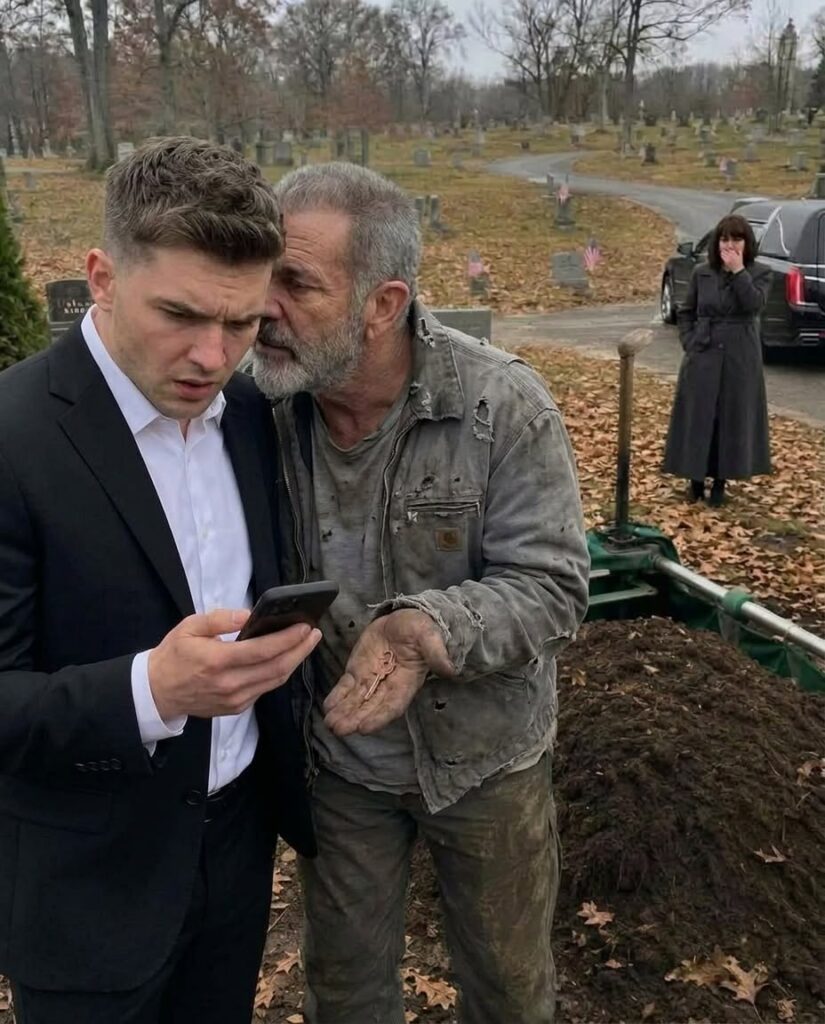
He stood quietly beside me while the pastor continued speaking to the crowd gathered around the casket.
Then he leaned closer.
“Ms. Carter,” he whispered, “your mother paid me to bury an empty coffin.”
My entire body went cold.
For a second, I genuinely thought grief had distorted his words.
“What?”
Earl did not smile.
Instead, he slipped something cold into my palm.
A small brass key.
Attached to it was a faded tag.
Unit 16.
“Don’t go home,” he said quietly. “Go to Safelock Storage. Unit 16. Right now.”
Before I could ask another question, my phone buzzed.
I pulled it from my coat pocket.
My breath caught.
A text message.
From my mother.
Come home alone.
I stared at her name on the screen.
My mother had been dead for six days.
I had identified her body.
I had signed the paperwork.
I had approved her obituary.
An hour earlier, I had stood beside her coffin while strangers told me she was finally at peace.
But now her name glowed on my phone as casually as if she had stepped out to buy groceries.
When I looked up, Earl had already returned to his place beside the grave.
Nobody else seemed to notice anything unusual.
I closed my hand around the brass key and walked toward my car.
Twenty minutes later, I pulled into Safelock Storage near the highway.
Unit 16 sat among dozens of identical metal doors behind a chain-link fence.
My hands shook so badly that I dropped the key twice before finally unlocking it.
The door rolled upward.
I froze.
There was no furniture.
No decorations.
No old family belongings.
Instead, the storage unit looked like an emergency shelter.
A folding chair.
A lantern.
Three large water jugs.
A legal file box.
And my mother’s navy handbag.
The same handbag police claimed had been found with her body.
An envelope was taped to the front.
My name was written across it in my mother’s handwriting.
For Emily.
If you’re reading this, they lied to you first.
Then I heard tires crunch over gravel behind me.
A black SUV slowly entered the lane.
It stopped two rows away.
The engine remained running.
Panic surged through me.
I pulled the storage door down and slipped inside, lowering it until only a narrow strip of daylight remained.
Footsteps approached.
Then a man’s voice came through the metal door.
“Ms. Carter? We only want to talk.”
I stayed perfectly still.
Another voice followed.
Colder.
Sharper.
“Your mother involved you in something she shouldn’t have.”
I opened the envelope.
Emily, if anyone follows you here, do not trust the police, Richard Hale, or anyone from Lawson Financial. Take the red folder and leave through the back fence. I’m sorry.
My stomach dropped.
Richard Hale.
My mother’s boss for nineteen years.
The same man who had hugged me at the funeral.
The same man I had thanked for being there.
Outside, metal scraped against the lock.
I opened the file box at my feet.
Inside were dozens of organized folders.
Bank records.
Wire transfers.
Printed emails.
Property documents.
A flash drive taped beneath the lid.
And one red folder.
I lifted it.
It was packed with financial transactions and signatures.
Then I noticed something else.
The back wall.
A sheet of plywood covered part of it.
I pulled it aside.
Behind it was a section of chain-link fence that had already been cut open.
My mother had built an escape route.
The voice outside returned.
“Open the unit, Emily.”
Then he said something that changed everything.
“Your mother is dead because she stopped cooperating.”
I stopped breathing.
She had not simply died.
Someone had killed her.
Or wanted me to believe they had.
I grabbed the red folder, shoved the flash drive into my pocket, and crawled through the opening.
The wire tore my blouse.
I kept moving.
Behind me, someone slammed into the storage door.
I ran through weeds and drainage ditches until I reached the service road.
My phone buzzed again.
Two more messages.
Go to Daniel Brooks. County Recorder’s Office. Trust no one else.
Then another.
If Hale finds you first, burn everything.
Daniel Brooks looked nothing like a hero.
He sat behind a plain government desk wearing a stained tie and rolled-up sleeves.
But when I entered, he immediately stood.
“Emily Carter,” he said.
It was not a question.
“My mother sent you?”
“She said you might come.”
He handed me another envelope.
Again, it was my mother’s handwriting.
The letter was dated three weeks before her supposed death.
As I read, the world around me shifted.
Lawson Financial had been stealing millions through shell companies, fake estate transfers, and hidden accounts.
My mother discovered everything by accident.
When she confronted Richard Hale, he used her own credentials to frame her.
Then he threatened me.
So she pretended to cooperate.
All while secretly collecting evidence.
She arranged an empty funeral because if Hale believed she was dead, he would stop searching long enough for me to expose him.
My mother was alive.
Daniel confirmed it.
Four days earlier, she had called him from a prepaid phone.
I felt two emotions at once.
Relief.
And anger.
She had let me mourn her.
She had watched me stand beside an empty coffin.
She had allowed me to believe she was gone forever.
“Show me the drive,” I said.
Daniel plugged it into his computer.
What we found was overwhelming.
Shell corporations.
Property fraud.
Payment trails.
Emails.
Names of local officials.
Even records connecting Hale to a deputy coroner.
My mother had built an entire criminal case.
That night, Daniel and I took everything to federal financial crimes investigator Audrey Marsh.
Forty-eight hours later, Richard Hale was arrested.
Two associates were arrested.
So was the deputy coroner who helped falsify my mother’s death records.
Nine days later, my phone rang.
Arizona.
I answered.
“Emily?”
My knees nearly gave out.
It was her.
My mother.
She sounded older.
Tired.
Alive.
“I did it to protect you,” she said.
“I know,” I answered.
I did not tell her I was still angry.
Some truths cannot be repaired in a single conversation.
Months later, she finally came home.
We sat together at my kitchen table drinking coffee.
For the first time, I told her exactly what that funeral had done to me.
How broken I felt.
How abandoned I felt.
How I had stood over an empty grave believing my entire world had ended.
She listened quietly.
Then she said, “I would do it again. But I am sorry for the pain it caused.”
I nodded.
“I know.”
And I truly did.
I still keep the brass key from Unit 16 inside a small dish on my dresser.
Sometimes I pick it up and remember the cold weight of it in my hand beside that grave.
My mother’s choices were not simple.
They hurt me.
They saved me.
And for now, the fact that she is alive is enough to begin again.
{"post":104774,"page":2,"next":[{"id":104771,"title":"My Mother In Law Told Me To Pay Every Bill So I Revealed The House I Bought Before Marriage","url":"https:\/\/new24.info\/104771"},{"id":104768,"title":"I Paid My Son\u0027s Crush to Ask Him to Prom \u2013 When I Saw Pictures from the Evening, I Couldn\u0027t Believe My Eyes","url":"https:\/\/new24.info\/104768"},{"id":104765,"title":"Nobody Expected the Principal to Stop the Graduation Ceremony for a Late Father \u2013 What He Said Next Left the Entire Room Speechless","url":"https:\/\/new24.info\/104765"},{"id":104762,"title":"Lip reader \u2018reveals\u2019 Donald Trump\u2019s 8-word remark to UFC fighter who called Michelle Obama \u2018a man\u2019","url":"https:\/\/new24.info\/104762"},{"id":104757,"title":"How My Shocking Military Return Uncovered A Massive Family Financial Fraud Scheme","url":"https:\/\/new24.info\/104757"},{"id":104753,"title":"Why Stopping For Stranded Sisters Saved My Auto Repair Business","url":"https:\/\/new24.info\/104753"},{"id":104749,"title":"BREAKING NEWS: Trump and Iran Reach Tentative Agreement as World Watches Closely","url":"https:\/\/new24.info\/104749"},{"id":104746,"title":"My Husband Got Angry When Our Daughter Said, \u2018Mommy, the Lady in the Red Car Pays Daddy to Cry\u2019","url":"https:\/\/new24.info\/104746"},{"id":104743,"title":"What Happens When You Sleep Too Cold","url":"https:\/\/new24.info\/104743"},{"id":104737,"title":"Victoria Beckham sparks concern among fans with detail during Walk of Fame appearance","url":"https:\/\/new24.info\/104737"},{"id":104732,"title":"The Stalled Engine of a Three-Year Silence and the Winter Night the Hallway Finally Closed","url":"https:\/\/new24.info\/104732"},{"id":104728,"title":"How Revealing A Hidden Property Deed Stopped My Demanding Family Cold","url":"https:\/\/new24.info\/104728"},{"id":104724,"title":"I Married a Man 30 Years Older for His Fortune \u2013 After His Funeral, His Lawyer Gave Me a Box and Said, \u2018He Made Sure You Got Exactly What You Deserved\u2019","url":"https:\/\/new24.info\/104724"},{"id":104721,"title":"My 4-Year-Old Daughter Suddenly Passed Away at Daycare \u2013 Then Her Teacher Called and Said, \u2018I Sent You the Security Footage. Your Husband Is Lying\u2019","url":"https:\/\/new24.info\/104721"},{"id":104718,"title":"I walked into court holding my newborn son while my husband\u2019s lawyer smiled like I was already defeated.","url":"https:\/\/new24.info\/104718"},{"id":104715,"title":"I Married My School Sweetheart \u2013 On Our First Anniversary, I Overheard a Phone Call That Made Me Gasp","url":"https:\/\/new24.info\/104715"},{"id":104712,"title":"After 28 Years of Marriage, I Caught My Husband with My Younger Sister \u2013 I Didn\u0027t Scream, I Just Led Them Straight Into My Trap","url":"https:\/\/new24.info\/104712"},{"id":104709,"title":"21-year-old\u2019s final post takes on gut-wrenching meaning after fatal bridge jump accident","url":"https:\/\/new24.info\/104709"},{"id":104703,"title":"Beloved TV mom from hit series ALF dies aged 77","url":"https:\/\/new24.info\/104703"},{"id":104700,"title":"Haunting 5 words heard seconds after woman was thrown to her death after bungee crew \u2018forgot\u2019to attach safety rope","url":"https:\/\/new24.info\/104700"}]}