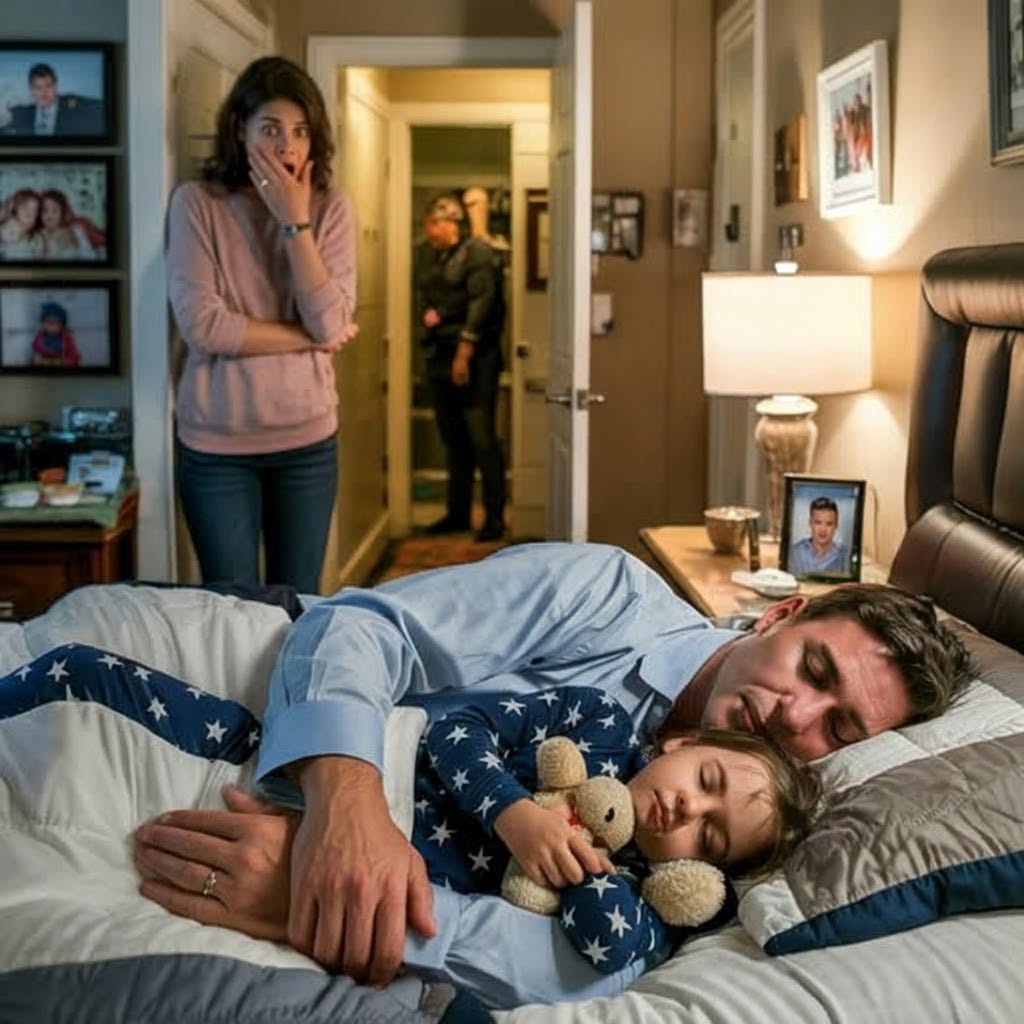
Like many parents, our first instinct was practical.
We checked the room.
We reviewed routines.
We considered whether stress, sleep habits, or imagination might explain what she was describing.
When the answers remained unclear, we took additional steps to understand what was happening during the night.
What we discovered was unexpected.
It was not a stranger.
It was not a danger.
It was someone we loved.
A Different Kind of Vulnerability
The person entering Emily’s room was my mother-in-law, Margaret.
She would quietly make her way into the room and lie beside her granddaughter while she slept.
Watching this was deeply emotional.
Not because we felt anger.
Because we realized something important.
Margaret was not acting out of intention in the ordinary sense.
She was living with the early effects of Alzheimer’s disease.
The behavior was not primarily about Emily’s bed.
It was about confusion, memory, comfort, and the ways illness can alter a person’s relationship with the world around them.
Remembering the Woman Behind the Illness
It is easy to focus entirely on symptoms.
Harder, but more important, to remember the person.
Before Alzheimer’s entered our lives, Margaret had spent decades caring for others.
She worked tirelessly.
She sacrificed comforts.
She devoted herself to her family.
Much of what our household enjoyed existed because of years of effort that often went unnoticed.
Now, the same woman who once provided security for others was struggling to find security herself.
That realization changed how we viewed the situation.
Instead of asking, “Why is this happening?”
We began asking, “What does she need?”
Grief and Compassion Together
Illnesses that affect memory create a particular kind of grief.
The person is still present.
Yet aspects of them seem increasingly difficult to reach.
Families often find themselves caring not only for practical needs but also for the sadness that accompanies gradual change.
There are moments of frustration.
Moments of confusion.
Moments of exhaustion.
There are also moments of unexpected tenderness.
All of these realities can exist at the same time.
Compassion does not require pretending that caregiving is easy.
It requires remaining committed even when it is difficult.
Adapting the Home
As a family, we began making adjustments.
Not because Margaret was a burden.
Because her needs had changed.
We created safer routines.
We modified sleeping arrangements.
We looked for ways to preserve both Emily’s rest and Margaret’s dignity.
The goal was not merely to manage a problem.
The goal was to care for a person.
That distinction mattered.
What Emily Learned
Children often understand more than adults expect.
As we explained the situation to Emily in age-appropriate ways, she responded with remarkable kindness.
She began seeing not just the behavior, but the person behind it.
She learned that aging and illness sometimes make people vulnerable.
She learned that love occasionally asks us to be patient with things we do not fully understand.
Most importantly, she learned that family responsibilities do not disappear when circumstances become difficult.
The Meaning of Home
Over time, our understanding of home changed.
We had once thought primarily about comfort, independence, and order.
Those things still mattered.
But another purpose became clearer.
A home is also a place where people are cared for when they can no longer care for themselves in the same way.
It is where dignity is protected.
Where weakness is not treated as failure.
Where people are valued for who they are, not only for what they can contribute.
Holding On to What Matters
Alzheimer’s takes much from those who live with it and from the families who walk alongside them.
Yet even as memory changes, certain things remain meaningful.
A familiar voice.
A photograph.
A shared meal.
A hand held during a difficult moment.
Love does not erase illness.
Nor does illness erase a lifetime of love.
The challenge for families is learning how to honor both truths.
Looking back, the most important discovery was not who had been entering Emily’s room.
It was the reminder that every person deserves patience and dignity, especially when life has become confusing and frightening.
The woman who once spent years caring for her family now needed her family to care for her.
And perhaps that, too, is part of what family is meant to be.
{"post":104607,"page":2,"next":[{"id":104603,"title":"The Unlabeled Shadow in the Preschool Gallery-","url":"https:\/\/new24.info\/104603"},{"id":104599,"title":"The Architectural Fortress of a Seven-Year-Old\u2019s Vow and the Unspoken Covenant That Reclaimed the Echoes of a Hollow Home","url":"https:\/\/new24.info\/104599"},{"id":104595,"title":"The Little Girl Who Ran to the Scariest Biker and Changed Everything-","url":"https:\/\/new24.info\/104595"},{"id":104591,"title":"I Texted My Dad From the ER After a Cr3sh and His Reply Changed Everything","url":"https:\/\/new24.info\/104591"},{"id":104588,"title":"I never told my boyfriend\u2019s snobbish parents that I owned the bank holding their massive debt. To them, I was just a \u201cbarista with no future.\u201d","url":"https:\/\/new24.info\/104588"},{"id":104583,"title":"What Happens to Your Body When Intim:acy Fades With Age","url":"https:\/\/new24.info\/104583"},{"id":104580,"title":"I Gave up Everything to Raise My Late Fianc\u00e9e\u2019s 6 Children \u2013 10 Years Later, Her Oldest Son Came to Me and Said, \u2018Dad, I Think You Deserve to Know the Truth About Mom\u2019","url":"https:\/\/new24.info\/104580"},{"id":104577,"title":"My 4-Year-Old Daughter Suddenly Passed Away at Daycare \u2013 Then Her Teacher Called and Said, \u0027I Sent You the Security Footage. Your Husband Is Lying\u0027","url":"https:\/\/new24.info\/104577"},{"id":104574,"title":"My Mother Kept Paying for a Storage Unit After My Father Passed Away \u2013 When I Finally Opened It, Every Box Had My Name Crossed Out","url":"https:\/\/new24.info\/104574"},{"id":104568,"title":"Sister Canceled Our Invitation So I Revoked Her Entire Trust Fund Access","url":"https:\/\/new24.info\/104568"},{"id":104563,"title":"How A Secret Audio Recording Saved My Decade Of Life Savings","url":"https:\/\/new24.info\/104563"},{"id":104559,"title":"How My Family Unknowingly Trespassed Into My Secret South Carolina Estate","url":"https:\/\/new24.info\/104559"},{"id":104556,"title":"I caught my 17-year-old sneaking back in at 4 a.m. after prom \u2014 what fell out of her purse broke my heart.","url":"https:\/\/new24.info\/104556"},{"id":104552,"title":"My Entitled Neighbor Destroyed My Son\u0027s Bike and Refused to Pay \u2013 What Happened the Next Day Left Everyone Stunned","url":"https:\/\/new24.info\/104552"},{"id":104549,"title":"Woman returned early from a business trip and found her father kneeling on the floor cleaning, while her mother-in-law mocked him: \u201cThis house smells like the countryside.\u201d","url":"https:\/\/new24.info\/104549"},{"id":104546,"title":"My sister shoved me off my chair at family dinner and told me to eat on the floor \u2014 so I smiled, tapped my phone once, and by morning she had called me 73 times.","url":"https:\/\/new24.info\/104546"},{"id":104543,"title":"After 42 Years of Marriage, My Husband Asked for a Divorce, Admitting He Had Fallen in Love with Someone Else \u2013 But a Message on His Smartwatch Revealed the Truth Behind It","url":"https:\/\/new24.info\/104543"},{"id":104540,"title":"My MIL Gave My Husband Divorce Papers as a Birthday Gift \u2013 What My FIL Pulled Out Next Made Her Go Pale","url":"https:\/\/new24.info\/104540"},{"id":104537,"title":"My Husband Got Angry When Our Daughter Said, \u0027Mommy, the Lady in the Red Car Pays Daddy to Cry\u0027","url":"https:\/\/new24.info\/104537"},{"id":104532,"title":"Why My Deceased Father Secretly Hid Our Family Estate Inside A Corporation","url":"https:\/\/new24.info\/104532"}]}