
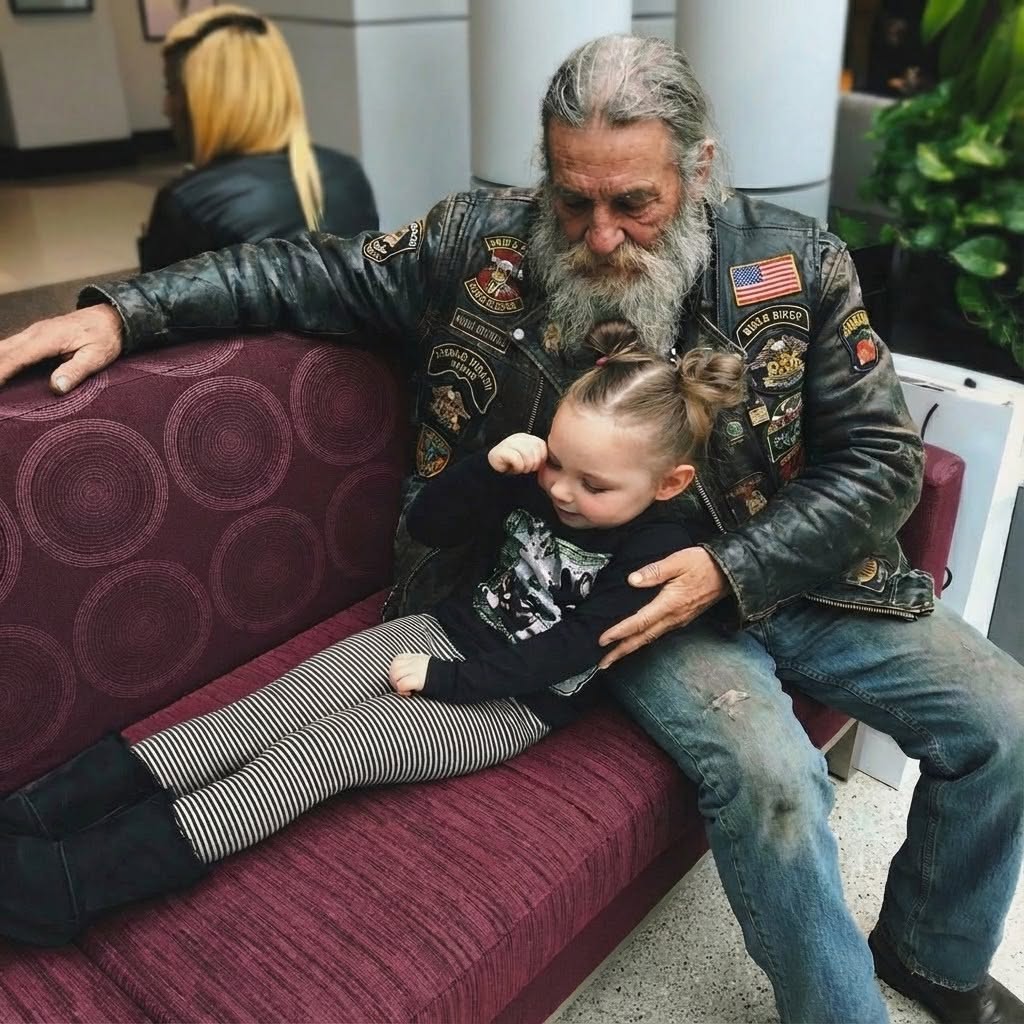
The child was frightened.
That much was obvious.
She clung to me with a desperation that did not fit the ordinary confusion of a lost traveler.
As people nearby turned to look, I became aware of the scene through their eyes.
I was a large man covered in tattoos, wearing clothes that often caused strangers to keep their distance.
Yet this little girl had run past countless other people and chosen me.
Not because she knew me.
Because, for reasons only she could explain, she felt safe.
Then she quietly asked me not to let someone take her away.
The request changed everything.
Choosing Caution
A man soon approached and attempted to call the child toward him.
The situation was unclear.
I did not know the child.
I did not know the man.
What mattered was that the child was visibly afraid.
Rather than making assumptions, I focused on a simple responsibility: remain calm and ensure the situation was handled by the proper authorities.
Security personnel were contacted.
Police officers arrived.
Questions were asked.
The process moved forward the way such situations should.
When uncertainty involves a vulnerable child, caution is wisdom.
The Importance of Listening
As adults spoke, explanations emerged.
Yet what mattered most was not who spoke first or most confidently.
It was that the child was given space to be heard.
Children do not always possess the vocabulary to explain complex situations, but they often communicate clearly when they feel safe enough to do so.
Gradually, a fuller understanding emerged.
The authorities took the necessary steps.
Additional family members were contacted.
And the situation began moving toward resolution.
A Small Act of Presence
While we waited, the child remained beside me.
There was nothing extraordinary about what I did.
I stayed.
I listened.
I offered reassurance.
Sometimes people imagine protection as dramatic action.
More often, protection is simply refusing to walk away when someone vulnerable needs stability.
The child eventually shared why she had approached me.
She said I reminded her of someone she loved.
Someone who made her feel safe.
Someone she missed.
Whether the resemblance was real or imagined hardly mattered.
In that moment, trust had been placed in me.
My responsibility was to honor it.
Looking Beyond Appearances
When the child’s mother finally arrived, relief filled the room.
The reunion required no words to explain its significance.
Fear gave way to gratitude.
Uncertainty gave way to comfort.
Watching them together was a reminder of how precious ordinary safety truly is.
Before leaving, the child handed me a drawing.
It was simple and imperfect in the way children’s drawings often are.
Yet it carried a message I would not forget.
Not because it praised me.
But because it reflected what she had been searching for all along:
Someone willing to stand between fear and safety.
What This Moment Revealed
The experience taught me something worth remembering.
People often make quick judgments based on appearance.
They see size, clothing, age, status, or reputation and assume they understand who a person is.
Reality is usually more complicated.
Character reveals itself through actions rather than appearances.
A gentle heart may exist beneath a rough exterior.
A trustworthy person may not look the way others expect.
And a frightened child may sometimes recognize safety where others see only assumptions.
The Quiet Responsibility We Share
Most people will never find themselves in exactly this situation.
Yet opportunities to protect, assist, or advocate for others appear every day in smaller forms.
A child who needs attention.
A stranger who needs help.
A person who feels alone.
The world depends more than we realize on ordinary people choosing not to look away.
That day, I was not the hero of someone’s story.
I was simply the adult who happened to be there when a child needed help.
Sometimes that is enough.
And sometimes, being present when someone is afraid becomes a gift to both the person receiving it and the person offering it.
The child left with her family.
I continued on with my life.
Yet I carried away a quiet reminder:
The measure of a person is not how they appear from a distance, but how they respond when another human being places their trust in them.