My stepfather, Richard Hale, had pulled over after I complained that my half brother Mason had dumped soda inside my backpack.
My mother sighed like I was the problem.
My cousin Brooke lifted her camcorder.
She always liked recording things when they were humiliating for someone else.
Richard threw my backpack into the dirt.
“Go cool off,” he said.
At first, I thought he meant for a few minutes.
Then he climbed back into the SUV.
“Mom?” I called, stepping toward the open window.
Linda did not even remove her sunglasses.
“Maybe this will teach you not to ruin everyone’s vacation, Erin.”
From the back seat, Mason grinned.
“Let’s see if she can handle it!”
Brooke laughed so hard the camera shook.
Then the SUV rolled away.
I stood there waiting for the brake lights.
Waiting for Richard to stop.
Waiting for my mother to realize this had gone too far.
But the red lights vanished around the bend.
The desert went quiet.
My phone was dead.
My water bottle was in the car.
Inside my backpack were two shirts, a paperback book, and one crushed granola bar.
By sunset, I understood the truth.
They were not coming back that day.
I walked until my legs trembled. My throat burned. The road blurred in the heat. A truck passed after dark, and I screamed until my voice broke, but it never slowed.
By morning, my lips were cracked and bleeding.
I collapsed near a cattle fence and woke to an elderly Navajo woman tipping water gently into my mouth.
Her name was Ruth Yazzie.
She saved my life.
Ruth took me to her trailer outside Kayenta, gave me water, food, and a blanket, then called the police.
I told them everything.
Two days later, an officer returned with a strange expression.
“Your mother reported you missing,” he said. “She says you ran away after an argument.”
I stared at him.
Waiting for him to say he knew better.
He did not.
Richard had told them I was unstable.
Brooke’s edited video showed me yelling beside the car, but not the part where they drove away.
My mother appeared on local television crying and begging me to come home.
I watched her performance from Ruth’s sofa.
That was when I made the first real decision of my life.
I would never go back.
The girl they abandoned on that road died beside Mile 42.
The woman who survived learned patience.
Ruth did not teach me revenge.
She taught me survival.
“Drink water before you cry,” she would say. “Then decide what comes next.”
What came next was school.
Legal aid.
Victim advocates.
A new name after I turned eighteen.
Scholarships.
Debt.
Long nights.
Years of studying how lies move through systems.
Police reports.
Insurance forms.
Nonprofits.
Tax filings.
Court records.
My family believed they had buried me beneath their version of the story.
They were wrong.
They had created a paper trail.
While I rebuilt my life, they built theirs on my disappearance.
My mother started a foundation called Bring Erin Home.
She raised money for runaway prevention and family reunification.
Richard became the grieving stepfather in interviews.
Brooke made a documentary about trauma and healing, editing herself into the role of heartbroken cousin.
Mason grew into a real estate developer who used my missing-person story at charity events.
They did not just lie about what happened.
They profited from it.
Fifteen years after they left me behind, they finally found out what I had become.
I was no longer Erin Hale.
I was Special Agent Erin Voss.
And their names had landed on my desk inside a federal fraud investigation.
At first, the case was about money.
Federal grants had moved through my mother’s foundation.
Those funds passed into Richard’s company, Brooke’s media business, and Mason’s development firm.
Money meant for housing projects became luxury rentals.
Charity donations became consulting fees.
Foundation accounts became personal bank accounts.
Everything connected back to the same lie.
Me.
I disclosed the conflict immediately.
I expected to be removed from the investigation.
Instead, my supervisor looked at me and said, “You won’t conduct interviews alone. You won’t make decisions alone. But nobody knows their history better than you.”
For eleven months, the case grew.
Subpoenas opened accounts.
Accounts opened emails.
Emails opened fear.
And fear made people talk.
A former bookkeeper admitted my mother had known for years that I was alive.
A retired deputy admitted Richard had pressured him to ignore my original statement.
Then came Brooke’s unedited footage.
She had kept the raw video.
She had labeled it Summer Breakdown Raw.
That was the kind of arrogance that ruins criminals.
The video showed everything.
Me standing beside the road.
Mason laughing.
Richard saying, “Let her walk a few miles.”
My mother saying, “Don’t turn around yet. She needs to learn.”
And then, twenty-three minutes later, Richard asking, “Should we go back?”
My mother answered clearly.
“Not until she’s scared enough.”
Mason asked, “What if she tells?”
And my mother said the sentence that became the heart of the case.
“Who would believe her?”
Years later, I sat across from them in a federal interview room.
Not a living room.
Not a reunion.
A steel table.
Recording devices.
Lawyers.
A camera in the corner.
That was where they saw me again.
Linda’s face changed first.
Richard went pale.
Brooke whispered, “No.”
Mason stared at me as if my survival offended him.
“Erin,” my mother breathed.
“My legal name is Erin Voss,” I said.
Her eyes filled instantly.
She had always known how to cry when it helped.
“I thought you were dead,” she said.
“No,” I replied. “You didn’t.”
Richard leaned forward.
“You have no idea what happened back then.”
“I have Brooke’s original footage.”
Brooke flinched.
The room went still.
One by one, their masks slipped.
My mother tried calling it a mistake.
Richard said I had been fine because I survived.
Mason accused me of building a life around revenge.
Brooke cried and said she had been afraid.
I looked at her and said the truth that had lived in my chest for fifteen years.
“I was seventeen.”
That silenced her.
The prosecutors laid out the charges.
Wire fraud.
Obstruction.
False statements.
Financial crimes.
The original abandonment was being reviewed by Arizona authorities.
Suddenly, the family that had laughed together in the SUV began turning on one another.
Richard blamed Linda.
Linda blamed Richard.
Brooke blamed Mason.
Mason blamed everyone.
That was the moment I finally understood them.
They had never been united by love.
Only by convenience.
And once survival required betrayal, they betrayed each other easily.
The trial was long.
Messy.
Public.
News outlets dug up my old missing-person posters and placed them beside my current photograph.
Strangers debated whether I was brave, cold, damaged, or obsessed.
I ignored most of it.
Ruth came to the first major hearing wearing a turquoise necklace and a black dress. She sat behind me like a quiet mountain.
When my mother saw her, confusion flickered across her face.
I think she understood then that a stranger had become more family to me than she had ever been.
During the trial, Brooke testified.
The raw footage played in court.
On the screen, seventeen-year-old me stood shrinking in the dust while the SUV drove away.
I did not watch myself.
I watched the jury.
One woman covered her mouth.
One man’s jaw tightened.
Another juror looked directly at my mother and wrote something down.
Richard testified against his lawyer’s advice.
It was a disaster.
He tried charm.
Then outrage.
Then blame.
By the end, the evidence had stripped him of every version of himself except the real one.
Linda refused to testify.
Mason’s lawyer tried to argue that he had been a child when it happened.
The prosecutor agreed.
Then he showed the jury Mason’s adult texts, fake invoices, and real estate transfers.
Mason had not created the original lie.
He had inherited it, fed it, and spent it.
The verdict came after four days.
Guilty on most major counts.
My mother closed her eyes.
Richard stared ahead, hollow and red-faced.
Mason cursed under his breath.
Brooke cried quietly.
At sentencing, I gave my statement.
“My family once left me on a road and expected fear to make me smaller,” I said. “For a while, it did. Then it made me precise.”
The courtroom was silent.
“I am not here because they were bad relatives. I am here because they committed crimes, repeated them, profited from them, and trusted that the girl they abandoned would remain voiceless.”
I paused.
“I did not.”
Behind me, Ruth lowered her eyes.
“I survived because a stranger stopped when my family did not. Her name is Ruth Yazzie. Everything I became began with her decision to treat my life as worth saving.”
The sentences were real.
Federal prison.
Restitution.
Asset forfeiture.
The dissolution of the foundation.
Their perfect image was dismantled piece by piece.
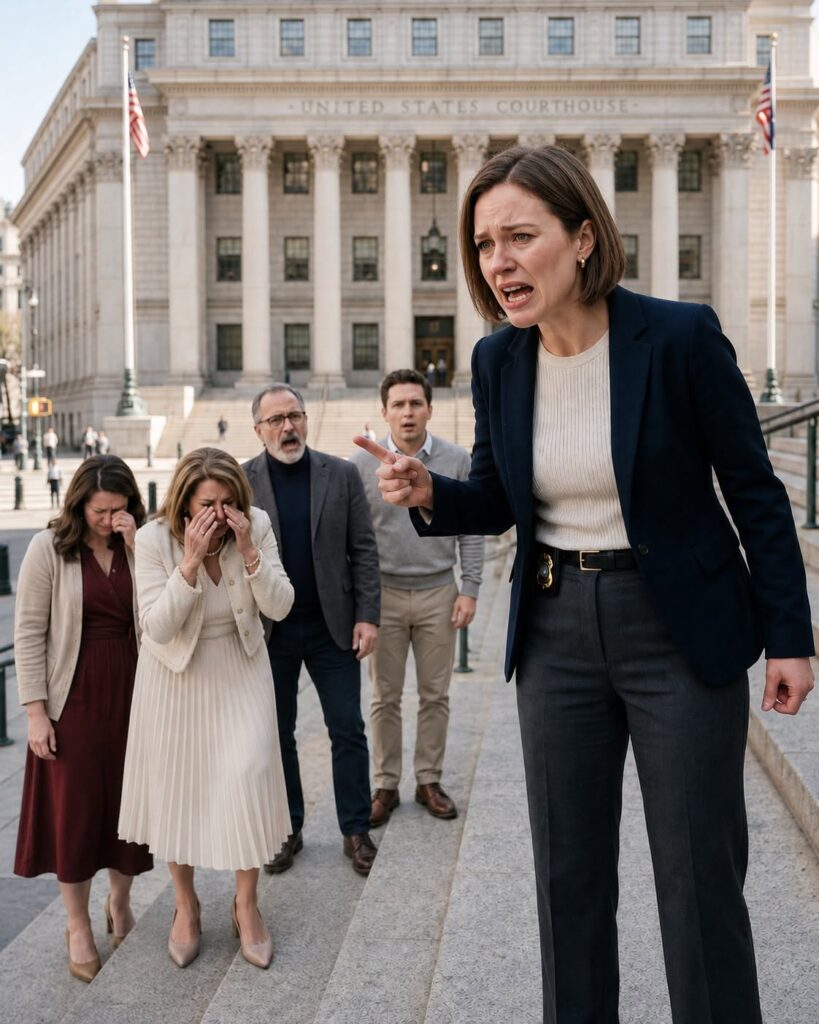
Outside the courthouse, reporters shouted my old name.
“Erin! Do you forgive your mother?”
I stopped on the steps.
For one second, sunlight flashed against the cameras, and I remembered the desert.
The heat.
The dust.
The laughter fading down the road.
Then I said the only honest thing I could.
“I don’t live my life around her anymore.”
A month later, Ruth and I returned to Mile 42.
The sign had been replaced.
The road looked smaller than it had in my nightmares.
I stood where they had left me.
There was no dramatic music.
No thunder.
No great feeling of victory.
Only wind, dust, and the simple truth that I was still there.
Ruth stood beside me.
“You okay?”
I thought about the girl I had been.
Frightened.
Furious.
Certain that being unwanted meant being worthless.
“I’m here,” I said.
Ruth nodded.
“That counts.”
Before we left, I placed a bottle of water beside the fence post.
Not as forgiveness.
Not as a memorial.
Just proof.
Proof that on the same road where my family chose cruelty, someone else could choose mercy.
Then I climbed into the truck and drove away.
This time, no one left me behind.
{"post":104482,"page":2,"next":[{"id":104467,"title":"I Caught My 17-Year-Old Sneaking Back in at 4 AM After Prom \u2013 What Fell Out of Her Purse Broke My Heart","url":"https:\/\/new24.info\/104467"},{"id":104450,"title":"My Prom Dress SAT in the Closet While I Faced a Stage 3 Diagnosis \u2013 What My Date Did at Prom Changed My Life Forever","url":"https:\/\/new24.info\/104450"},{"id":104455,"title":"Shocking Gender Reveal Party Exposed A Secret Betrayal By My Partner","url":"https:\/\/new24.info\/104455"},{"id":104443,"title":"Did You Know Emotional Connection Can Change With Age?","url":"https:\/\/new24.info\/104443"},{"id":104447,"title":"I paid for my mother\u2019s 70th birthday and, in front of the whole family, they told my children to sit by the flowerpots: \u201cThat way they learn their place.\u201d I stayed quiet, asked for the receipt and only signed a change\u2026 but nobody imagined what that night was going to uncover.","url":"https:\/\/new24.info\/104447"},{"id":104444,"title":"I Was Paid to Pretend to Be a Blind Veteran\u2019s Granddaughter Every Sunday\u2014But After He Passed Away, His Final Wish Changed My Life Forever","url":"https:\/\/new24.info\/104444"},{"id":104436,"title":"Giant Hail Left This Town Counting the Damage","url":"https:\/\/new24.info\/104436"},{"id":104432,"title":"Why Meghan Markle\u2019s Changing Look Keeps Drawing Attention","url":"https:\/\/new24.info\/104432"},{"id":104425,"title":"t1.chainityai.com","url":"https:\/\/new24.info\/104425"},{"id":104419,"title":"After a severe car accident, I was rushed to the hospital. My husband barged into the room, raging. \u201cEnough with the theatrics!\u201d he shouted. \u201cGet out of that bed\u2014I\u2019m not wasting my money on this!\u201d He grabbed me, trying to drag me off the mattress. When I struggled, he slammed both fists into my stomach. What happened next was beyond anything I could\u2019ve imagined\u2026","url":"https:\/\/new24.info\/104419"},{"id":104421,"title":"storyviral.us","url":"https:\/\/new24.info\/104421"},{"id":104415,"title":"I Discovered a Phone Number on a $5 Bill I Received as Change \u2013 I Called It, and What the Voice on the Other End Said Made My Blood Run Cold","url":"https:\/\/new24.info\/104415"},{"id":104411,"title":"Devastating new detail revealed after father shoots 10-year-old twin sons","url":"https:\/\/new24.info\/104411"},{"id":104408,"title":"Sinister meaning behind \u20188647\u2019 message after numbers are found carved into National Mall grass","url":"https:\/\/new24.info\/104408"},{"id":104404,"title":"I Gave up Everything to Raise My Late Fianc\u00e9e\u0027s Six Children \u2013 10 Years Later, Her Oldest Son Came to Me and Said, \u0027Dad, I Think You Deserve to Know the Truth About Mom\u0027","url":"https:\/\/new24.info\/104404"},{"id":104400,"title":"New Photo Review Keeps Madeleine McCann Case in Focus","url":"https:\/\/new24.info\/104400"},{"id":104396,"title":"Relationship Experts Share Key Insights About Intimacy and Communication","url":"https:\/\/new24.info\/104396"},{"id":104391,"title":"Planning a World Cup Trip to Mexico? Here\u2019s What Officials Are Advising","url":"https:\/\/new24.info\/104391"},{"id":104387,"title":"On the first morning after our wedding, my husband sla:pped me while his whole family watched. They expected tears, sh:ame, and silence. Instead, I looked at him coldly and left without a word.","url":"https:\/\/new24.info\/104387"},{"id":104384,"title":"I watched a married woman sell the last thing she owned so her little boy could breathe that night. Ten minutes later,","url":"https:\/\/new24.info\/104384"}]}