That evening, I opened an old desk drawer and looked through decades of financial records. There were tuition payments, emergency expenses, household contributions, and countless other forms of assistance given freely and without expectation.
As I sat alone, I found myself thinking about my late husband, Arthur.
A difficult truth slowly emerged.
Generosity can strengthen relationships, but it cannot replace them. And when giving becomes the only language through which a person feels valued, something essential has already been lost.
The next morning, I met with my banker, Lydia Chen.
Together, we reviewed the many ongoing payments connected to Wesley and Serena’s household. Mortgage assistance, insurance contributions, and other recurring expenses had gradually accumulated over the years until they formed a quiet system of support that touched nearly every corner of their lives.
As I signed the paperwork to end those arrangements, I felt neither anger nor satisfaction.
What I felt was clarity.
Children eventually become adults. Support that is meant to help can sometimes become a substitute for responsibility. By continuing indefinitely, I realized I might have been preventing growth rather than encouraging it.
The changes became noticeable almost immediately.
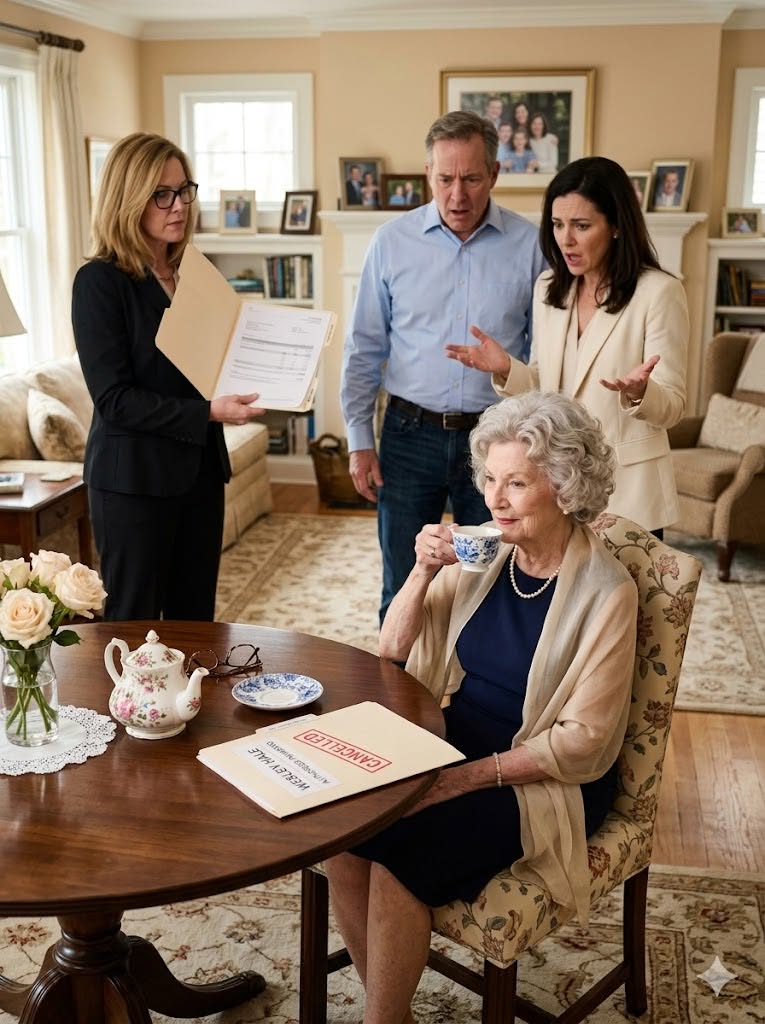
Before long, Wesley and Serena arrived at my home, distressed and demanding answers.
Lydia remained present as a witness while we spoke.
For the first time in years, I explained openly how much support I had provided and how often I had felt excluded despite those efforts. I did not raise my voice. I did not seek to shame anyone. I simply told the truth.
The conversation was difficult.
Wesley listened quietly as the full picture became impossible to ignore.
I explained that I was not withdrawing support to punish him. I was doing so because I believed he was capable of standing on his own feet, and because our relationship could not continue being measured through financial dependence.
The weeks that followed were not easy.
Silence often carries its own kind of grief.
Yet as time passed, I began building a life that was not centered around waiting to be needed. I joined a local bridge group at the library, made new friends, and rediscovered interests that had been neglected for years.
Gradually, the loneliness gave way to peace.
About a month later, a letter arrived.
It was handwritten by Wesley.
Page after page, he reflected on choices he had made, responsibilities he had avoided, and ways he had taken both my support and my presence for granted. There were no excuses. Only honesty.
Months later, he visited me alone.
He spoke openly about changes he was making in his life and about the work of becoming a more responsible father and a more thoughtful son. The conversation was not perfect, but it was real.
That mattered more than perfection ever could.
A year later, Wesley and my granddaughter Lily came to my home for dinner.
The evening was simple.
There were no financial discussions, no obligations, and no expectations attached to the gathering. At one point, Lily handed me a cookie she had carefully saved for me.
It was a small gesture.
Yet it carried more warmth than any expensive gift ever could.
As I looked around the table, I realized something important.
Love grows strongest when it is freely given and freely returned. It cannot be purchased, negotiated, or maintained through obligation alone.
The boundaries I set had not destroyed my family.
They had created space for honesty.
And in that space, something healthier finally had a chance to grow.
For the first time in many years, I felt surrounded not by transactions, but by genuine affection.
That was the gift I had been hoping for all along.