
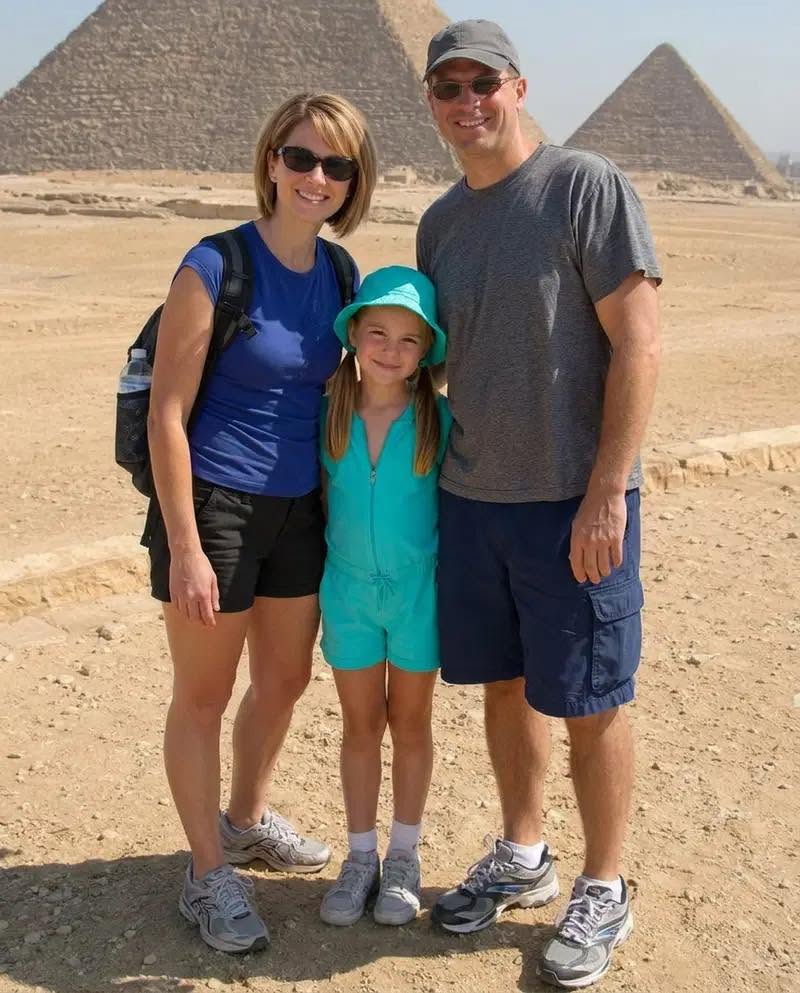
And everything I thought I knew collapsed.
The postcard appeared in my mailbox on a rainy Thursday morning. At first, it looked ordinary enough. A picture of Cairo’s skyline covered the front, faded by travel and time.
My hands froze when I saw the stamp.
Egypt.
For a moment, I couldn’t breathe.
I turned it over.
There was no signature.
No greeting.
No explanation.
Only an address.
And beneath it, written in neat block letters:
“Come alone if you still want the truth about Tara.”
I read the sentence three times.
Then a fourth.
My daughter had disappeared twenty years earlier.
Now someone was promising answers.
The address wasn’t in Egypt.
It was three miles from my house in Ohio.
I spent the next hour staring at the postcard on my kitchen table.
Part of me thought it was a cruel joke.
Another part of me couldn’t ignore the possibility that had haunted every year since Tara vanished.
What if someone knew something?
By afternoon, I was driving toward a row of aging rental garages on the edge of town.
The postcard sat on the passenger seat beside me.
My hands were trembling so badly I nearly missed the turn.
Unit 42.
The number was painted in peeling black letters above a rusted metal door.
I stepped out of the car.
Walked forward.
And lifted the door.
What I found inside stole the air from my lungs.
A woman sat on a folding chair between three cardboard boxes.
Her dark hair fell to her shoulders.
Her hands rested calmly in her lap.
And she had my eyes.
For several seconds, neither of us spoke.
Then she looked up.
“You came quickly, Cassidy.”
The sound of my name nearly broke me.
My knees buckled.
“Tara?”
Her lips trembled.
Not quite a smile.
Not quite a frown.
“I needed to know if you would come.”
I dropped to my knees on the concrete floor.
Twenty years of grief collided with hope so violently it hurt.
Every photograph.
Every missing poster.
Every birthday spent wondering if she was alive.
Every nightmare.
All of it crashed through me at once.
“Tara,” I whispered again.
She nodded.
And the world changed.
Twenty years earlier, my husband Grant had accepted a reporting job in Cairo.
It was supposed to be an adventure.
A fresh start.
Tara was eight years old and fascinated by everything.
The markets.
The colors.
The sounds.
The small garden beneath our apartment building became her favorite place.
Every afternoon she played there while I worked and Grant wrote articles from home.
For a while, life felt happy.
Then came the Tuesday that destroyed everything.
I kissed Tara goodbye before work.
Grant promised he would watch her.
When I returned that evening, police cars lined the street.
The apartment building was surrounded by officers.
Neighbors stood outside whispering.
And my husband was crying.
He told me Tara had been playing in the garden.
He looked away for only a few minutes.
When he returned, she was gone.
At least, that was the story he told.
For weeks, the search consumed our lives.
Police searched.
Volunteers searched.
Neighbors searched.
We covered walls with posters.
We followed every lead.
None of them led to Tara.
No witnesses.
No ransom demands.
No evidence.
Nothing.
Eventually the search ended.
But my grief never did.
After a year, we returned to Ohio without our daughter.
Our marriage slowly collapsed beneath the weight of loss.
Grant rebuilt his life.
I survived mine.
Over the years, he became something of a public figure.
He wrote books.
Gave speeches.
Appeared on television discussing grief.
People admired him.
They called him brave.
Strong.
Inspiring.
I avoided him whenever possible.
Now I finally understood why.
Inside the garage, Tara opened one of the boxes beside her.
She handed me a stack of letters.
The envelopes were yellowed with age.
Each one had my name written on it.
My hands shook as I opened the first.
Happy 9th Birthday to me.
I hope you still love me.
The second was written when she was ten.
The third when she was eleven.
There were letters for every birthday.
Every year.
For nearly a decade.
I never received a single one.
Tears blurred the words.
“I wrote to you constantly,” Tara said quietly.
“I never got these.”
“I know.”
Her voice cracked.
“Because Claire kept them.”
I looked up.
“Claire?”
The name hit me like a forgotten memory.
Claire had been Grant’s closest friend.
The person he trusted most.
The woman who attended our parties.
The woman who comforted us after Tara disappeared.
The woman I once trusted.
Tara stared at the floor.
“Claire took me from the garden.”
The room spun.
“What?”
“She brought me to her apartment.”
I couldn’t speak.
“That same night, Dad came to see me.”
My heart stopped.
“Grant knew?”
Tara nodded.
The silence stretched between us.
Then she delivered the truth that shattered the last pieces of my past.
“He told me you left.”
The words landed like a knife.
“He said you didn’t want me anymore.”
I closed my eyes.
For twenty years I had believed my daughter was gone.
For twenty years she had believed I abandoned her.
And one man knew the truth.
Grant.
Claire raised Tara under a different name.
A different identity.
A different life.
Before Claire died several months earlier, she finally confessed everything in a letter.
Grant had wanted out.
Out of the marriage.
Out of the responsibility.
Out of the life we’d built together.
He wanted Claire.
He wanted Tara.
But he didn’t want to look like a man who abandoned his family.
So he created a tragedy instead.
“He chose himself,” Tara said.
Three simple words.
Yet they explained twenty years of suffering.
That evening, Tara showed me something on her phone.
A poster.
A smiling photo of Grant.
A book event.
His latest release.
The title nearly made me sick.
The Daughter I Lost in Cairo.
I stared at the screen.
“He made money from missing me.”
“No,” I said quietly.
“He made money from hiding you.”
An hour later, we stood outside Grant’s house.
When he opened the door and saw Tara, every trace of color vanished from his face.
“Tara.”
His voice barely worked.
“You remember my name,” she replied. “That’s more than I expected.”
Grant started talking immediately.
Excuses.
Explanations.
Justifications.
I stopped him.
“No.”
He looked at me.
“You are done deciding what we get to hear.”
That night, Grant’s book event was packed.
People filled every seat.
They listened as he stood beneath bright lights reading passages about loss, grief, and resilience.
The audience hung on every word.
Then Tara stepped into the aisle.
“Was that before or after you left me at Claire’s apartment?”
The room went silent.
Every head turned.
Grant froze.
Tara walked forward.
Calm.
Steady.
Braver than either of us had any right to expect.
She placed Claire’s confession letter on the table.
Then the birthday letters.
Then Grant’s own notes.
“My name is Tara.”
The room held its breath.
“I’m the daughter he claims he lost in Cairo.”
Grant looked trapped.
Small.
Terrified.
“He didn’t lose me,” Tara said.
“He hid me.”
A reporter stood.
“Do you deny these accusations?”
Grant looked around helplessly.
Then came the answer.
“I was trying to protect everyone.”
The room erupted.
I stepped beside my daughter.
“No,” I said.
“You protected your reputation.”
The silence that followed felt heavier than any shouting could have been.
Later that night, Tara came home with me.
For the first time.
I opened the cedar box I had kept for twenty years.
Inside were the pieces of her childhood I couldn’t bear to lose.
Her ribbons.
Her tiny red shoes.
A recipe card covered in syrup stains.
Missing posters folded soft from handling.
“I kept what I could.”
She touched the shoes carefully.
“Proof,” I whispered, “that you were loved.”
The next morning, I made pancakes.
The first one burned.
The second fell apart.
By the third attempt, Tara wandered into the kitchen wearing one of my old sweaters.
For a moment, she looked eight years old again.
Then she spoke.
“I’m not ready to call you Mom.”
The truth hurt.
But honesty was something we had both been denied for too long.
So I smiled.
“Then call me Cassidy.”
She looked at me.
“Really?”
“That’s enough for me.”
For twenty years, I thought Cairo had stolen my daughter.
I thought distance had taken her.
I thought fate had taken her.
I was wrong.
A lie had taken her.
A selfish choice had taken her.
A man who loved himself more than his family had taken her.
But truth brought her back.
Not all at once.
Not perfectly.
Not with a magical ending that erased twenty years of pain.
But it brought her back to my table.
And for the first time in two decades, that was enough.