
I called back.
No answer.
I called again.
Voicemail.
By 3:07, I was in my car, coat thrown over my pajamas, boots barely tied, driving into a blizzard with my heart trying to break through my ribs.
Saint Agnes Hospital was 300 miles away, in Ashbury, the town I had left ten years earlier with one suitcase, one scholarship check, and no intention of ever returning.
The town where my stepfather, Warren Vale, had once stood on the porch and laughed as I left.
“You’ll come crawling back,” he told me when I was nineteen. “Girls like you don’t survive in the real world.”
My half-brother, Caleb, had laughed beside him.
My mother had stood behind them, silent, one hand covering a bruise she claimed came from a cabinet door.
Now the highway was nearly invisible beneath the storm. Snow swallowed the lanes. Trucks sat abandoned along the shoulder like frozen animals. My windshield wipers scraped uselessly against ice, and my hands locked so tightly around the steering wheel that my fingers ached.
All I could hear was her voice.
Help me.
At 8:46 a.m., I reached Saint Agnes Hospital.
And then I saw her.
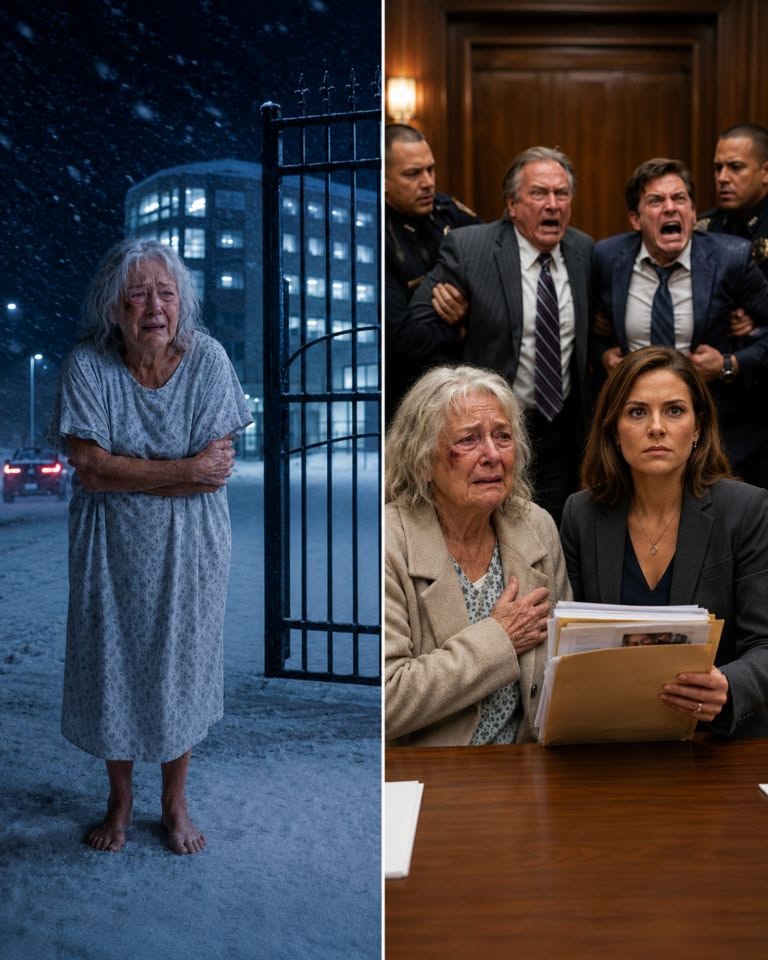
My mother stood outside the locked emergency entrance in a thin hospital gown, barefoot in the snow.
Her lips were blue.
Her gray hair was frozen against her cheeks.
Bruises bloomed across her throat and arms.
She looked smaller than any version of her I had ever known.
I ran toward her so fast I nearly slipped.
“Mom!”
Her eyes moved slowly, searching through the cold until they found me.
“Mara?”
I wrapped my coat around her shaking body.
“Who did this?”
Her teeth chattered. “Warren said I was wasting money.”
My blood turned cold.
“Caleb said the house wasn’t mine anymore.”
“The house?”
Her eyes filled with terror. “They made me sign papers.”
I lifted my gaze toward the security camera above the hospital gate.
A little red light blinked steadily.
Good.
Inside, a nurse gasped when she saw us. Doctors rushed my mother behind curtains while I stood in the hallway, soaked from snow, staring at the blood on my sleeve.
Something inside me went quiet.
Not calm.
Not peaceful.
Dangerous.
At 10:12, Warren called.
“Well,” he said smoothly, “if it isn’t the runaway daughter.”
Caleb’s voice sounded faintly in the background. “Tell her Mom’s being dramatic.”
I looked down at my mother’s blood staining my coat.
“You left her outside a hospital in a blizzard.”
Warren chuckled softly.
“Careful, Mara. You’re not in Chicago now. You have no power here.”
For the first time that morning, I smiled.
“That’s where you’re wrong.”
Warren arrived at the hospital wearing a camel-colored coat and the relaxed expression of a wealthy man who believed consequences were for other people.
Caleb followed behind him in designer sneakers, carrying two coffees as if this were some irritating family errand.
My mother recoiled the moment they entered her room.
Warren noticed.
And smiled.
“There she is,” he said. “The fragile queen.”
I stepped between him and her bed.
Caleb rolled his eyes. “Move, Mara. This is family business.”
“She is my mother.”
“She was,” Caleb said. “Until she signed everything over.”
Warren pulled a folder from inside his coat.
“Durable power of attorney. Property transfer. Medical release. All signed.”
Mom whispered from the bed, “I didn’t know what they were.”
“She knew,” Warren snapped.
Then, when a doctor glanced over, he lowered his voice.
“She’s confused. Age does that.”
“She’s fifty-nine,” I said.
Caleb laughed. “You were always dramatic.”
Warren leaned closer, close enough for me to smell mint on his breath.
“Listen carefully. Your mother is unstable. The police know me. The hospital board knows me. The mayor plays golf with me. You, sweetheart, are just some office girl from the city.”
I let him finish.
Then I said, “Paralegal, actually.”
Caleb smirked. “Terrifying.”
I nodded once.
“For you? It should be.”
His smirk faded slightly.
What they did not know was that I had not been merely a paralegal for years.
I was the managing partner of a forensic litigation firm that handled elder abuse, financial fraud, coerced estate transfers, and criminal asset recovery.
What they did not know was that three months earlier, Mom had quietly mailed me copies of bank statements because Warren kept “moving numbers around.”
What they did not know was that I had already started building a case before that phone call ever came.
And what they truly did not know was this:
My dashcam had recorded my arrival.
The hospital camera had recorded my mother being abandoned.
My phone had recorded Warren’s call.
But rage released too early only warns the enemy.
So I gave them what they expected.
I looked tired.
I looked scared.
I let my eyes fill with tears.
I asked Warren what he wanted.
His face lit up.
“The sensible thing,” he said, “is for you to leave. Evelyn will recover. Caleb and I will manage her affairs.”
“Her money,” I said.
He shrugged. “Same thing eventually.”
Caleb stepped closer.
“And don’t think you can fight it. Mom signed. The house is mine. Accounts are locked. You get nothing.”
I looked straight at him.
“Was that the point?”
His eyes hardened.
“The point is you lost.”
That afternoon, I went to the county clerk’s office.
Warren’s property transfer had been filed at 4:12 p.m. the previous day.
The notary was his receptionist.
The witness was Caleb’s girlfriend.
My mother had been admitted to urgent care two hours earlier with a concussion.
Careless.
Arrogant men always mistake fear for intelligence.
By evening, I had drafted a restraining order request, filed an emergency guardianship petition, and sent the bank records to a forensic accountant.
By midnight, my investigator found the first transfer.
Seventy-eight thousand dollars from my mother’s retirement account into Caleb’s failed crypto business.
By morning, six more transfers had surfaced.
That afternoon, Caleb posted a photo of himself standing in front of Mom’s house.
The caption read:
“New beginnings. Some people just don’t deserve what they have.”
I screenshotted it.
Minutes later, Warren texted me.
“Leave town before you embarrass yourself.”
I replied with one sentence.
“You targeted the wrong daughter.”
He sent back a laughing emoji.
Perfect.
The hearing was set for Friday morning.
Warren entered the courtroom smiling. Caleb walked beside him, both dressed like men arriving at someone else’s defeat.
In a way, they were.
My mother sat beside me in a wheelchair, wrapped in a navy coat. Her bruises had begun fading from purple to yellow, but her hand still trembled inside mine.
Warren’s attorney stood first.
“Your Honor, this is a family disagreement being exaggerated by an estranged daughter with financial motives.”
The judge turned to me.
“Ms. Vale?”
I rose.
“My name is Mara Ellis,” I said. “And this is not a family disagreement. This is elder abuse, fraud, unlawful abandonment, assault, and financial exploitation.”
Warren sighed dramatically.
Caleb muttered, “Here we go.”
I connected my laptop.
The courtroom screen brightened.
First came the hospital security footage.
My mother barefoot in the snow.
Warren’s car driving away.
Caleb stepping out only long enough to throw a plastic bag at her feet.
The courtroom went silent.
My mother began to cry.
Warren’s attorney turned pale.
Then came the audio from Warren’s call.
“You have no power here.”
The judge’s expression hardened.
Next came the bank transfers.
Dates.
Amounts.
Caleb’s account.
Warren’s shell company.
Forged signatures placed beside my mother’s real ones by a handwriting expert.
Caleb’s smile vanished.
Then came the notary log.
Warren’s receptionist had notarized the documents while my mother was medically recorded as disoriented from head trauma.
Warren shot to his feet.
“This is private family business!”
The judge snapped, “Sit down.”
He sat.
Then I presented the final piece.
My investigator had obtained doorbell footage from the neighbor across the street.
It showed Warren dragging my mother by the arm toward the car while Caleb shouted:
“Sign it or freeze in your own house, old woman!”
A sound moved through the courtroom.
Not quite a gasp.
Not quite a whisper.
Something colder.
Recognition.
Before lunch, the judge granted emergency guardianship to me, froze every transferred asset, voided the property deed pending criminal investigation, and referred the matter to the district attorney.
Outside the courtroom, Caleb lunged at me.
“You ruined my life!”
Two deputies grabbed him before he reached me.
I stepped close enough that only he could hear.
“No, Caleb. I documented it.”
Warren stared at me with hatred burning through his polished calm.
“You think this is over?”
I looked at his cufflinks, his expensive shoes, and the tremor in his mouth.
“It ended the moment you left her in the snow.”
Three months later, Warren pleaded guilty to felony financial exploitation and assault to avoid a longer sentence.
He still received seven years.
Caleb received four for fraud, coercion, and violating the protection order after he tried to break into Mom’s house looking for “his” safe.
There was no safe.
Only files.
Mine.
Mom’s house was returned to her. Most of her retirement was recovered through restitution, insurance, and the seizure of Warren’s accounts.
Caleb’s crypto business collapsed so fast that his investors sued him before sentencing.
Six months later, Mom and I painted her kitchen yellow.
Not beige.
Not gray.
Yellow.
“Too bright?” she asked, holding the paint roller like a weapon.
I watched sunlight pour through the clean windows and spill across the floor where Warren used to stand and shout.
“No,” I said. “It’s perfect.”
Then she smiled.
Truly smiled.
And for one clear second, I saw the woman I remembered.
Fierce.
Beautiful.
Unbroken.
That winter, snow fell over Ashbury again.
But this time, my mother was inside.
Her feet were warm.
Her door was locked.
Her name was on every document, every account, every piece of property that belonged to her.
She sat wrapped in a blanket by the fire, drinking tea while the storm pressed harmlessly against the windows.
And the men who believed she was powerless learned the truth far too late.
Some daughters do not come home to beg.
Some daughters come home with evidence.