
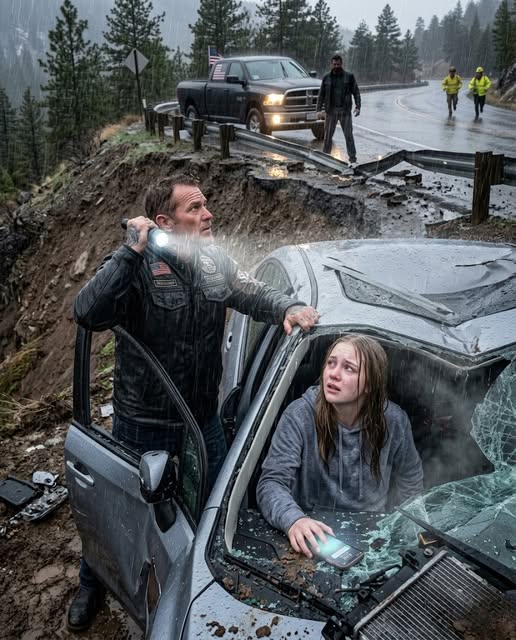
The voice belonged to a girl named Megan, and her plea wasn’t just for help—it was the sound of someone who had learned that the world was a predatory place. Jackson, a man accustomed to people crossing the street to avoid his scarred knuckles and cold gaze, didn’t hesitate. He didn’t care about his reputation or the optics of a biker hovering over a crash site. He descended into the mud and wreckage, his presence a stark contrast to the fragile, broken metal pinning the girl to her seat.
As he worked to keep her calm, he noticed the details that didn’t add up. A phone in the mud displayed a chilling message: Don’t tell anyone where you’re going. The skid marks above hadn’t been an accident; they were the result of a hunt. When a dark pickup truck appeared at the top of the ravine, its driver watching with predatory silence rather than offering aid, the reality of the situation crystallized. This wasn’t a rescue; it was a cleanup.
Jackson stood his ground, his silhouette framed by the harsh light of his own flashlight, effectively becoming a human shield between the girl and the man who had run her off the road. When the man approached, claiming to be a relative, Jackson’s instincts—honed by years of navigating the fringes of society—saw through the lie instantly. He held his position, kept the dispatcher on the line, and forced the assailant to retreat just as the wail of sirens cut through the storm.
In the aftermath, the truth emerged: Megan had uncovered a dangerous secret, and the man in the truck had been sent to silence her. The biker, a man the world had labeled a monster, had been the only one to listen when she whispered for help. When Megan finally looked at him from her hospital bed, she didn’t see the patch or the leather; she saw the man who had refused to look away. Jackson kept her handwritten note of thanks in his pocket, a quiet reminder that dignity isn’t found in a reputation, but in the choice to stand firm when the dark closes in.