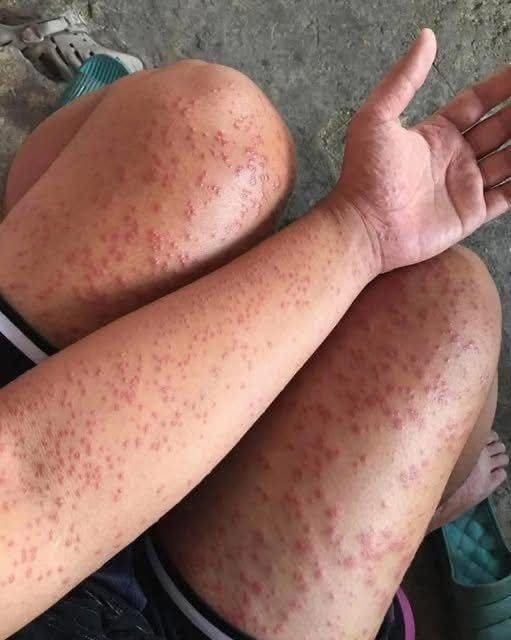
But there are situations where hives can be an early warning sign of something much more serious—and recognizing the difference matters.
What Hives Can Look Like
Hives (also called urticaria) usually appear as raised red or pink welts on the skin that may:
- itch intensely
- burn or sting
- change shape or size
- spread quickly
- disappear in one area and reappear in another
They can show up on the arms, chest, legs, back, neck, or almost anywhere on the body.
Hives themselves are common and can happen for many reasons, including allergies, infections, medications, heat, stress, or even no obvious trigger.
When Hives Become More Concerning
The biggest concern is when hives happen alongside symptoms affecting breathing, swelling, or circulation.
Warning signs that need urgent medical attention can include:
- trouble breathing or shortness of breath
- wheezing or persistent coughing
- tightness in the chest
- swelling of the lips, tongue, face, or throat
- feeling like the throat is tightening
- dizziness or faintness
- rapid heartbeat
- pale or clammy skin
- sudden weakness or confusion
When symptoms involve more than the skin—especially the airway—it may indicate a severe allergic reaction such as anaphylaxis.
Why Timing Matters
Severe allergic reactions can sometimes progress quickly.
Symptoms may begin with skin changes like itching or hives, then move into:
- breathing difficulty
- throat swelling
- low blood pressure
- feeling faint or collapsing
Not every case follows this pattern—but when it does, early recognition is important.
Common Triggers
Severe allergic reactions can happen after exposure to many everyday things, including:
- certain foods
- medications
- insect stings
- latex
- environmental allergens
- or sometimes no clear trigger at all
Sometimes people know they have an allergy.
Other times, the first major reaction is unexpected.
What to Do If Hives Appear With Other Serious Symptoms
If hives occur together with breathing difficulty, facial or tongue swelling, dizziness, or faintness, it should be treated as urgent.
General emergency guidance often includes:
- seeking emergency medical help immediately
- using an epinephrine auto-injector if one has been prescribed and is available
- staying with the person and monitoring symptoms closely
Even if symptoms improve, medical evaluation is still often recommended because severe reactions can sometimes return after the first wave passes.
The Key Difference
Many skin reactions are mild and temporary.
The important distinction is whether the reaction stays limited to the skin—or whether it starts affecting the rest of the body.
When symptoms move beyond itching and welts into breathing, swelling, or feeling faint, it’s no longer “just a rash.”
Bottom Line
Itchy red welts after sleep are often caused by something minor.
But when hives appear together with symptoms like breathing changes, swelling of the mouth or throat, or dizziness, they can signal a more serious allergic reaction that needs urgent medical attention.
Paying attention to what else is happening besides the rash is often the most important clue.
{"post":103517,"page":2,"next":[{"id":103510,"title":"A Man\u2019s Tattoo Goes Viral After People Struggle to Understand Its Meaning - Terbv","url":"https:\/\/new24.info\/103510"},{"id":103505,"title":"Teen Sentenced to 452 Years in Prison After He Ra\u2026See moree\u2026.","url":"https:\/\/new24.info\/103505"},{"id":103498,"title":"Search Results for \u201cHere\u2019s what the sticker says. What do you think??\u2026\u2026\u201d \u2013 Tbdig Divaxo","url":"https:\/\/new24.info\/103498"},{"id":103494,"title":"What Do Green Lights on Cars Mean? Understanding Medical Transport Vehicles","url":"https:\/\/new24.info\/103494"},{"id":103488,"title":"Police Follow a Foul Smell Near Missing Womans Home What They Found Inside Left Everyone Reeling","url":"https:\/\/new24.info\/103488"},{"id":103484,"title":"WHEEL OF FORTUNE CONTESTANT DELINDA ROOD STUNS RYAN SEACREST WITH A LIGHTNING FAST BONUS ROUND SOLVE THAT LEAVES THE AUDIENCE GASPING AND WALKS AWAY WITH A MASSIVE SIX FIGURE FORTUNE","url":"https:\/\/new24.info\/103484"},{"id":103479,"title":"I Drove Through the Night After Learning My Son Had Been Left Alone - samsingg - Blogstyle","url":"https:\/\/new24.info\/103479"},{"id":103473,"title":"My Daughter Was Left Bleeding In The Driveway While I Was 500 Miles Away-heyily - Blogstyle","url":"https:\/\/new24.info\/103473"},{"id":103470,"title":"The storm outside sounded harmless compared to the nightmare hidden behind the walls of... - samsingg - Blogstyle","url":"https:\/\/new24.info\/103470"},{"id":103464,"title":"Most Drivers Never Realize What That Small Gap in a Cup Holder Is For","url":"https:\/\/new24.info\/103464"},{"id":103460,"title":"What Happened Outside the White House Is Drawing Major Attention Online","url":"https:\/\/new24.info\/103460"},{"id":103456,"title":"Understanding the Latest Updates on COVID-19 Vaccination Research-","url":"https:\/\/new24.info\/103456"},{"id":103452,"title":"The Surprising Reasons You Might Have Lines on Your Nails","url":"https:\/\/new24.info\/103452"},{"id":103448,"title":"Brad Pitt\u2019s Daughter Shares a Personal Reflection That Has Fans Talking","url":"https:\/\/new24.info\/103448"},{"id":103444,"title":"I Was Paying $2,500 Every Month for a Year to Cover My Stepmom\u0027s Assisted Living \u2013 When I Found Out What She Was Really Spending the Money On, I Went Pale","url":"https:\/\/new24.info\/103444"},{"id":103441,"title":"Erika Kirk issues brutal response after sudden boyfriend rumor","url":"https:\/\/new24.info\/103441"},{"id":103438,"title":"I was days away from my due date when I caught my husband dismantling our custom-built crib. \u201cMy sister needs it more, she\u2019s having twins,\u201d he grunted, loading it into his truck.","url":"https:\/\/new24.info\/103438"},{"id":103435,"title":"I took my 4-year-old triplets to my millionaire ex-husband\u2019s wedding and his family\u2019s reaction was chilling.","url":"https:\/\/new24.info\/103435"},{"id":103432,"title":"During my daughter\u2019s baby shower, I walked in to find her on her hands and knees scrubbing spilled wine off the rug.","url":"https:\/\/new24.info\/103432"},{"id":103429,"title":"During her VIP wedding dress fitting, I caught my fianc\u00e9e kicking my mother\u2019s cane away. \u201cPick up my train, you clumsy old bat,\u201d she hissed as my mother stumbled to the floor.","url":"https:\/\/new24.info\/103429"}]}