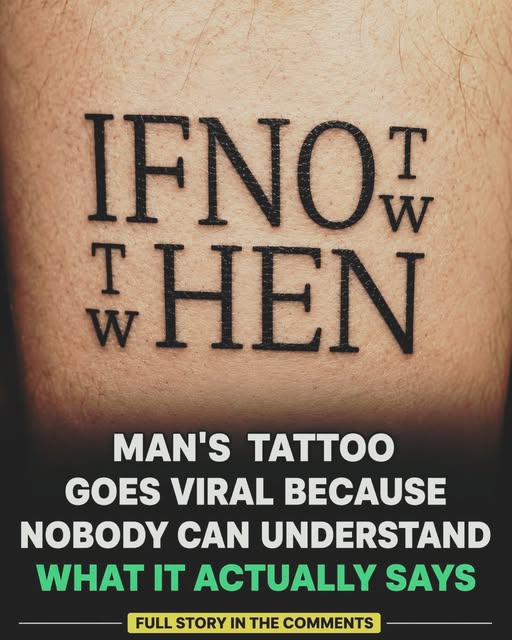
The letters, stretched in some areas and crushed into illegible clusters in others, created a visual tension that forced the human brain to revolt against the task of reading. We are hardwired to seek patterns and order; when that structure is stripped away, the mind doesn’t just see words—it sees a puzzle, a barrier, or an abstract art piece that demands an answer. This frustration, however, is exactly what turned a simple tattoo into a digital phenomenon.
As the image spread across social media, the comment sections became a battlefield of interpretation. Some users saw isolated word fragments, while others squinted at the screen, desperate to impose logic on the chaos. The ambiguity didn’t repel the audience; it pulled them in. People began to compare notes, debating the spacing and the hierarchy of the letters, turning a private piece of body art into a collective, public investigation. It wasn’t just a tattoo anymore; it was a cognitive challenge that required a community to solve.
Eventually, the consensus emerged: the hidden message was the classic, urgent mantra, “If not now, then when?” It is a phrase designed to spark immediate action, yet the irony is palpable. The very design meant to broadcast this urgency forces the viewer to stop, pause, and analyze, effectively creating the exact delay the words warn against. It is a masterclass in how form dictates function; when the medium is poorly structured, the message loses its immediacy, even if the intent remains noble.
This viral moment highlights a fundamental truth about human communication: clarity is not merely an aesthetic choice—it is a necessity. Even the most powerful, life-changing sentiments can be lost in the noise if they are not presented with intention. The tattoo serves as a permanent reminder that in a world of constant, fragmented information, we are all searching for meaning. When that meaning is obscured, we don’t just walk away; we lean in, we argue, and we struggle to find the truth hidden beneath the surface.
Ultimately, the wearer of the tattoo achieved a level of engagement most brands would kill for, though likely not in the way he originally envisioned. He taught the internet that we are naturally inclined to find order in the void, and that our desire to understand is stronger than our urge to ignore. The tattoo remains a testament to the fact that sometimes, the most memorable messages are the ones that make us work the hardest to see them.