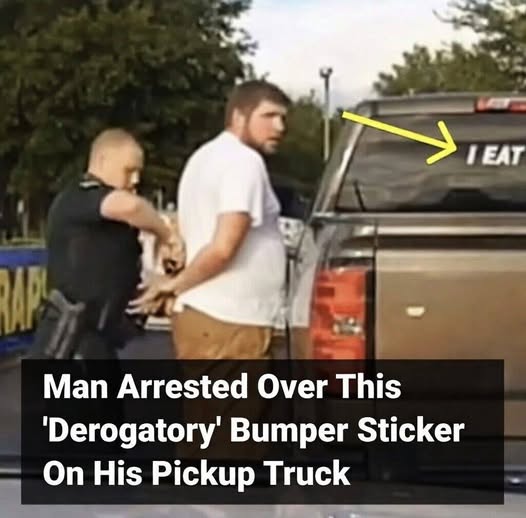
…consequential than a mere warning for a broken taillight or a rolling stop. The sticker, innocuous to some but inflammatory to others, became the focal point of a tense standoff between personal expression and the perceived boundaries of public order. In that moment, the roadside became a courtroom, and the driver was forced to decide whether to yield to the pressure of authority or stand firm on the principle that a bumper is not a license for police intervention.
The incident, which quickly rippled through local community forums and social media, serves as a stark reminder of the fragile line between protected speech and the subjective interpretation of law enforcement. For many, the sticker was a badge of identity, a way to broadcast values in a world that often feels like it is moving too fast to listen. To the officer, however, it represented a potential provocation, a signal that demanded scrutiny. This intersection of intent and perception is where the real conflict lies.
As the conversation escalated, the driver realized that the sticker had become a proxy for a much larger debate. It wasn’t just about the words printed on the vinyl; it was about the right to exist in public space without being subject to the whims of those tasked with maintaining order. The dignity of the individual, often stripped away during the vulnerability of a traffic stop, was suddenly at the center of a high-stakes negotiation of rights.
The fallout from the stop was immediate. Neighbors began to weigh in, taking sides based on their own interpretations of the sticker’s message. Some saw it as a courageous act of defiance, a necessary pushback against an overreaching state. Others viewed it as an unnecessary invitation for trouble, a distraction that undermined the safety of the roads. Yet, beneath the noise of the debate, a deeper question emerged: at what point does the state’s desire for compliance infringe upon the citizen’s right to dissent?
The resolution of the encounter did not come through a simple apology or a ticket. It came through the realization that the sticker had sparked a conversation that needed to happen. It forced the community to look at the power dynamics present in every interaction between the badge and the citizen. It reminded everyone that the First Amendment doesn’t stop at the bumper of a car, even when the message makes those in power uncomfortable.
Ultimately, the story of this Lake City traffic stop is not about a piece of plastic stuck to a vehicle. It is a story about the resilience of the individual voice. It serves as a testament to the fact that even in the most mundane moments of our lives, we are constantly defining the boundaries of our freedom. The sticker remains, a silent witness to a moment that changed the way a community views the relationship between authority and the people it serves. It stands as a reminder that sometimes, the most powerful statements are the ones we choose to carry with us, regardless of who is watching.